
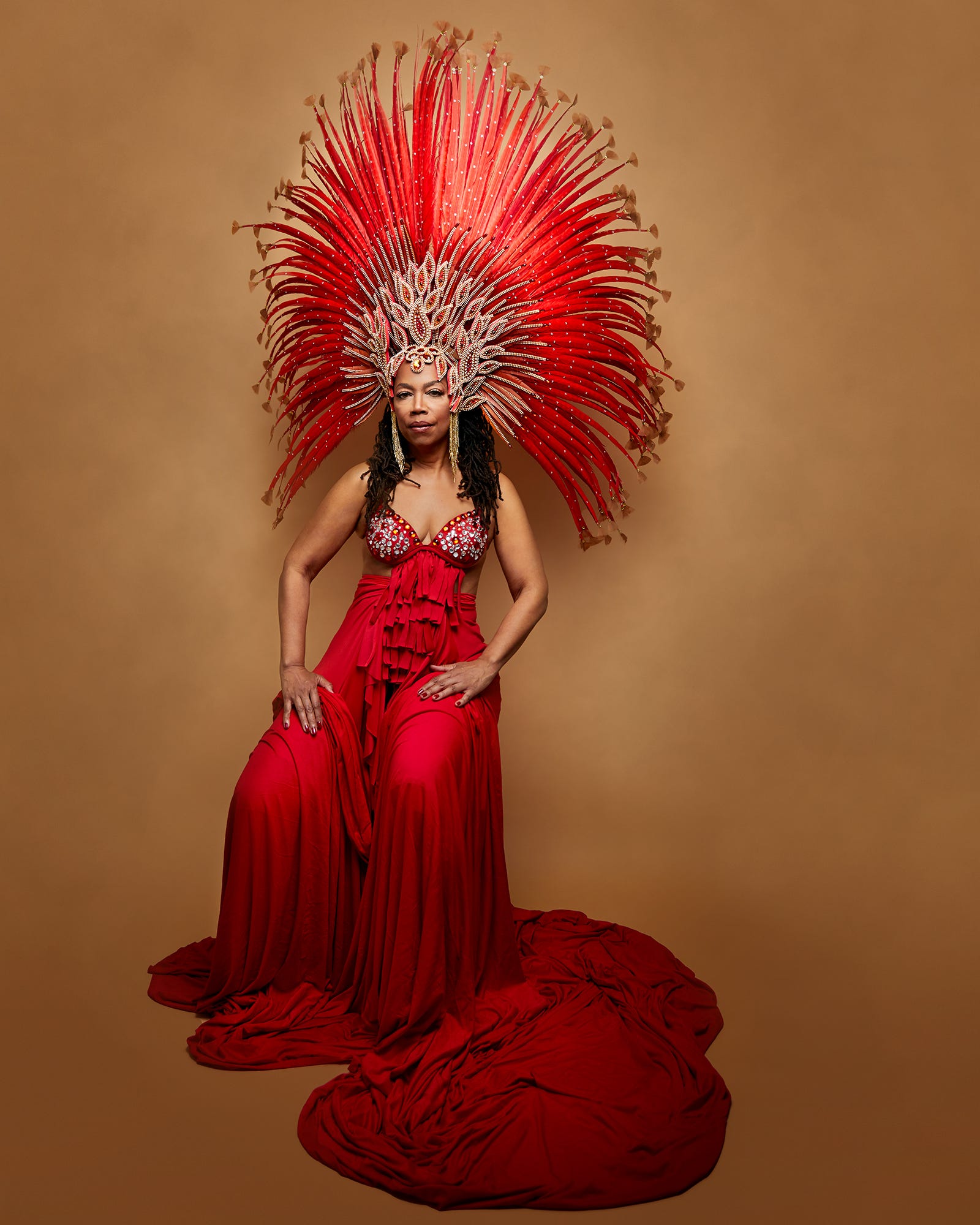
photo credit: Mike Ford
Quarter inch wide strips of elastic sewn onto soft pink fabric by our mothers held our ballet slippers onto our feet. We wore ‘flesh tone’ tights on our little brown legs. My parents spoke of dancers Beryl Mc Bernie and Geoffrey Holder. They openly admired writers like C.L.R. James and Derek Walcott. I don’t think, however, that they expected me to take their unspoken messages about the importance of such things quite so seriously, resulting in me becoming a poet with a propensity for dancing.
This is the first paragraph of my essay, ‘Joy’ part of my first book of personal essays, Black Cake, Turtle Soup, and Other Dilemmas: essays on music, memory, and motion. The essay explore a part of my decades long love affair with Samba, from playing in various baterias, to studying violão (Brazilian guitar), to taking a plethora of dance classes to learn Samba and its origins in Orixa Dance Movement. The latter led to two trips to Salvador, Bahia for dance intensives at the Escola de Dança in Pelorinho.
Samba as Resistance
Annette, my host in San Antonio, just up the hill from Pelorinho, tells me that a doctor prescribed Samba recently for some serious health issues of a woman she knows. Movement can lead the way, be an opening, an awakening of vocabulary in the body. And Samba is rich medicine. And here in Bahia, I found an environment where I could thrive and be beautiful in a Black body, something not always felt at home in Canada. In my time there, I am surrounded a culture that holds deep respect for art, artists, musicians, dancers. The city has museums that celebrates writers and books. I felt vibrant, creative, beautiful, strong and multi-hyphenate, polymath self, felt comfortably ordinary in this culturally rich environment.
I learned about the origins of Samba in the Afro-Brazilian religion of Candomblé. When I danced the Orixa Iemanjá, I became the goddess of the sea, mother, protector, and was fluid and sensual, with the infinite power of the waves. When I danced Xangô, the male god of justice, I threw bolts of lightning at the sky. I was fiery, direct and clear in my intensions. As Oxumarê the snake, I slithered through the grass. My right hand was the head and I used it to bite and stop someone in their tracks, while my left arm, the snake’s tail, swung around to point and indicate a better way to live. I was Ossaim, the medicine man who drank too much. I stumbled around and yet made brilliant medicines out of plants from the forest. In these movements we explored how to be one thing and yet another – fierce and generous, resilient and wild, to hold a multitude of possibilities, a multiplicity of selves. Perhaps the movement vocabulary of Afro-Brazilian dance, of samba, could inform a new way for me to live.
My heart captured
I followed up my trips to Salvador with a deepening connection with both the music and movement of Samba. Samba de Roda, to Roda de Samba and the driving percussion of the Carnaval schools completely capture my heart.
In an exercise of imagination, and recreating the feeling of the Orixa, Iansa, I am dressed and draped in red, by my dance teacher Adrianna. Jill has carefully covered my face in the mask-like make-up required by samba dancers. My eyes leak tears from the eye lash glue and I swear to myself that I’ll never wear these things again. It was however, important to me to wear the whole shebang - just this one time - the costume of the samba dancer. Don’t let them fool you with their grace and smiles. The headdress is seriously heavy, the rapid dance requires strength and athleticism, and they do it all in heels.
It has always been important to me to stay connected to the music, whether playing tambourim or agogo in a bateria or taking a break from playing and listening obsessively to samba either live or recorded.
What I learned from the dance and the music has been extraordinary. What was carried in the bodies and hearts of our ancestors from Africa across the world in the middle passage, has evolved in different ways on various nations in the Caribbean and in the Americas. The resonance Samba has within me is connected to my histories, even if not to my specific origins in Trinidad and Tobago. And I drink it in like a tonic, like a celebration, like an embrace, like a rich deep message be shared, a limpeza of sound.
More on dance, music and travel in my book Black Cake, Turtle Soup, and Other Dilemmas
Comments
Nothing yet. Say the first thing.
Sign in to join the conversation.