
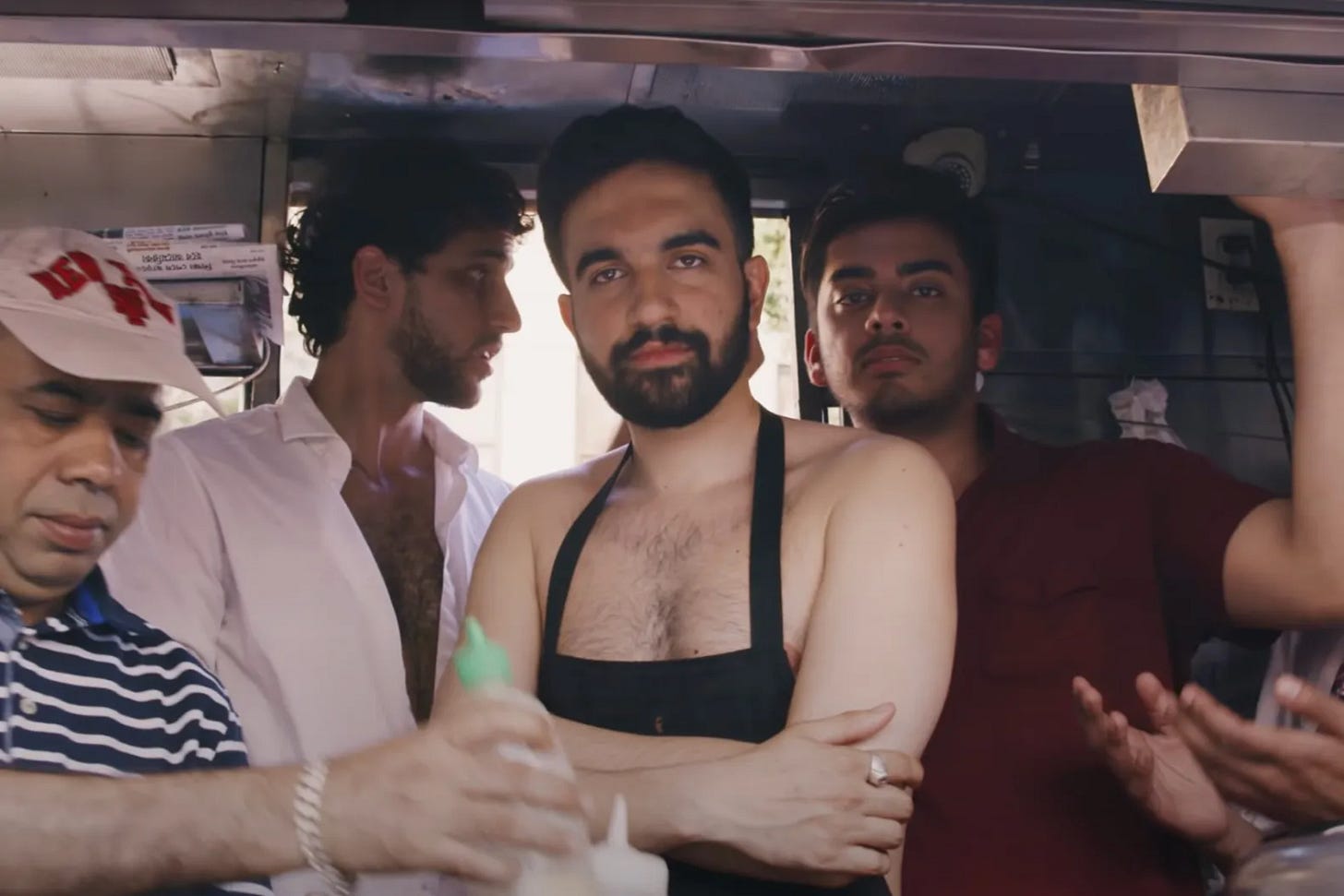
Before Zohran Mamdani became mayor-elect of New York City, he was shirtless in a halal food truck, shooting a music video about his grandmother.
The year was 2019. The track—performed under his rap alias Mr. Cardamom—was called “Nani,” and it’s now recirculating like wildfire. Delivered in a Ying Yang Twins-style whisper flow, the lyrics are from the perspective of a tough, glamorous, no-nonsense grandmother… and lip-synced by actress and cookbook icon Madhur Jaffrey.
Mamdani pops in and out of frame, dancing behind the counter as his apron slides dangerously sideways—serving up several nip slips nobody asked for.
It’s chaotic. It’s cheeky. And for most political candidates, the mere existence of this video would be a PR nightmare.
For Mamdani though, it’s oddly on-brand.
Sure, he looked a little stunned when CNN’s Erin Burnett ambushed him with the clip during a live interview. But he recovered quickly—pivoting to stats about his campaign’s grassroots growth and policy platform. And that recovery tells us something.
We’ve been conditioned to see nonlinear careers as liabilities. To see creative detours or “cringe” phases as distractions from real leadership. But what if the opposite is true?
What if Mamdani’s B-list rap career didn’t hurt his political future—but is exactly the thing that helped launch him into the mayor’s seat?
It’s easy to laugh at the video now, but here’s what most people miss: that wasn’t a detour. It was rehearsal. The flow, the punchlines, the delivery. All of it was training.
Because rap isn’t just about rhyming. It’s about presence, performance and knowing exactly when to go on the offensive.
We saw it in the debate, when Andrew Cuomo challenged him on his experience. Mamdani didn’t stammer or spin. He struck hard:
“What I don’t have in experience, I make up for in integrity. And what you don’t have in integrity, you could never make up for in experience.”
That’s not a talking point. That’s a bar. A full-circle reversal delivered with the cadence of someone who knows how to land a knockout in one line.
Even in his acceptance speech, Mamdani knew how to deliver a line that worked on multiple levels:
“A great New Yorker once said that while you campaign in poetry, you govern in prose.”
The quote belonged to Mario Cuomo. But Mamdani never said the name. Just “a great New Yorker.”
That phrasing wasn’t an accident.
It was a tribute to the father and a pointed exclusion of the son. One Cuomo earned the title. The other didn’t. It was Mamdani’s way of quietly reminding the room that greatness isn’t inherited.
But Mamdani doesn’t just aim sideways. He aims up.
In an era where many Democrats are still tiptoeing around Donald Trump, Mamdani calls him out directly—by name, on record, without flinching.
Mamdani may hold a much smaller office, but he doesn’t play small. That’s the battle-rap mentality at work: you don’t wait to be invited into the ring. You choose your opponent, and you show up ready.
Of course, Mamdani’s rap career wasn’t his only professional chapter.
Before entering politics, he worked as a foreclosure prevention counselor in Queens, helping lower-income immigrant families fight eviction. That work led him into organizing. He volunteered for local campaigns, managed a State Senate race, and worked as a field organizer for a progressive district attorney candidate. By the time he ran for Assembly in 2019, he’d built a track record in housing justice and grassroots politics. He won his primary against a five-term incumbent.
But I focused on the rap—not because it’s the most important, but because it’s the one people are quickest to laugh at.
And that’s exactly why it matters.
We’re taught to hide the messy or unconventional parts of our past. To edit our resume into something clean and linear. But I don’t believe in wasted jobs—or wasted phases. Even the most “off-brand,” embarrassing, or seemingly irrelevant role gave you something you’re probably using right now.
Maybe your call center job taught you how to smile through the phone while someone yelled at you about a billing error that happened when you were still in middle school. What you were really learning? How to stay cool under pressure, de-escalate conflict, and keep your composure when everything in you wants to scream.
Maybe your restaurant job taught you to push the least popular dish like it’s a viral TikTok sensation—because the dish everyone actually wants just sold out. But what you were practicing was sales: learning to pivot, frame a narrative, and sell with confidence even when the odds weren’t in your favor.
And that soul-crushing admin role where you answered to three different bosses? That’s where you learned to wield “as per my last email” like a scalpel—the professional equivalent of telling someone to fuck all the way off without actually saying it. Translation: boundary-setting, clarity under pressure, and holding your line with grace.
Every job teaches you something useful.
Put enough of them together, and that knowledge compounds. Over time, that very unique and specific skill stack becomes your unfair advantage.
Right now, you might be looking at your own resume and seeing nothing but disconnected jobs. A stint in marketing. That side hustle you abandoned. The role you took because you needed the paycheck. The creative project nobody understood.
You might be wondering if any of it mattered. If any of it counts.
Here’s what I know: it all counts. Every single thing you’ve done has taught you something that will become useful later, often in ways you can’t predict right now.
But here’s what makes this moment different from any other time in history: we’re entering an era where the ability to stack and remix your skills isn’t just valuable. It’s going to be essential for survival.
The world of work is being fundamentally restructured. AI isn’t just changing individual jobs. It’s dissolving the very concept of linear careers. And while everyone’s focused on what skills to learn next, they’re missing the bigger question:
How do you build a career that can’t be obsoleted?
The answer isn’t another certification or bootcamp. It’s understanding how to recognize the value in what you’ve already done and how to recombine those skills in ways no one else can replicate. That’s what I’ve been researching and writing about—and it turns out, I’d been living the answer for years without realizing it.
Not long ago, I was sitting in a friend’s kitchen, both of us in our forties, both moms, doing what we do best: second-guessing every career choice we’d ever made.
“I probably would’ve had more saved if I’d stayed corporate,” I admitted. “All that compound interest I missed out on…”
I was thinking about the former colleagues who took the straight path. Biweekly paychecks. Retirement accounts. Predictable raises. Meanwhile, my income had moved like a rollercoaster—record highs, sudden drops, and entire months of holding my breath.
She looked at me and said:
“But look at what you’ve actually been doing. Every time you’ve launched something new, you’ve gotten better at it. Faster. Sharper. Your entrepreneurial skills are your compound interest.”
And she was right. I hadn’t just been launching projects. I’d been stacking skills.
Finance taught me to analyze problems. Media taught me to craft narratives. Running a small business taught me how to lead, how to sell, and how to stay standing when everything felt uncertain.
All of it layered. All of it building.
So when I started my next thing, I wasn’t starting from scratch. I was starting from experience.
When you’re in the middle of a pivot—or picking yourself up from one—it’s easy to feel like you’ve gone off-track. Like your past experience doesn’t “fit” what you’re trying to do now.
But every weird job, off-brand side hustle, or slightly humiliating career experiment taught you something. Maybe it gave you stamina. Or emotional range. Or the nerve to stand up in front of people and speak from your gut.
That stuff doesn’t show up neatly on a resume.
But it shows up when it matters.
We’re entering a work era where adaptability beats specialization. Where your ability to remix what you’ve done before is more valuable than any one credential.
Zohran Mamdani didn’t get elected in spite of his rap career. He got elected, in part, because of it. Because he’d already learned how to hold a mic, own a room, and punch up.
The same is true for you.
If you’re sitting in that tension right now—the place where your current role doesn’t fit anymore but you’re not sure what comes next—you’re in exactly the right place. Not because it feels good. But because you’re at the edge of something.
I write about this every week: how to navigate these transitions without losing yourself in the process. How to recognize when stepping back is actually the smartest move forward. How to build a career that can bend without breaking.
If that sounds like something you need right now, I’d love to have you join me.
You’re not starting over.
You’re stacking up.
There’s no paywall on any of my writing. Paid subscribers aren’t paying for access—they’re investing in work that resonates.
As a thank-you, you’ll receive a special gift:
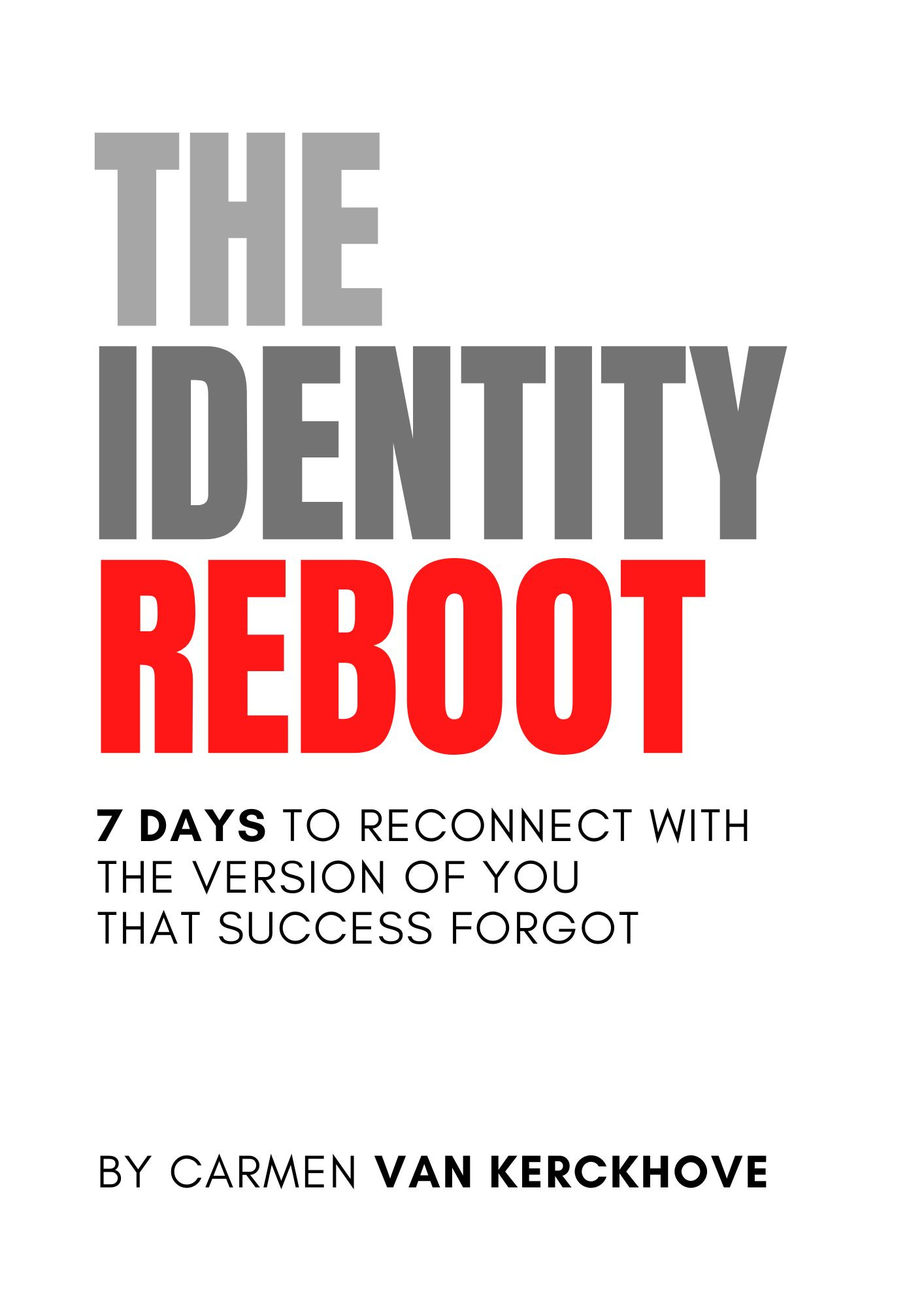
If your sense of self has gotten tangled up in roles, titles, accomplishments—or the pressure to stay impressive—this guide is for you.
This is your reset.
It’s a 7-day PDF experience designed to strip away everything you’ve outgrown, so you can reconnect with what’s real, true, and still yours.
Inside, you’ll:
Uncover who you are beyond the resume, the job title, or the public performance
Identify which parts of your identity feel authentic—and which feel like armor
Rebuild a vision of yourself that isn’t based on productivity, approval, or prestige
This isn’t about starting from scratch. It’s about remembering who you were before the world told you who to be.
If you’ve ever seen yourself in my writing, this is your next step:
And if now’s not the right time?
I’m still glad you’re here.
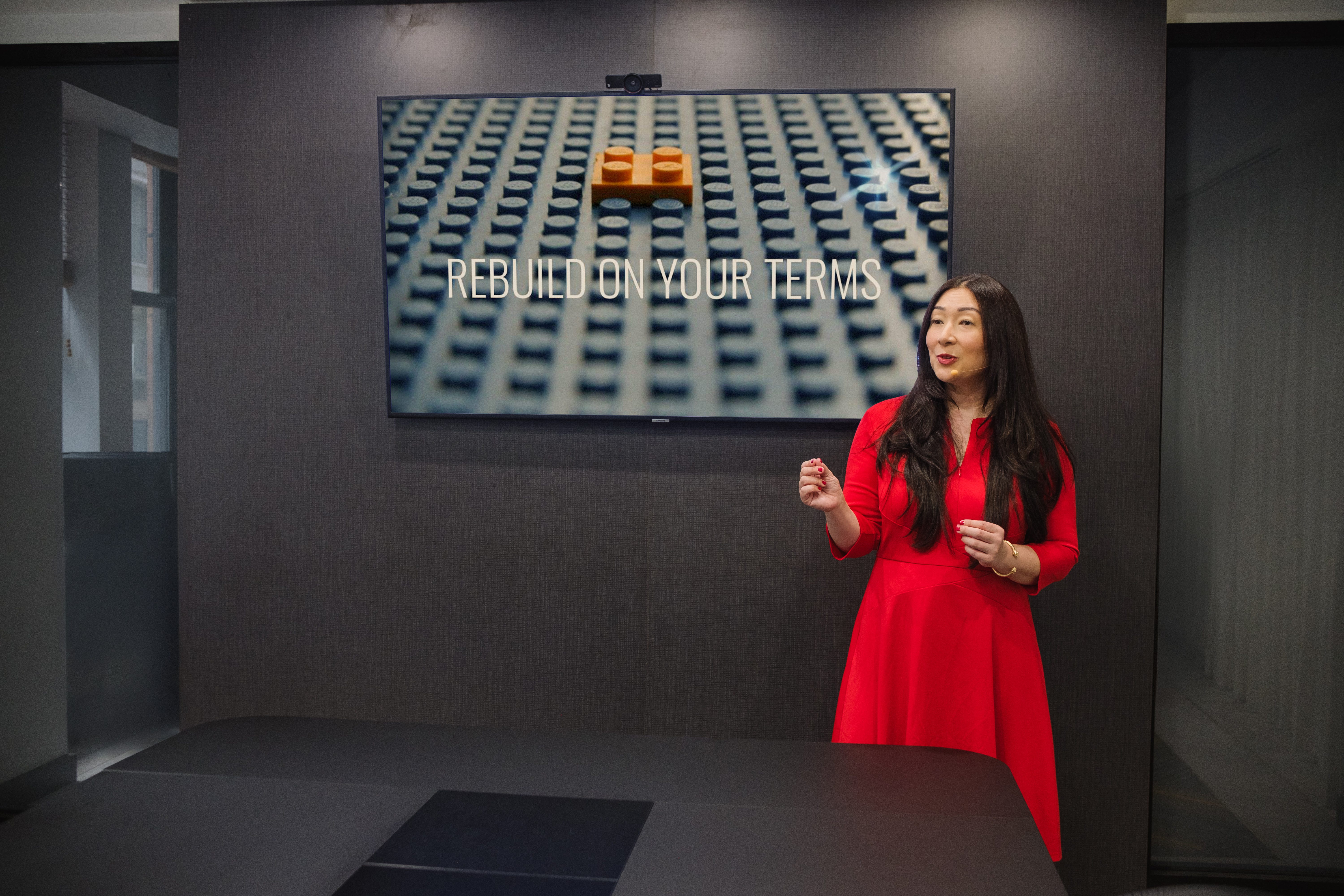
Carmen Van Kerckhove is an author and keynote speaker whose work explores how technology, social class, and cultural change are reshaping ambition, identity, and the future of work. Her upcoming book, The Slingshot Effect (Crown Currency), shows why pulling back isn’t a setback—it’s how every breakthrough begins.
Based in New York City, Carmen speaks at keynotes, conferences, leadership summits, and company retreats. Explore her signature talks here.
→ For speaking inquiries, contact info@topflightfamilymedia.com.
No posts
Comments
Nothing yet. Say the first thing.
Sign in to join the conversation.