
Welcome to the Crime Fiction Files. I’m CIA veteran Carmen Amato, sharing the encounters, experiences and current events behind my crime fiction thrillers, including the award-winning Detective Emilia Cruz police series set in Acapulco.

Image by Valentina Rubio via Unsplash
I was grocery shopping in Mexico City’s Lomas Altas neighborhood when our housekeeper called. Our daughter, a first grader at the American School, didn’t come home on the bus. The driver said she never got on.
To say that I levitated out of the store, abandoning a full shopping cart, is no exaggeration. I got to the school in record time to question teachers and security guards. I called everyone we knew.
My daughter was eventually found at a friend’s house, having coolly convinced the bus supervisor (in Spanish) that she had permission to get on a different bus.
But what if we hadn’t found her? What if she became one of Mexico’s 130,000 missing persons?
Please read on.
No one was more surprised than me when the United Nations’ Committee on Enforced Disappearances (CED) determined that past and ongoing enforced disappearances in Mexico should be considered crimes against humanity.
Endorsing the CED decision, the International Federation for Human Rights (FIDH) said:
Organized crime groups practice enforced disappearances in a widespread and systematic manner in the country, often with the authorization, support or acquiescence of local public officials, and frequently in contexts of corruption.
The best known example of this authorization, support or acquiescence is the 2014 mass disappearance of 43 students from a rural teaching college in Ayotzinapa, Guerrero, which inspired the 6th Detective Emilia Cruz novel 43 MISSING.

Shrouded in confusion and contradictions, the best explanation for the true crime is that the students unwittingly jumped aboard buses used by a consortium of narcos, local cops and Army troops to move drugs.
Unlike 43 MISSING, which offered closure in a way real life has not, most of the students’ remains have never been found.
President Claudia Sheinbaum rejected the CED determination, ostensibly made for “political reasons.” She claims it only took into account actions of past administrations and ignores current realities.
“There are no systematic attacks against the civilian population by the State,” the president declared, along with an assertion that her government is working with searchers known as buscadores.
In response to Sheinbaum, Alexia Martínez Montalban, a lawyer and international expert with the Miguel Agustín Pro Juárez Human Rights Center, said,
“It’s not so much the ordering of disappearances, but rather the inadequacy of investigations and the complicity of the authorities that create conditions for disappearances to continue in Mexico.”
FYI, her organization is named after Padre Pro, a martyr of Mexico’s Cristero War of the 1920s when the government tried to ban Catholicism. During a trip to Italy, a chance discovery of a book about him inspired the 3rd Detective Emilia Cruz mystery, DIABLO NIGHTS.

Mexico City probably knew the CED determination was coming because a few days earlier, a new government report claimed that based on “vaccination records, birth and marriage registries and tax filings” as many as a third of the disappeared might not be disappeared at all.
Most of the report involved lots of confusing numbers. Hard to know if this is deliberate obfuscation or the process of cleaning up Mexican accounting is incomprehensibly complex.
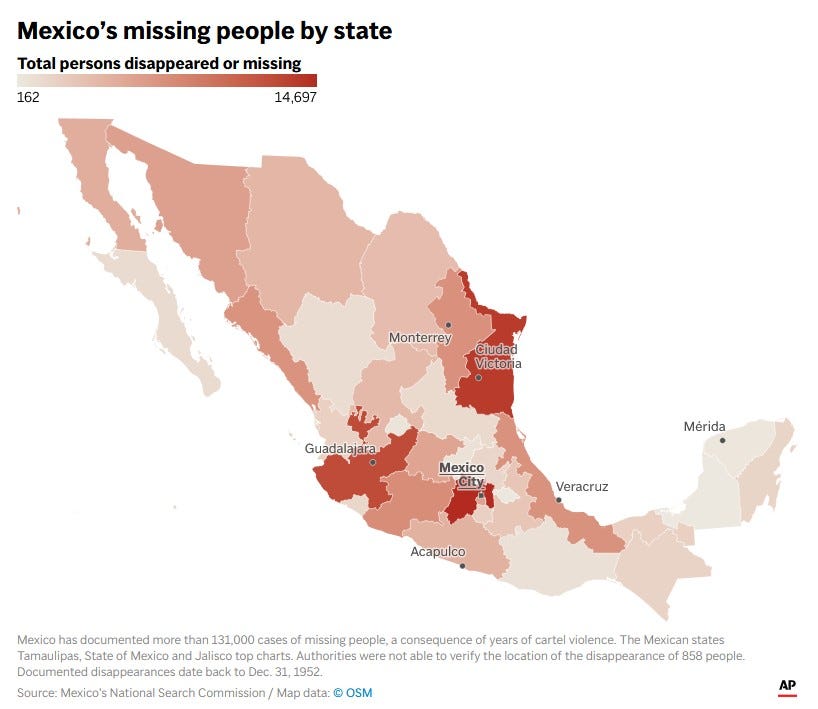
The CED cited the discovery of 4,500 clandestine graves with over 6,200 bodies, 4,600 human remains and around 72,000 unidentified human remains since it began monitoring Mexico 14 years ago.
Numbers tell the story . . .
· Disappearances rose 7% in 2023 and 6% in 2024.
· 72,100 unidentified bodies are held in morgues.
· 30 people go missing in the country every day.
· 96% of crimes in Mexico go unsolved.
One UN report actually changes little for those involved in the endless search for answers.
In their own voices . . .
“After fighting against everything, against oblivion, against apathy, against the hard, dry land scorched by the sun that was always there, leaving part of our blood and skin behind, crying to wipe away the dust that blinded us, because there was no time, because I believed that with every step I would find you alive.” – Celia Flores, founder of the search collective Madres Buscadoras de Sonora, upon the discovery of her son’s bones.
In the Detective Emilia Cruz series, the disappeared aren’t just statistics to be rejected or fudged.
They are catalysts for justice from a flawed system.
As a police detective in Acapulco, Emilia is stuck in a system in which officialdom and organized crime often operate in lockstep. She refuses to be either defined or constrained by it, an attitude that comes with a personal price.
DRAGON CARTEL, coming 16 June, leads Emilia on a search you’ll never forget.

In DRAGON CARTEL, Emilia is hunting for a missing Customs inspector. Her former partner and boss, Franco Silvio, digs up a piece of the puzzle:
The pedestrian bridge above the traffic on la Costera was high enough for Emilia to see a ripple of blue ocean beyond the clustered buildings of the port complex. The white warehouse was closest, presenting its flat roof for inspection. More distant, the port’s yellow multi-purpose building undulated like a sloppily built layer cake. The usual line of parked cars snaked along the service road, glass and paint and chrome twinkling in the afternoon sun.
“Okay, you got me up here.” Emilia pulled her eyes away from the view and fished out a slice of mango from the plastic cup of fruit from a vendor in the park on the north side of la Costera. “Now tell me why.”
Silvio faced west toward the yellow layer cake. “How far can you see?”
“Pretty far.” Emilia ate the mango, careful not to lean against the bridge’s flaking white paint. Not only would it leave marks on her black jeans but she didn’t want to test the railing’s structural soundness.
“You can see where Lastra’s car was parked when they found it, right?”
The fact that Lastra had left his car on the service road instead of using his assigned spot in the employee garage was still an open question. “Along with every other car on the service road,” Emilia said.
Silvio turned to face her again as he wiped pineapple juice off his chin with the back of his hand. “The day Lastra disappeared, there was a little street festival behind the warehouse, right where the sidewalk widens into that little plaza. The same mariachi band that gets hired when cruise ships dock played that day.”
“A festival? Nobody mentioned that before.”
“Yeah, it was some kid thing. Jugglers, toy vendors, balloons, whatever. The point is that the mariachis played until dark, then passed the hat and everybody went home.”
“Okay.” A bus passed under the bridge, heading east. Emilia felt the vibration in the soles of her feet.
“The trumpet player, a fellow named Rojas, started walking home that way.” Silvio pointed with his half-empty cup of fruit toward the yellow multipurpose building.
“Past Lastra’s car,” Emilia said with sudden understanding of where the conversation was headed.
That’s all for this edition. Thank you for spending this time with me.
Until next time,

PS: A percentage of book sales and affiliate links go to support veterans and first responder organizations. When you buy a book, invite me on a podcast or recommend this newsletter, you help me help others. Thank you.
Please tap the heart at the top or bottom of this email, to make it easier for others to find this publication. Thank you!
MY BACKSTORY— I learned a few things about danger, deception and resilience during a 30-year career with the CIA focusing on counterdrug and technical collection. Now a mystery author, those lessons play out on the page, especially in the Detective Emilia Cruz mystery series set in Acapulco. Starting with Cliff Diver, the series is a back-to-back winner of the Poison Cup Award for Outstanding Series from CrimeMasters of America. I’ve also written historical and political thrillers, essays about the craft of crime fiction, and live with a very large white dog named Bear.
In case you missed earlier newsletters:
Comments
Nothing yet. Say the first thing.
Sign in to join the conversation.