
I’ve taken a little hiatus from posting here lately - not because I’ve been idle, but the exact opposite in fact. My department at King’s College London (the Global Health and Social Medicine dept) have a PhD milestone which has to be submitted when you’re about 9 months into the PhD, called the Aims and Methods essay. It’s a 5,000-word piece which basically outlines, you guessed it, your aims for your research, and the proposed methods you plan to use to reach those aims. It also includes a mini-literature review, locating your research within the wider context, engaging with existing literature in the field/s.
I submitted mine today, and the process of writing this piece has been super useful in helping me to plan my focus for the next few months. It’s also helped me to unearth more literature around pleasure, embodiment, selfhood and survivorship which is useful for helping me decide exactly what I want to engage with, and which scholars I’m building upon.
It’s quite common while researching for a PhD (especially one in the social sciences) that your focus shifts over time. So while my focus has shifted slightly from my original aims, I’m sure it will shift again, especially when I start my fieldwork next year. My new abstract is:
One in two people will be diagnosed with cancer in their lifetime. Hearing the phrase ‘you have cancer’ is devastating; it causes a temporal rupture, a major disruption of one’s anticipated life trajectory, and a significant threat to the self. This threat is physical: a diagnosis of cancer is predicated on the discovery of its presence in the body. However, the impact extends to all areas of one’s life, manifesting temporally, psychosocially, interpersonally, causing a loss of identity. Renegotiating one’s sense of self in the face of a cancer diagnosis requires navigating biomedical power structures, gender and corporeal norms, and working with and within hegemonic cancer culture. Based on the significant role that pleasure and sexuality play in subject formation, and the place of art and creativity in facilitating the remaking of the self, this research will investigate the ways in which people renegotiate their embodied sense of self following a breast cancer diagnosis, use arts-based research methods to explore the place of pleasure and sexuality in this process, and define the implications for practices in, and experiences of, cancer survivorship.
I’ve also progressed considerably with planning the arts-based research methods I’m going to use for this project, and I’ve settled on body-mapping and collage. I can’t start to recruit participants until I have ethical clearance, so submitting my ethics application is a priority over the coming months.
The next stage of a PhD is called the ‘upgrade’. This is a 15,000-word piece which is basically an expansion on what I’ve just produced, going deeper into the literature and being specific about how I’m going to achieve my aims within the PhD timeframe. I’m aiming to submit this in December, and I will have to deliver a mini-viva (viva voce - an oral exam where I have to basically talk for about an hour defending my thesis, and then get grilled by the examiners). This is a simple pass/fail milestone and is the final hurdle to being able to start on my PhD project in earnest. So the next few months I’ll be hunkered down, reading and writing and furthering my thinking.
Of course I’ve been reading plenty of papers and books, but haven’t had chance to summarise them here. I might try to summarise some of the key ones over this summer, but the next big piece of writing I’m planning is one on selfhood and embodiment. Hopefully coming sometime in August!
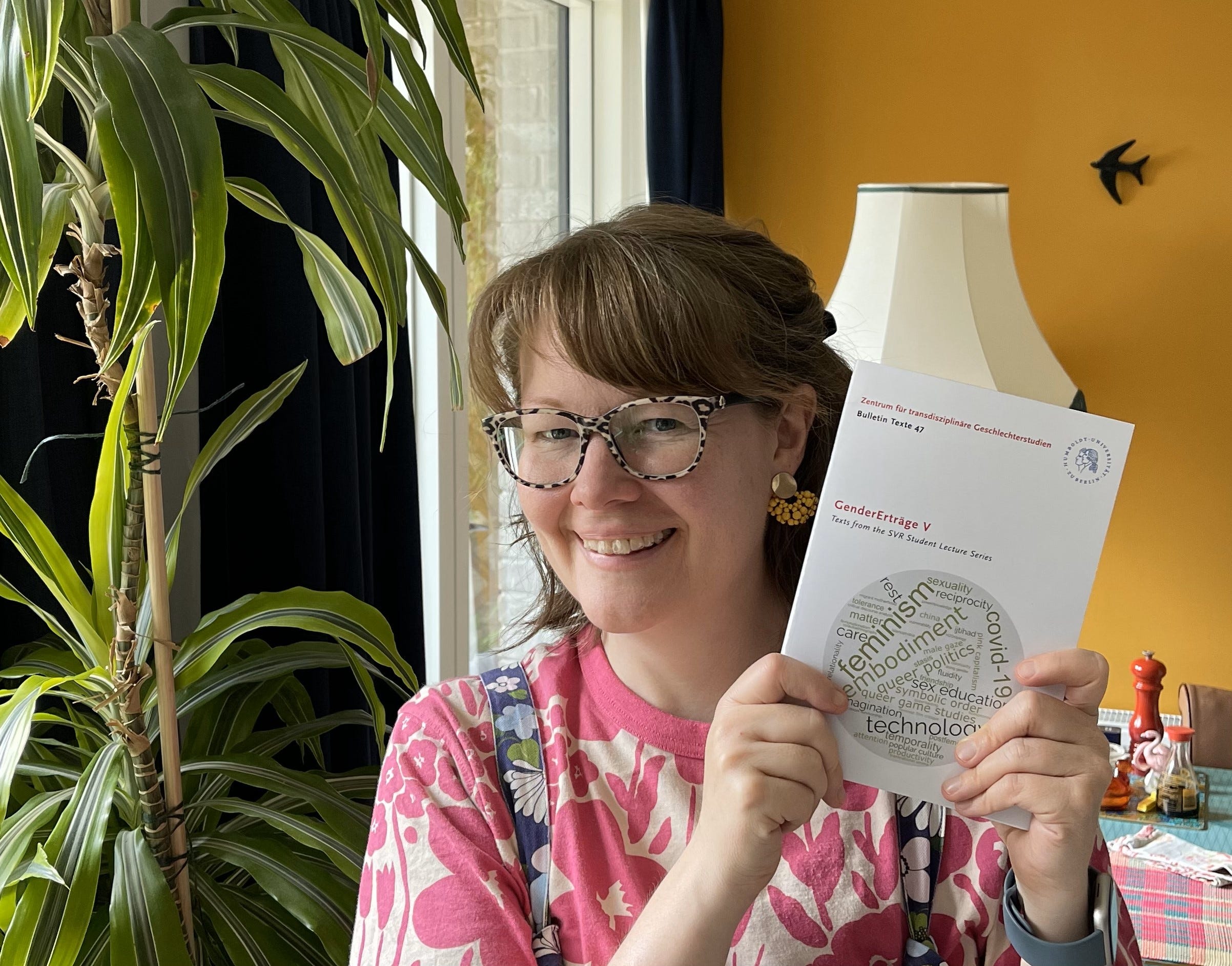
In the meantime, here’s a pic of me looking pleased as punch, holding up my first ever peer-reviewed publication! In 2020 I delivered a conference paper with a friend, Taey Iohe, and the resulting paper from this conference has finally been published. It’s taken so long, that the paper definitely feels quite dated already (we talk about migrant motherhood and cancer survivorship in the context of the early months of the pandemic) but it’s still a huge achievement and one of which I’m very proud. The process of peer review was so fascinating. This is where the paper is anonymously sent by the publication’s editors to two academics in relevant fields. They read the paper and send notes and thoughts, as well as recommendations as to whether it should be published or not. The authors (Taey and I) then have the opportunity to revise the paper accordingly. One of our reviewers also gave some excellent suggestions for other papers we could read to help us expand our argument, which was super useful. The final paper is Open Access and is available from the Humboldt University webiste. Our paper is the first one in the 47th edition of Bulletin-Texte, ‘Texts from the SVR Lecture Series’. If you do give it a read, be gracious and understand that both Taey and I have developed our thinking and our practice quite considerably since we wrote this three years ago, but also send me your thoughts!
Anyway, I’m going to take a little break this weekend - a brief but well-earned rest before starting back on Monday.
Comments
Nothing yet. Say the first thing.
Sign in to join the conversation.