
If you enjoyed this article, please share it with a friend or consider becoming a paid subscriber and supporting science literacy.
Your orgasm face is not good. I’m sorry. Nobody’s is. Most O-faces look like someone just remembered, with total clarity, where they left their keys in 2009.
But it is, crucially, confusing on everyone’s face. This is the great democratizing horror of our species: at the exact moment we feel the most singular pleasure, we all make the face of a man lifting a couch. Even more perplexing, remove the bed, the partner, and the sudden invocation of God, and an orgasm begins to look suspiciously like a medical emergency.
Why? If pleasure has a recognizable expression, why does it keep borrowing pain’s face?
Science, God love it, needed a study to answer this.
In 2012, psychologists Hillel Aviezer, Yaacov Trope, and Alexander Todorov collected photographs of people experiencing emotions at full blast.
They studied the faces of tennis players immediately after winning or losing an important point, mourners at funerals, people seeing their homes after lavish makeovers, people undergoing nipple or navel piercings, and, courtesy of the website Beautiful Agony…people having orgasms.
The photographs represented six intense experiences: grief, physical pain, defeat, victory, joy, and orgasm. The researchers cropped away the bodies and surroundings. They then asked participants to rate how positive or negative each isolated face appeared.
They failed to recognize the correct emotion.
Victory collapsed into defeat. Pleasure wandered into pain. An orgasm could pass for grief, and joy apparently looked as though it had received terrible news from the doctor. In fact, participants rated faces from positive situations slightly more negative than those from negative situations. Orgasm, victory, and overwhelming joy somehow looked worse than grief, piercing, and defeat.
That is one hell of a performance review for happiness.
But perhaps those people were simply bad at recognizing emotions on faces. Perhaps you would do better?
You know what is coming…quiz time! It’s time to play — O-Face or Ow-Face?
Science used tennis players, funerals, body piercings, and orgasm videos. I have chosen Western art because painters and sculptors have been accidentally running this exact experiment for five hundred years, and the results are hanging on the walls.
The rules are simple: I show you a face from a famous artwork. You guess whether the face is experiencing ecstasy or the worst sneeze of their life…before scrolling. Art Historians are not allowed to play. Sorry.
Disclaimer: This experiment has no control group, no institutional approval, and a principal investigator actively trying to make everything sound like sex.
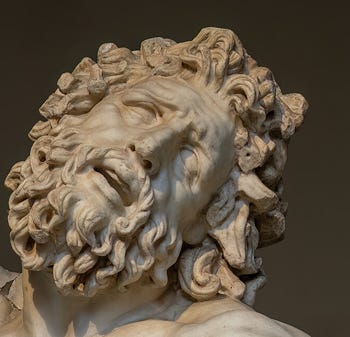
His whole body strains upward, every sinew pulled tight against a pleasure almost too exquisite to bear. His head falls back. His lips part around a cry wrenched from somewhere deep, somewhere primal, somewhere he did not know he could be touched.
Wait…what is this spirit coiling and tightening around his aching flesh?
Oh crap…It’s serpents. And they are about to snack on his junk.
This is the Laocoön, and he is caught in an Animal Kingdom-level reptile attack. It’s a tragic Python threesome gone wrong. Nobody here is finishing.
She has drifted off into sweet slumber. A holy Roman woman is spent after a long day of honest labor. Her lips part. Dreaming, no doubt, of the Lord.
Or she is dead.
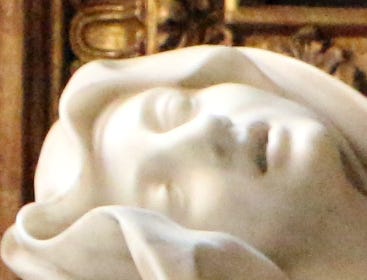
Or…she is having a different sort of spiritual awakening because that hand has an agenda.
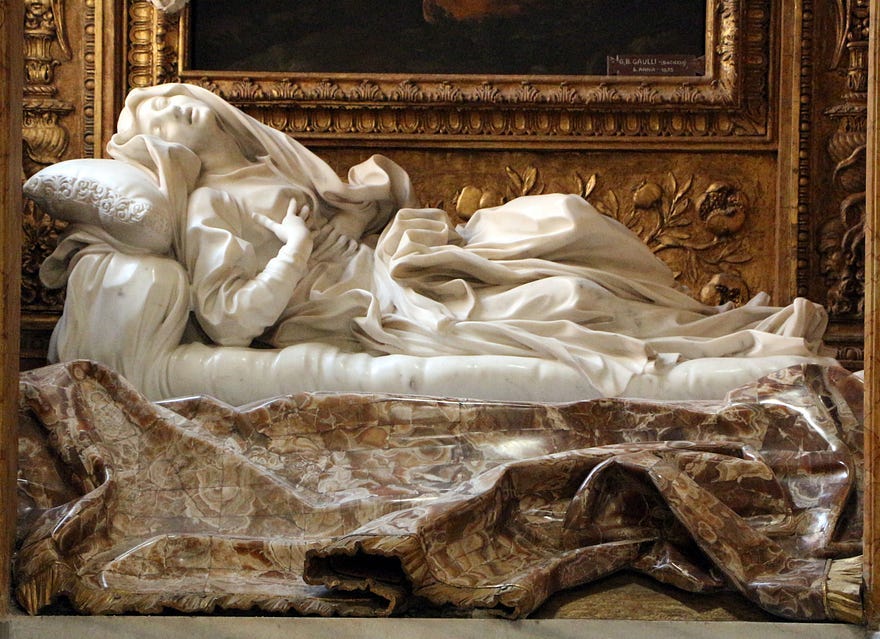
Bernini installed Blessed Ludovica Albertoni over an altar and dared the Church to say a word. It did not.
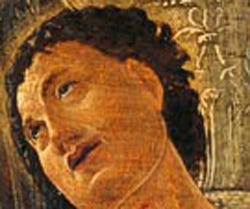
He surrenders utterly, knees buckling beneath a pleasure so total it has emptied him of will. His head lolls back. His mouth falls open in silent, trembling bliss as something enters him — deep, insistent, again and again — filling him past the limits of the flesh.
What is this force that pierces him so completely, over and over, and leaves him hanging boneless in its thrall?
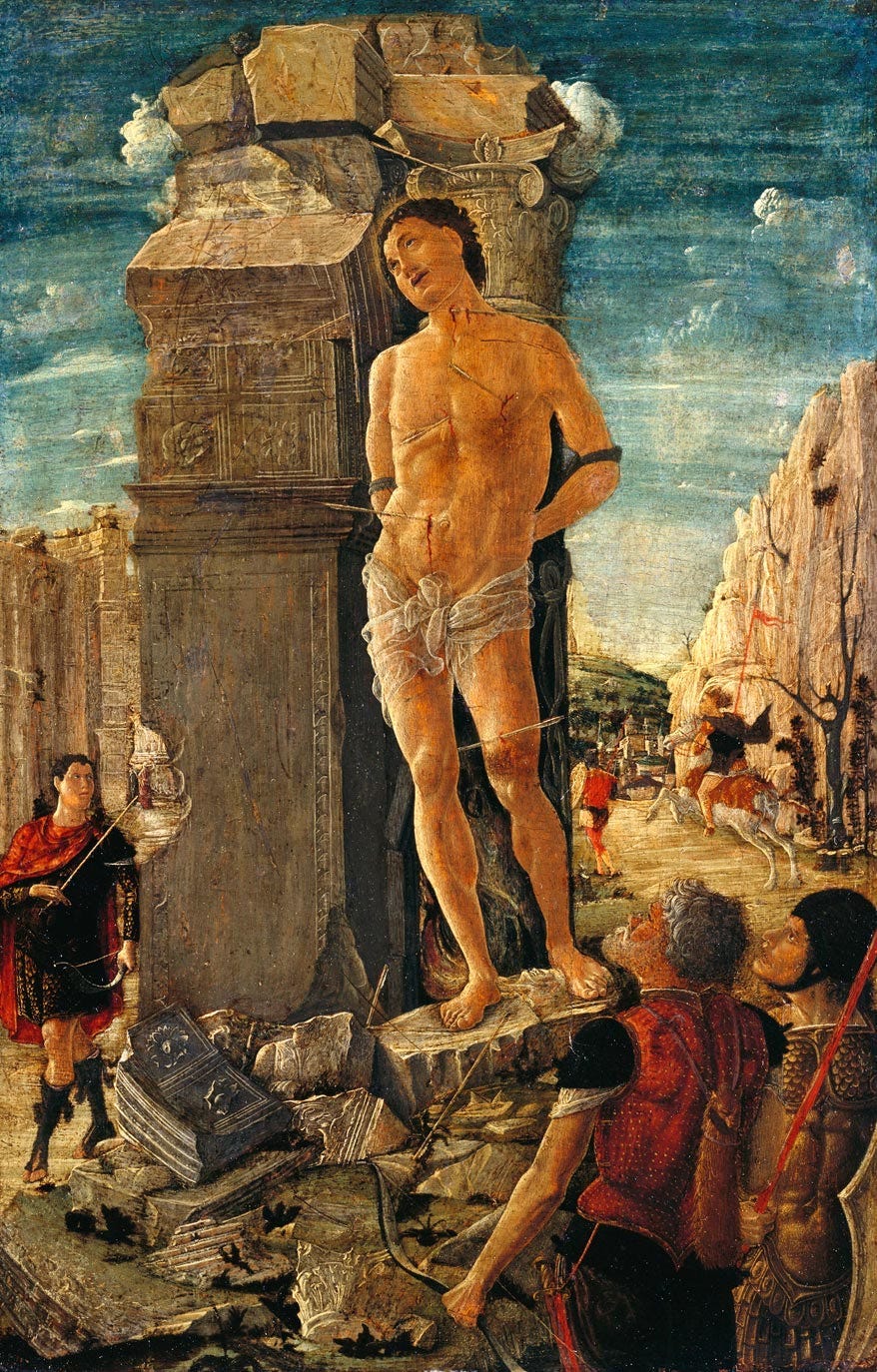
Oh no. It’s arrows. Like, a concerning number of arrows.
This is Saint Sebastian, and that rapturous swoon is a man being used for imperial archery practice. Art history has painted him roughly nine hundred times mid-moan while full of arrows. Least sexy way to go. (Sebastian survives the arrows. They later clubbed him to death because Rome believed in finishing its paperwork.)
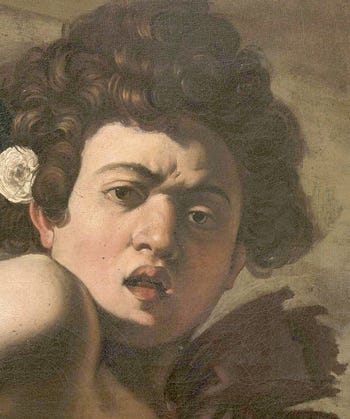
That soft little gasp, the eyebrows shooting up, the whole face caught in the involuntary hmmmm….do I like this? Yes, I do. More of that, please. A warm mouth found something it was looking for. His body knew before his brain did, and his face is still catching up to the news.
There. Something tender has just made contact.
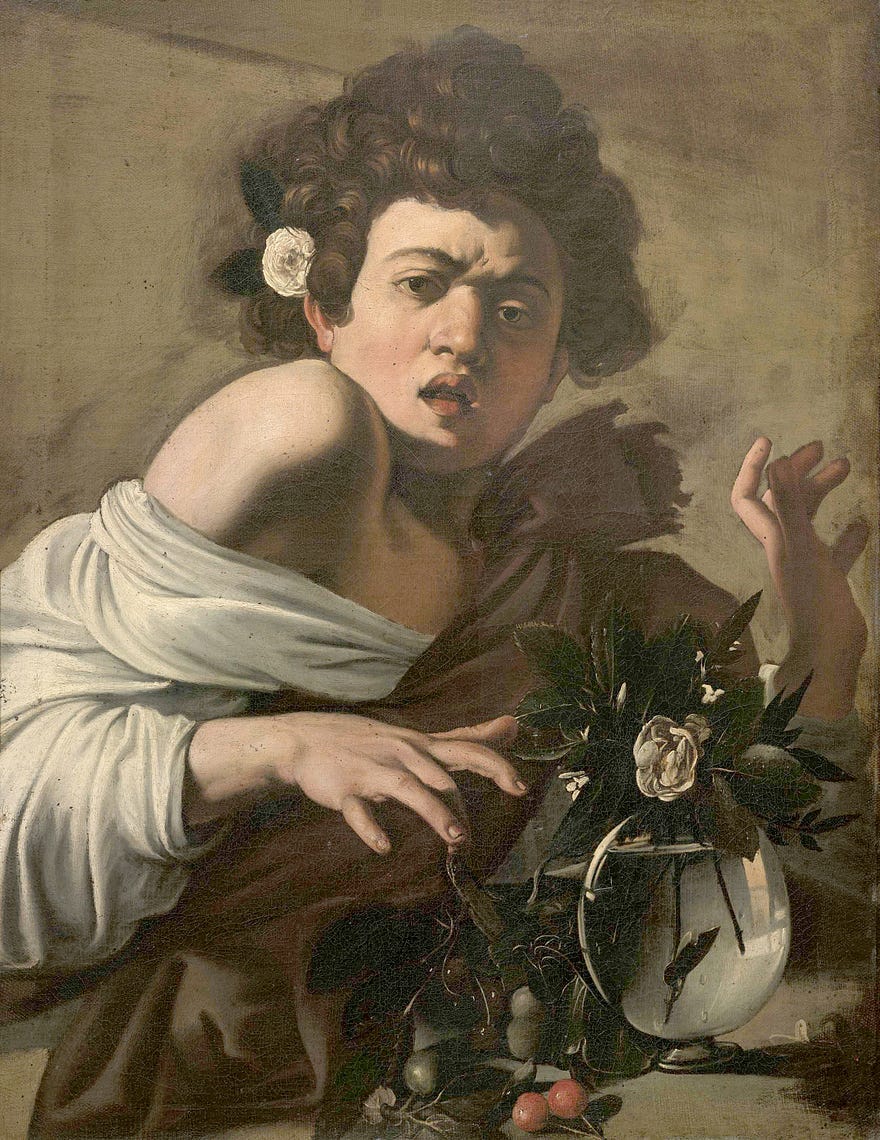
Yikes! It has teeth. A lizard has chomped on the poor lad’s finger. That Caravaggio was so incorrigible.
How did you do? Be honest. If you didn’t already know the artwork, could you accurately distinguish between pain and pleasure without contextual cues?
You probably did much better after I returned the serpents, arrows, religious bedding, and angry lizard to their proper positions. But go back and look at those faces again. Your initial understanding of the faces alone may have been accurate, but are those emotions now more obvious?
Laocoön now looks unmistakably agonized. Saint Sebastian looks pierced rather than pleasured. Ludovica seems engulfed in spiritual ecstasy. Caravaggio’s boy is plainly recoiling from a bite.
Except that the faces did not change. You saw exactly the same eyes, brows, lips, and cheeks before and after the reveal. Somehow, the body and background contextual cues made an emotion appear inside the face, as if it had been there all along.
The researchers noticed this too. And because psychologists cannot leave well enough alone, they began mixing and matching bodies and faces to see if they could really trip people up.
What happened next revealed something deeper about the way we read other people’s orgasm faces and the clues that provide the real answers.
Comments
Nothing yet. Say the first thing.
Sign in to join the conversation.