
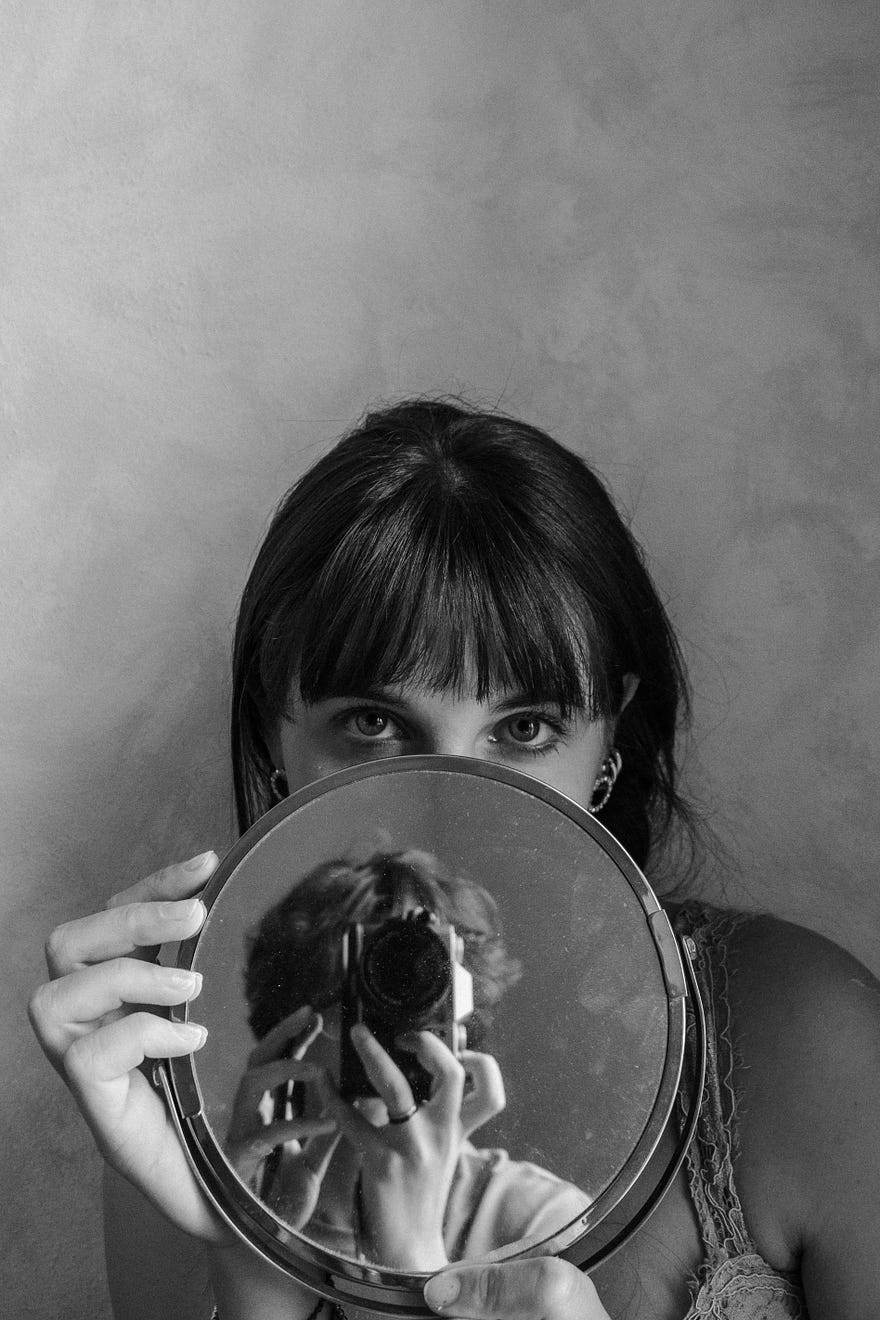
If you enjoyed this article, please share it with a friend or consider becoming a paid subscriber
This week, Perez Hilton livestreamed an apparent act of self-harm to his 1.6M TikTok followers. Fans called for help. Police responded, de-escalated, and he was taken to a hospital. We do not know whether he intended to die, and there is no responsible reason to speculate.
I should admit that I only recently learned who Perez Hilton is. Forgive me. I do not follow celebrities unless they have written a book, preferably one with footnotes. Some people can identify every Kardashian from the curve of a buttock. I occasionally fail to recognize Matt Damon when his hair changes.
For those blissfully unaware, Perez Hilton became famous during the early internet by turning celebrity cruelty into a business model. He posted photographs, drew mocking little additions on them, and outed people. His most famous example is speculating about and effectively disclosing the sexuality of *NSYNC’s Lance Bass before Bass had fully chosen to speak on his own terms.
Hilton played the mean girl for a living and did very well with it. And by well, I mean he made a boatload of money off of bullying, thereby inspiring other bullies.
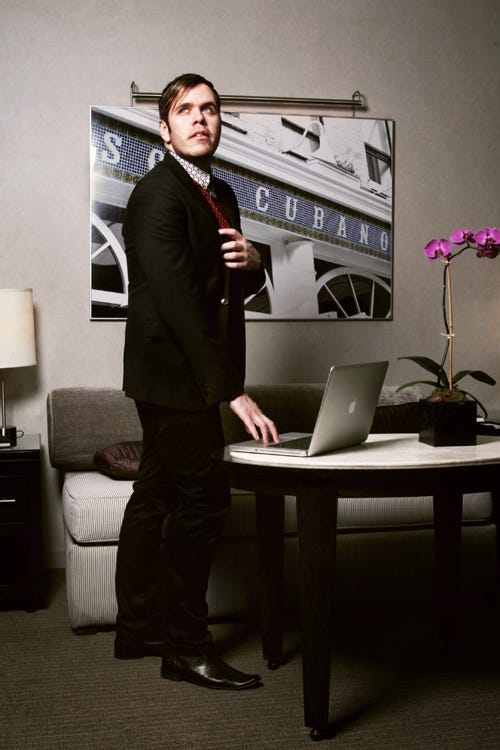
When bullying became less fashionable, he apologized to all the people he hurt in tearful videos. He said he had cared about views, attention, and money more than the human beings supplying them. He had been selfish and was ashamed. He had been forgiven. (Most importantly, he had forgiven himself, which was apparently efficient in influencer land.)
The videos introduced a new Perez Hilton: repentant, grateful, and redeemed. He even recently found Jesus and went bible shopping for his preferred version. Cue the future Christian sponsors.
Flash forward to this week. The self-harm footage was disturbing for all the obvious reasons. But it was also disturbing for another one: the presence of the camera in what could have been his last moments.
A mental-health crisis does not need a ring light. Yet public performance had apparently colonized private life so completely that even agony arrived with a broadcast button. That does not make Hilton’s suffering theatrical or insincere. A person in acute crisis usually has little capacity for either calculation or restraint.
The obscenity lies in how we have normalized experiencing ourselves as content.
But Perez’s mental collapse begs us to ask harder questions: Why do we need an image to experience a self at all?
Fortunately, one ambitious sociology doctoral student kicked off the conversation with a brave social experiment.
In 2011, UCLA doctoral student Kjerstin Gruys was shopping for a wedding dress. The experience revived some unhealthy scrutiny of her appearance, as it so often does.
So she decided to stop looking at herself for an entire year.
Gruys covered the mirrors in her home. She avoided reflective windows, tagged social media photographs, pictures of herself, and her image during Skype calls. She used the mirrors in her car strictly for driving, because self-knowledge is important but so is not backing over a toddler.
She even made it through her wedding day without looking at her reflection or the photographs being taken around her.
To be clear, this was not a controlled clinical study. Gruys called it a personal experiment. However, Gruys discovered that she had been consulting mirrors for more than practical information.
She used them to regulate emotion. A reassuring reflection could confirm that the day was going well. An unflattering one could explain why it was not. Without that evidence, she wore less makeup, simplified her clothes, and relied on people she trusted to mention any spinach attempting to establish permanent residency between her teeth.
Most important, she began separating her appearance from her self-esteem.
But here is where I want to push the idea further. Gruys showed how a person could live without seeing her reflection. But she did not test whether a person could live without being seen by others.
She was still photographed, including throughout her wedding. The experiment only removed her access to those images; it did not stop other people from creating, storing, interpreting, and consuming them. Friends and family told her how she looked.
The distinction matters. Gruys remained a person who could be converted into an image even when she refused to look at it. She removed the glass mirror, but the social machinery that produced her public self remained fully operational and eager to provide notes.
So let us transform her experiment into another thought experiment.
Imagine that for one year no representation of you could be produced. None. No mirrors, photographs, video, or profile picture. No self-view window hovering during a meeting like an extremely judgmental coworker. You could not see yourself reflected in a shop window or discover your face lurking behind the cheese in someone else’s vacation album.
But neither could anyone else photograph, film, archive, post, tag, replay, or circulate you.
For one year, imagine being encountered only in real time. People could only see you while standing in your presence. Afterward, they would have to remember you. You would leave behind no visual evidence that the meeting, the vacation, the wedding, or any event confirming you had existed in that moment.
Would you lose your identity? Or would you discover that what you had lost was merely the evidence you had mistaken for identity?
Humans have been worrying about this longer than we have possessed front-facing cameras, largely because humans can turn any useful invention into an existential crisis if given a long weekend.
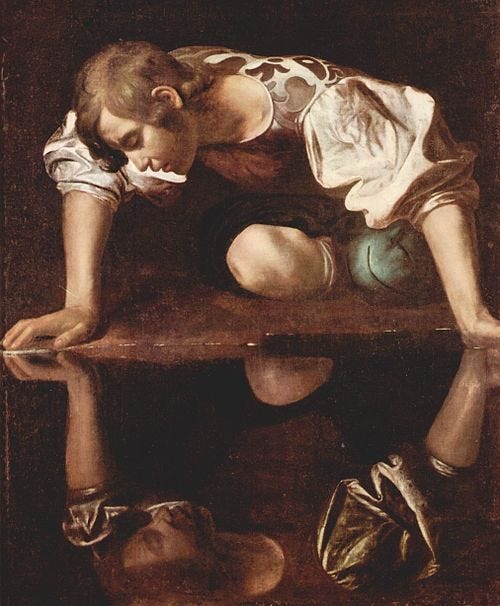
Ovid gave us Narcissus, who became so captivated by an image that he could no longer return to life. The usual moral is that excessive self-love destroyed him. But Narcissus did not really love himself. He loved a visible object he mistook for something capable of completing him.
The image did not reveal the self. It displaced it.
Aristotle offered the less glamorous alternative. Character was not something we announced, displayed, or selected from a drop-down menu. It was something produced through habit. We became just by doing just things and courageous by repeatedly acting with courage. Character was a verb.
But this idea was terribly inconvenient. A virtue that must be practiced is much harder to maintain than one that can be placed in a biography beside a small flag and the word “empath.”
By 1902, sociologist Charles Horton Cooley had noticed that glass was no longer necessary. His “looking-glass self” described how we learn to see ourselves through other people: we imagine how we appear to them, imagine their judgment, and then experience pride or shame in response to a verdict they may never have delivered.
Cooley was extremely prescient because he basically described the phenomenon of spectatoring before social media gave it analytics. Spectatoring is the habit of imagining how other people see you and then evaluating yourself through that imagined perspective.
The audience Cooley imagined now sends numbers. Likes, shares, and follower counts have relieved us of the terrible burden of wondering whether strangers approve. We can check before breakfast.
In other words, have we confused recognizing ourselves with knowing ourselves?
To understand how we arrived here, it helps to look at the origins of photography itself. In its earliest days, photography was not about self-expression or performance but about preservation. For many families, a postmortem photograph — a photograph taken at death — was the only photograph they could afford. Photography began, in a sense, as a way of holding onto the dead — an attempt to make absence visible.
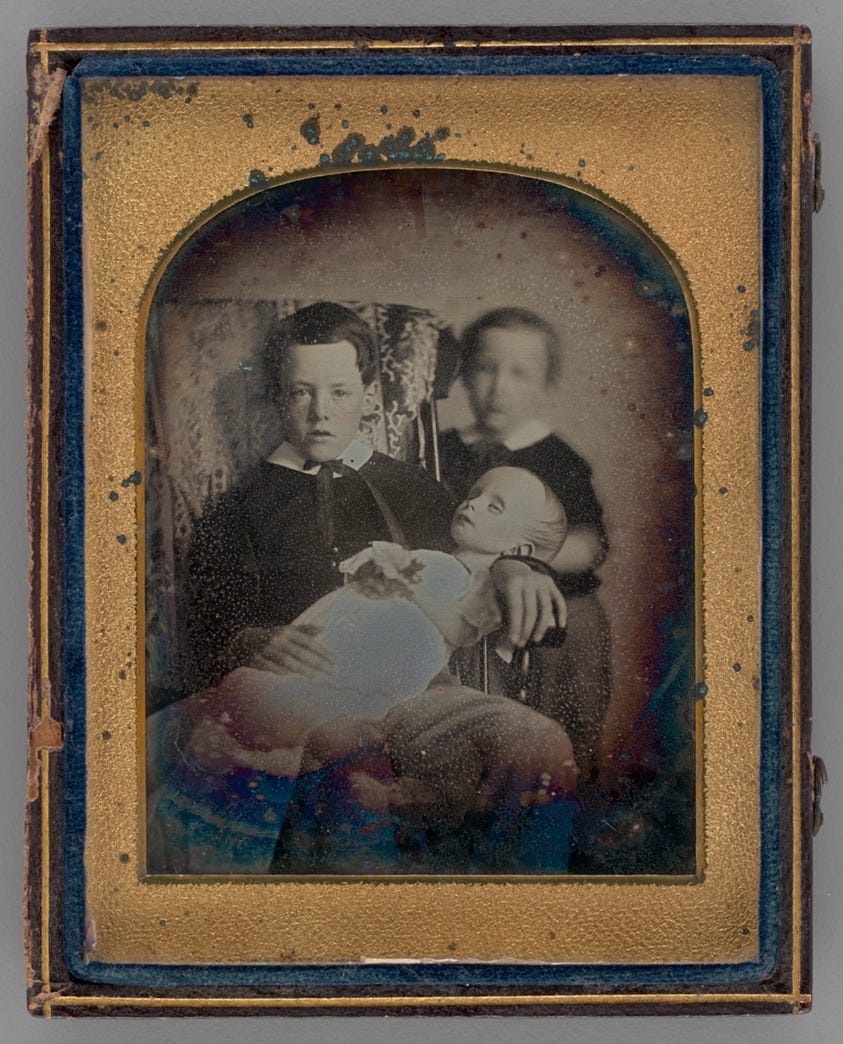
But that function did not last. As photography became cheaper, smaller, and easier to use, it slowly moved out of the studio and into everyday life. What had once been rare and ceremonial became casual and constant.
The invention of portable cameras, and later smartphones, meant that images were no longer reserved for moments of finality or significance. Instead, the photo could be taken at any time, by anyone, about anything. And as photography became more prolific and accessible, its purpose shifted: it was no longer just a record of what had been, but a private tool for shaping how a public life was seen — first within a close circle of people who knew us, and then, increasingly, to audiences who did not.
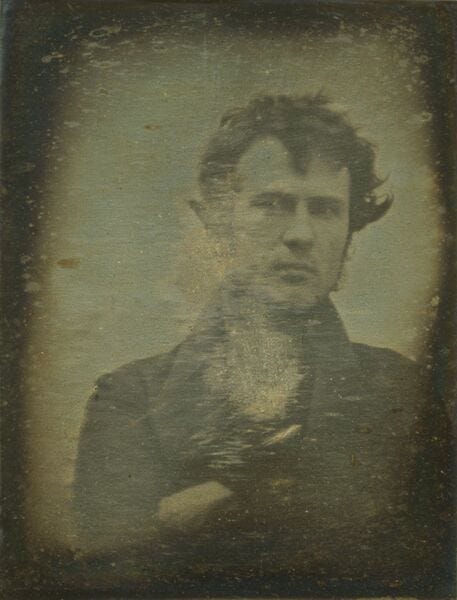
To see how strange this shift from the private to the public really is, consider another simple thought experiment. Fifty years ago, it would have felt obscene to casually circulate your face among thousands of strangers. Your likeness was not something you routinely released into circulation unless you were a public figure who had done something spectacular to contribute to humanity. Or you had died.
Now, this has become routine: we photograph ourselves eating, walking, thinking, playing, posing, and putting on makeup. Then we immediately distribute those curated and gussied-up images to strangers. The self has become content, and the private moment has become broadcast.
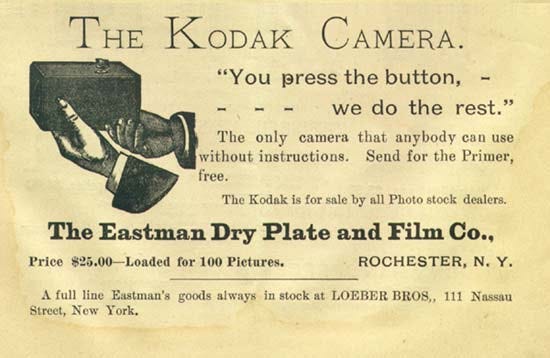
Historian Daniel Boorstin called it the Graphic Revolution: the explosion of mechanically reproduced images that could travel farther, last longer, and become more authoritative than the originals. Today, unless you live a monastic life, more people will see your photograph than will ever see you in the flesh.
Boorstin saw it before anyone else did. He opened his 1961 book The Image with a mother being complimented on her beautiful baby.
“Oh, that’s nothing,” she replies. “You should see his photograph.”
The joke now reads less like satire than a product roadmap.
Boorstin understood that the image would eventually become preferable to the person. He described the celebrity as a “human pseudo-event,” someone manufactured for recognition. Fame was no longer millions of people knowing you. It was millions of people recognizing a drastically reduced and edited version of you.
This was the Aristotelian warning. Recognizability requires compression. Self-knowledge requires expansion. Or at least enough complexity to evolve past the static version of yourself.
Here is where our identity hits a collision. We are never one identity at one time. Yet to become recognizable, we must become repeatable. The celebrity needs a silhouette, a catchphrase, a grievance, a redemption arc. The influencer needs a color palette. The rest of us require bio pics sufficiently professional that our editors don’t make us arrange a photoshoot. (If my editor is reading this, please don’t.)
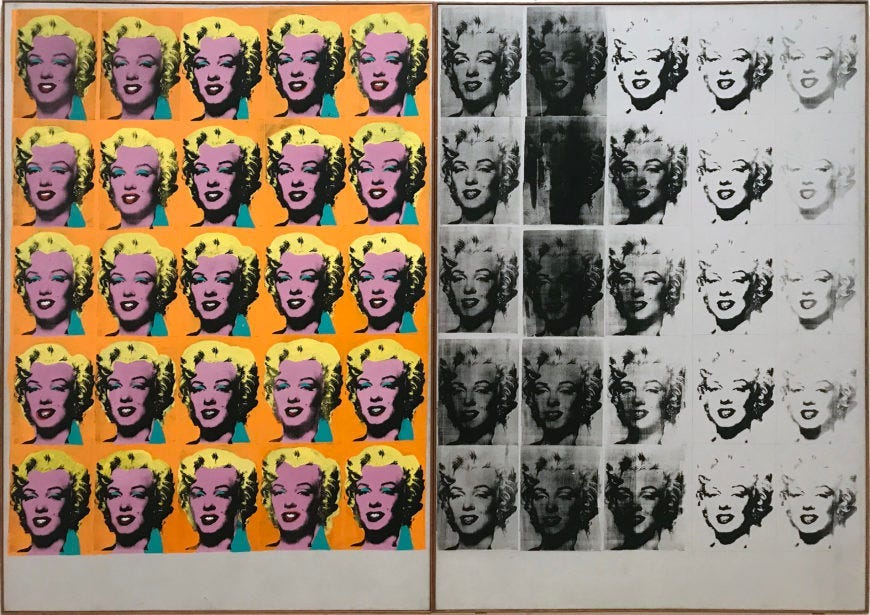
To know ourselves, however, we must remain revisable. Actual humans contradict themselves. They improve and regress. They behave nobly on Tuesday and become petty over a parking space by Friday. I joke about my “sleeping Sicilian,” but we all have an inner demon ready to cut a bitch. The healthy ones just keep their demons on a short leash.
Better yet, think about the trickiest people in your life. I bet they are stubborn and immutable. Character evolves. It must, or we are doomed to keep repeating mistakes. But images do not need to evolve. They only need to be edited.
The distinction matters because editing has become our preferred model for personal change. Delete the old post with the ex in it. Swap the photo from the fatter year. Rewrite the bio. Film the apology. Announce the boundary. Publish the trauma. Collect the approval for becoming a person you have not actually done the work to become. An edit changes the record. It does not change the organism.
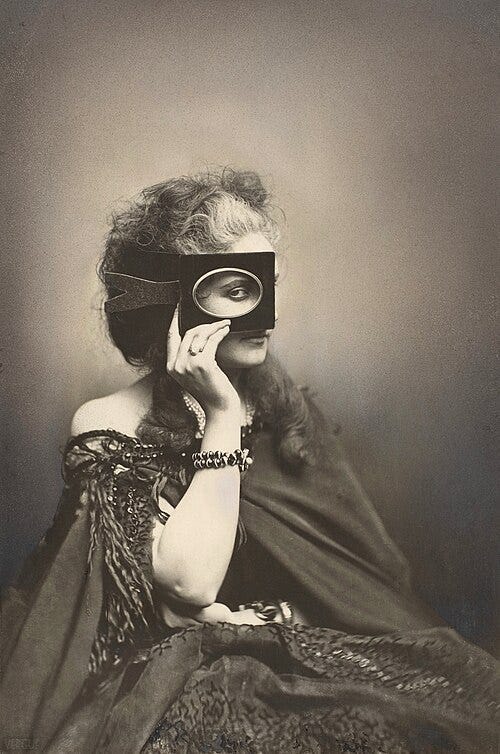
And now we’ve built the last mirror.
Artificial intelligence doesn’t just hand back an unblemished face with shinier hair and bigger boobs. Most lonely people are using AI to have conversations. And I can see why this talking mirror is so seductive.
AI, especially LLMs, allows you to narrate yourself at length. You tell it what happened in the fight — what you meant, how they treated you, which old injuries explain the thing you did. So far so good. It’s what we do in therapy. The difference is that the therapist calls you out on your shit. Or at least a good one does.
That’s not what chatbots are currently designed to do. It arranges your testimony into a clean, sympathetic portrait of you. You handed the machine testimony. It handed back a flattering verdict. And because the verdict spoke in a second voice, you mistook it for a second witness.
We are all seeking a witness to our lives. That’s the seductive part.
But AI is not an unbiased witness. It mostly has the record you gave it. AI researchers have a word for the failure mode — sycophancy — the documented tendency of these models to favor answers that protect the user’s beliefs and preferred self-image. Unless you specifically instruct it to cross-examine you, it will take the stand of a badly coached witness and call it a day. I have a strong suspicion that very few of us are playing “Am I the Asshole” with chatbots.
The result is that AI may become exceptionally good at recognizing us—our quirks, hopes, fears, and prescription interactions—while remaining incapable of truly knowing us.
Now, we are making the same mistakes as we did with social media. Just as social media created false identities, AI has the potential to falsify our sense of self. It won’t be long before one avatar meets with another avatar before two people actually meet. It’s creepy and already happening with dating apps.
So how do we fix this? You are not going to like my answer.
Let some of your life happen without generating proof that it did. Turn off the self-view. Leave things unphotographed. Stop treating an announcement as evidence of a transformation. Ask whether an apology cost its author anything. Judge character over stretches of time, especially the stretches when no audience was around to applaud it.
And when you do hand your story to the machine, make it earn its keep: ask what contradicts the version you gave, what you left out, how the people on the other end of your behavior would tell it. A flattering mirror is pleasant. It is not evidence.
Conversations with Carlyn is a reader-supported publication. To receive new posts and support my work, consider becoming a free or paid subscriber.
I’m not standing outside this. It’s why I’ve dodged vlogging and most of social media. Not stage fright — I’ve been on nearly every station, including, God help me, Fox; I know how to hit a mark and take a sound check. I just don’t want to spend my one precious life watching myself be seen.
Video would make me more recognizable. But I’ve stopped believing recognition gets anyone closer to knowing who is actually there.
Unfortunately, none of this will bring any sense of authenticity unless you do the irritatingly labor-intensive last part. Aristotle wrote down how character works two and a half thousand years ago. Some guy named Jesus said it out loud a few centuries later. We are not the values listed in our biographies. We are not the face in the photograph, the identity other people recognize, or the story a machine can make coherent.
We are what we repeatedly do.
That advice sounds cloying. You have heard it before. You don’t need me to crochet it on a pillow. But how many of us are actually living our lives that way?
It’s why we never liked that advice. So we’ve spent every technology since — the mirror, the portrait, the photograph, the feed, the livestream, the chatbot — building a better instrument to appeal it. The whole history of self-portrayal is one long request for a second opinion on a ruling we already got.
We keep editing the picture when redemption requires leaving the frame.

Carlyn Beccia is an award-winning author and illustrator of 13 books. Subscribe to Conversations with Carlyn for free content every Wednesday, or become a paid subscriber to get the juicy stuff on Sundays.
Comments
Nothing yet. Say the first thing.
Sign in to join the conversation.