
If you enjoyed this article, please share it with a friend or consider becoming a paid subscriber and supporting independent journalism.
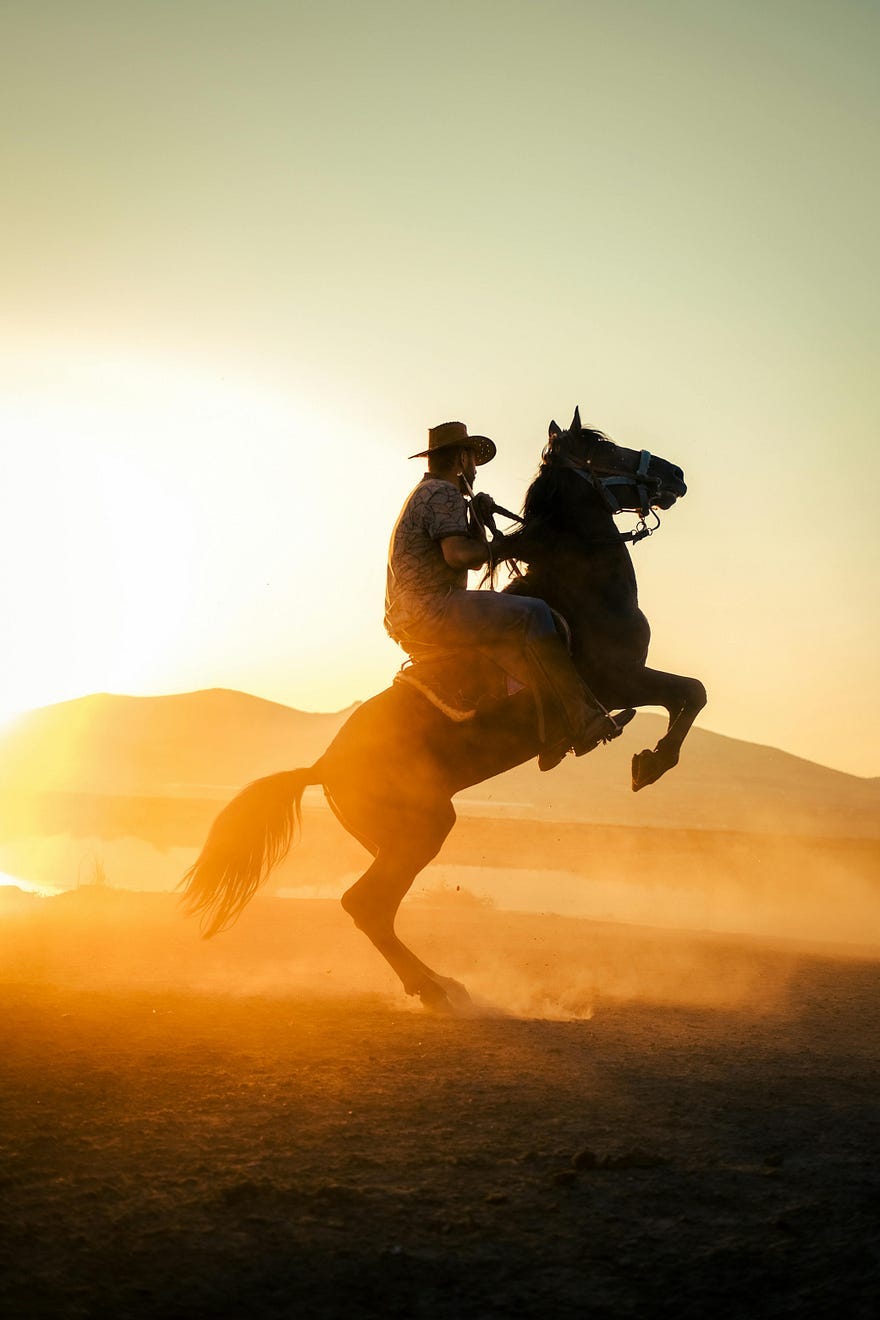
In 2014, a photograph sold at auction for $3.4 million. The photograph was a cowboy on a horse, ruggedly American, the kind of image that moves Marlboros by the carton. The man who sold it was Richard Prince.
The man who took it was Sam Abell, who had shot the original for a Marlboro campaign, been paid his standard advertising rate, and gone home.
Prince rephotographed Abell’s photograph, cropped out the cigarette copy, signed it, and collected roughly four orders of magnitude more than the man who had composed the frame.
This is not a story about theft, though Abell might use a stronger word. It is a story about what the market actually pays for, and it has been the same story for centuries.
In 1917, Marcel Duchamp bought a urinal at a plumbing supply store, signed it “R. Mutt,” and submitted it to an exhibition. The argument was explicit, and the art world has been metabolizing it ever since: the artist does not make, the artist selects. Authorship is curation. Originality is a myth we tell ourselves about acts of recombination.
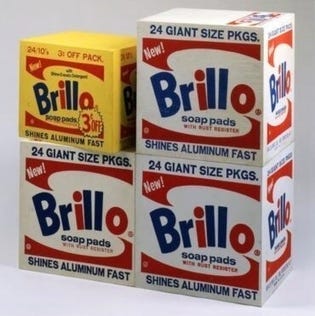
In 1964, Andy Warhol had a carpenter build plywood boxes and silkscreened the Brillo Soap Pad design onto them. The commercial designer who made the original Brillo box, James Harvey, was a working abstract expressionist who reportedly found Warhol’s show funny.
In 1981, Sherrie Levine photographed Walker Evans’s photographs and exhibited them as her own. Same decade, Prince started on the Marlboro ads.
The art world kept publishing the answer. Craft is not the asset. The asset is the authorial gesture — the frame, the claim, the name attached to the object.
Artists kept refusing to hear it, because hearing it meant accepting that the skill they had spent their lives building was never the thing the market was paying for.
Now meet the contemporary Abell. His name is Greg Rutkowski, he is a Polish fantasy illustrator, and for a period in 2022, his name was the single most-used artist prompt on Stable Diffusion. Tens of thousands of images were generated “in the style of Greg Rutkowski” before he knew it was happening.
Where Prince had to physically rephotograph Abell’s cowboy one image at a time, Stable Diffusion ingested Rutkowski’s entire corpus and produced infinite Rutkowski-adjacent outputs at zero marginal cost. Abell got his flat rate. Rutkowski got his name turned into a prompt token. The structure is identical; the scale is industrial.
Which brings us to the advice currently being offered to every young artist and writer in America.
You have seen the posts. The calligraphy hand holding a pencil. The essay about “reclaiming the sacred slowness of the human craft.” The LinkedIn dispatch from a creative director whose company is using AI internally, while telling junior designers and writers not to generate “AI slop.” The Substack piece insisting that audiences will always know, that the human soul shines through, that your authentic vision cannot be replicated by a machine. Cue the campfire jingles.
The advice, in every case, is to boycott. Do not touch AI. Stay pure. The market will reward you for your restraint.
That’s just adorable.
The people giving this advice fall into two camps. The first is the established artists who already made it — the ones whose careers were built in an economy that no longer exists and who feel, understandably, threatened by a technology that makes the ladder they climbed unclimbable for anyone behind them. Their advice is sincere and self-serving at the same time, which is a human condition rather than villainy.
The second camp is more sympathetic. These are the mid-career illustrators, concept artists, and writers whose incomes collapsed in 2023 and 2024, who are watching their rate sheets halve, and their clients substitute prompts for commissions. They are angry and looking for a moral framework that makes their wreckage feel like someone else’s fault.
To be clear, they are not wrong that something pure has been lost. They are wrong that anyone under thirty has the luxury of mourning it. Those losses are real. They are wrong, however, to think that young artists refusing to use AI will save them.
Nothing will save them.
Let me repeat that for the progress apostates at the back of the bus.
Nothing will stop this technology. And it doesn’t matter if the technology produces a new art movement or not, or if the art is better or worse.
What matters is that the industry has moved. Telling students to boycott technology is asking them to take on the cost of the boycott without any of its benefits. Those benefits would require collective action that is not going to happen. There is no creative union, no credentialing body, no certifying authority that can enforce a “human-made” premium. The market will not pay extra for human-made because the market cannot verify human-made, and the market never pays for what it cannot verify.
But the deeper problem with the boycott advice is that it rests on an empirical claim that has not stood up to scrutiny.
The claim is that audiences can tell. That AI art is soulless, that the human hand shines through, that a discerning viewer will always recognize the difference.
This is comforting. It is also, as far as the available evidence goes, complete hogwash.
Don’t shoot the messenger. Look at the research. In 2024, researchers at Western Sydney University ran a study published in Frontiers in Psychology in which they paired fifty lesser-known paintings by famous representational artists with fifty AI-generated images produced in similar styles using DALL·E 2.
Viewers were shown the pairs without attribution and asked which they preferred. They reliably preferred the AI-generated image. When the researchers controlled for art expertise — interest, knowledge of art history, self-rated artistic ability — the correlation with preference and detection accuracy was not statistically significant. The sophisticated art lovers did no better than the naive ones.
The audience preferred the machine.
A 2023 study published in Nature’s Scientific Reports found the mirror image. When viewers were told which images were AI-made and which were human-made, they rated the human-labeled images as more creative, more skillful, more likable, more appropriate for gallery sale — even when the images were, unknown to them, identical. The effect was large and consistent.
The preference for human art is not a perceptual effect. It is a labeling effect. When viewers cannot see the label, they do not prefer the human work. When they can see the label, they penalize the AI work regardless of what it actually looks like.
Put the two studies together, and the implication is devastating. The market premium for human-made art is a branding premium, not a quality premium. The label does the work that the object does not. Which is exactly what Duchamp said in 1917, what Warhol said in 1964, what Prince demonstrated in 1981, and what the art students currently being told “audiences will always know” are about to learn at their own expense.
Michelangelo would not be surprised by any of this.
The patron saint of craft, the man who spent four years lying on scaffolding until his eyes could no longer focus, wrote to his family that the Sistine commission was ruining him. Vasari recorded the physical toll in detail: Michelangelo could no longer read letters or look at drawings without tilting his head backward, a condition that persisted for months after he climbed down. He slept in his clothes. In his old age, he wore boots made of dog skin for months at a time; when he finally removed them, his skin came off with the leather. This is the man whose apprenticeship every craft-defender implicitly invokes.
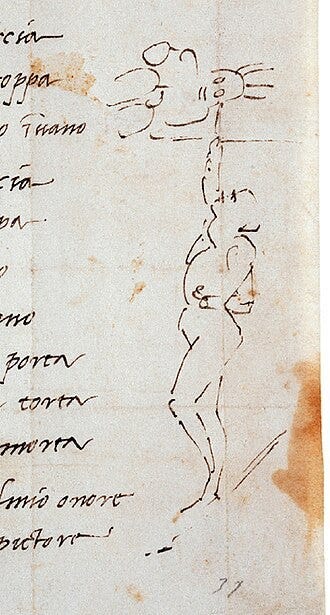
He knew. Vasari records him saying that “it is necessary to keep one’s compass in one’s eyes and not in the hand, for the hands execute, but the eye judges.”
Translation: The greatest practitioner of craft in the Western canon did not believe craft was the point. He believed the hand served the eye. He believed what the four-year suffering produced was not the ceiling, but the judgment behind the ceiling, and the judgment was where art lived.
The craft was the tuition. The eye was the job.
He also knew what the studies painfully prove: that what he poured into the ceiling and what the audience received from it were not the same thing. He understood, in 1508, that the viewer standing below had no access to the scaffolding years. The viewer had access to the ceiling. The ceiling was the object. The four years were private. The gap between making and reception was a fact of his working life, and it made him bitter, and he wrote it down, and the craft-defenders five hundred years later want to pretend he didn’t.
First: learn your craft with the ferocity of Michelangelo on a bad day. Not because craft will pay. It will not pay. Learn your craft because the eye is built by the hand. The artist who has drawn ten thousand bad hands before she touches a prompt will wield AI differently than the artist who started with prompts.
The difference will not be visible in any single image. It will be visible in the body of work, the signature across outputs, the taste that selects from twenty AI generations the one that is worth keeping. Craft is the apprenticeship of the eye. The eye is what wields every tool that comes after.
Second: use AI. Every day. Use it with the intensity of someone who understands that fluency is not a moral compromise but a baseline professional competence. The artists and writers telling you “don’t use AI” are telling you to enter the 2026 economy wielding the instruments of 1998. Don’t listen to them.
This is the advice I have failed to take myself for the last four years. Learn from my mistakes.
Third: build an audience, not a portfolio. A portfolio was the right unit for an economy that paid art directors to look at portfolios. An audience is the right unit for an economy that pays for the authorial claim, and the authorial claim requires a public that recognizes the name.
Substack, Medium, YouTube, direct relationships with readers — these are not marketing activities tacked on to the real work. They are half of the real work. The authorial gesture does not exist in a vacuum. It requires a “you” that the audience already knows.
And finally, the thing the boycott advice is really about: do not inherit the refusal. The people telling young artists to stay pure are not evil. They are scared, or tired, or built on a theory of value that the market has already abandoned, or all three.
Their advice is sincere. It is also the same advice every generation of craft-based artists has received during every technological transition since the power loom, and the artists who took it have, every time, been the ones who lost. The hand-weavers were right that something had been lost. They were wrong that the market would keep paying for it. The painters who dismissed photography in 1839 were right that something had been lost. They were wrong about what survived.
Be a Prince, not an Abell.
The instruction is ugly, and it sounds cynical, but it has been the correct instruction for centuries. Duchamp told you. Warhol showed you. Prince rubbed your face in it. The studies have now measured it. Michelangelo, bent and ruined on his scaffolding, wrote it down before any of them.
Use AI. Learn your craft. Teach your hand so your eye can see what the world cannot.

Carlyn Beccia is an award-winning author and illustrator of 13 books. Subscribe to Conversations with Carlyn for free content every Wednesday, or become a paid subscriber to get the juicy stuff on Sundays.
No posts
Comments
Nothing yet. Say the first thing.
Sign in to join the conversation.