
If you enjoyed this article, please share it with a friend or consider becoming a paid subscriber and supporting independent journalism.
Sometime in late 2024, a never-before-heard Michael Jackson song began circulating on social media. The song was titled “Palestine, Don’t Cry.” In 1993, Michael was returning from a concert in Tel Aviv, Israel, when he scribbled the lyrics on the plane.
He had intended the song for HIStory — his 1995 double album, the most politically raw thing he had ever made. The album that picked fights no one could win.
Michael Jackson never recorded the song.
Here is the thing about Michael Jackson: he did not abandon the most vulnerable. He was not, despite the high-pitched voice and gentle demeanor, a pushover. And he certainly did not suffer fools gladly.
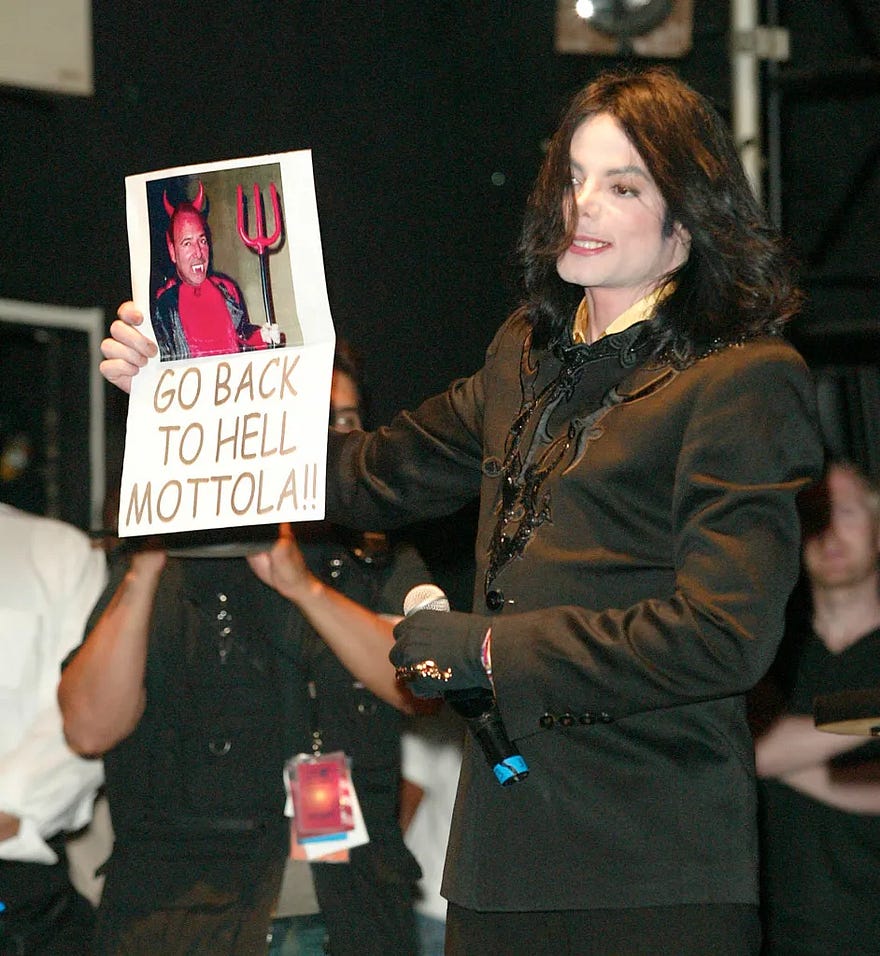
Case in point. In 2002, Michael Jackson stood on a stage in Harlem at Reverend Al Sharpton’s National Action Network and called Tommy Mottola, chairman of Sony Music — the most powerful record executive on earth, the man who controlled his entire catalog — a “devil” and a “racist.”
He didn’t just say it. He showed up with a hand-drawn poster of Mottola’s face, with literal devil horns sharpied in, and wrote in all-caps “Go Back To Hell Mottola.”
America laughed at Michael Jackson for two weeks. Every late night host ran bits about it. The press called it a meltdown, and Michael was dismissed as a celebrity unraveling in public.
Maybe he wasn’t unraveling. Maybe he was warning us.
And perhaps Michael had his reasons. Tommy Mottola was besties with Jeffrey Epstein, and his name appears more than 1,000 times in the Epstein files. (Mottola denies any allegations of sexual misconduct.)
Either way, it’s not hard to see why Michael was tired of the circus. By the time HIStory arrived in record stores in the summer of 1995, Michael had already survived things that would have ended lesser men. The unproven sexual abuse charges. The settlement. The tabloids that had decided, with extraordinary efficiency, that the most famous person on earth was also the most dangerous. He had endured all of it.
And then he walked into the studio and made the angriest album of his career.
Michael didn’t quietly swallow his convictions. On the very album that was supposed to include “Palestine, Don’t Cry,” he included a protest song called “They Don’t Care About Us.”
Let’s just say that the song got him in a lot of hot water. Buried inside it were two lines that detonated the day before HIStory hit record stores. Brace yourself…it’s bad.
“Jew me, sue me / kick me, kike me / don’t you black or white me.”
Make no mistake. The lyrics sit like a dead fish on their own. Jackson’s argument was that you can’t take one line out of the song because the context changes the meaning. The jury is still out on whether context is enough. But it’s safe to say that you don’t want kids chanting those lyrics on the playground.
The New York Times flagged the lyrics on June 15, 1995 — one day before the album’s release. The ADL issued a statement declaring Jackson had “an anti-Semitic streak.” Abraham Foxman, the ADL’s national director, went further, saying “every time he has a problem in his life, he blames the Jews.” The Simon Wiesenthal Center piled on. The cancel machinery clicked into place.
Jackson did not flinch. He went on television and said the song was about the pain of prejudice — that he was the voice of the accused, the attacked, the skinhead, and the Jew and the Black man simultaneously. His label called the lyrics “brilliant.” Spike Lee pointed out the double standard publicly — that The Notorious B.I.G. used the n-word on the same album and nobody said a word.
When Michael was asked to cut the lyrics, Dan Beck, an executive at Epic Records, claimed that Michael was so furious that he “trashed the studio,” throwing chairs.
Michael eventually agreed to re-record the song. He replaced “Jew me” with “do me” and “kike me” with “strike me,” but only after exhausting every other option.
Then he wrote a personal letter to Rabbi Marvin Hier at the Wiesenthal Center. Michael apologized to anyone who had been hurt, while insisting his intention had been solidarity, not attack.
He bled for that song. Publicly. On purpose. For eight days straight.
But here’s the part that doesn’t make sense. Two years earlier, on that same flight home from Tel Aviv, he had written something far more explicitly political. In “Palestine, Don’t Cry,” he certainly threw his share of punches. He named specific aggressors, a specific place, and a specific injustice.
The final line of the song: “I will die for you, Palestine.”
So the question isn’t why Michael Jackson wrote, “Palestine, Don’t Cry.” That part makes complete sense. The question is, why didn’t he finish it? Why did the most famous, most stubborn, most politically minded, cause-obsessed artist of the twentieth century let this particular song disappear without a fight?
Or more precisely: who, or what, made sure the song disappeared.
The lyric sheet for “Palestine, Don’t Cry” surfaced at auction in 2014. It sold for $600.
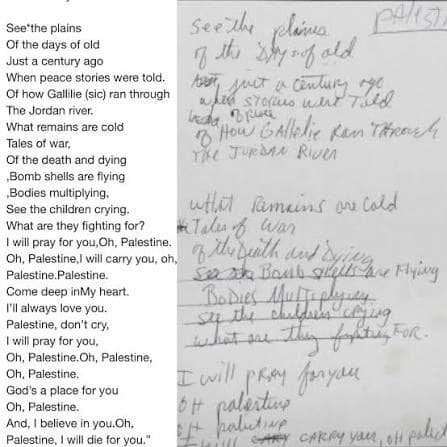
Six hundred dollars. For two pages of handwriting from the most famous recording artist who ever lived, about the most argued-over conflict on earth. The hammer came down, and that was that.
It sat in someone’s collection for nine more years. Then October 7th happened. Then Gaza happened. Then a French creator named Stéphane Desmoulin fed the lyrics into AI and asked it to imagine what Michael might have sounded like if he had been allowed to finish the thought.
Desmoulin didn’t profit from it. He didn’t claim credit for something he hadn’t done. He labeled it clearly — “Fanmade with AI” — and posted it on YouTube. He just thought the song deserved to exist. So in the absence of an industry willing to finish what Michael started, a stranger on the internet did it instead.
I would like to imagine that Michael would have found the reimagined song deeply moving. I can picture him demurring like he always did when the music stopped, and the spotlight shone too brightly on him. “Oh, you guys shouldn’t have.” Then he would have blushed, put a hand to his heart, and thanked his fans with the kind of raw sincerity that makes sincerity contagious.
But once the moment passed, Michael would have done what Michael always did. He would have reminded us, gently but without flinching, why the song existed in the first place.
That while we were moved by the music, children in Gaza were being pulled from rubble by their fathers’ bare hands. That they were dying of thirst within sight of the Mediterranean. That starvation was being used as a military strategy against a civilian population, and the world was still debating whether to call it what it was.
Michael knew what it was in 1993. He wrote it down at 60,000 feet.
We don’t know exactly what Michael saw on that trip to Israel. We don’t know which image broke through — whether it was a photograph, a conversation, a hungry child glimpsed from a car window. We only know that something crossed the threshold from awareness into necessity.
Every artist knows that crossroads. It arrives without warning, and it does not negotiate. It says: You have seen this. Now, you cannot unsee it. The question is whether you will say “no more.”
Michael said no more in the only way he knew how.
Because Palestinian children were dying. They are still dying. Of bombs. Of hunger. Of the specific cruelty of a world that has decided their lives are an acceptable cost of something. And there is a moment when you are standing in front of your own reflection, and the question is no longer about them.
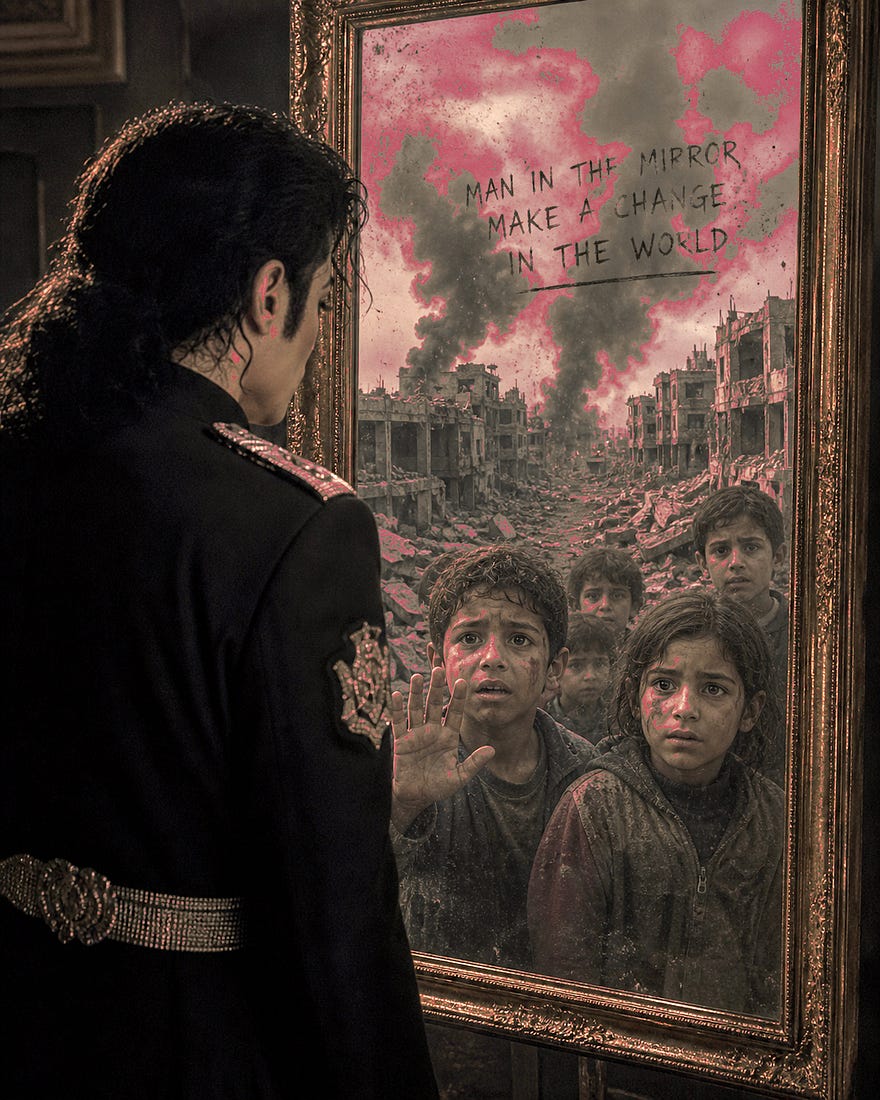
It is about you. Can you look in the mirror and do nothing?
Michael had already written that question into one of the most recognizable songs of his career: I’m starting with the man in the mirror. I’m asking him to change his ways. He wasn’t being metaphorical. He meant it as instruction. For himself. For us.
Is the song perfect? No, there are parts that don’t sound like Michael. AI can never replace a human artist. That’s not the point.
The point is that the children Michael wrote about are still there. Different children. Same sky. Same silence from the people who are supposed to speak.
We can’t look away any longer. We can’t.
Palestine, Don’t Cry. We should be the ones crying now.

Carlyn Beccia is an award-winning author and illustrator of 13 books. Subscribe to Conversations with Carlyn for free content every Wednesday, or become a paid subscriber to get the juicy stuff on Sundays.
No posts
Comments
Nothing yet. Say the first thing.
Sign in to join the conversation.