
One of the most common questions I receive about our particular approach to home education is how she’s going to learn to read and write without tuition.
Well… I actually planned for her to not even think about reading and writing until she was much older.
This is something I feel quite strongly about. We as modern humans view being ‘illiterate’ as something terrible to be countered at all costs. And as an avid, obsessive reader I can agree with this. Reading is such a blessing and I wouldn’t be without it nor would I want my daughter to not be able to read. But something we forget is that literacy is a modern concept. For most of human history we were illiterate. Information was shared through the generations orally, stories travelled down ancestral lines round the fire, our brains were capable of holding so much more.
Literacy is a feature of domestication.
Literacy changes the brain.
When we start to write things down, store them in writing and spend time reading. Something is changed, you could even say lost.
Tyson Yunkaporta, Australian academic, author and indigenous thinker, shared in his book 'Sand Talk’ that there’s a part of the brain called the ‘nucleus basalis’ which we’re told starts to shrink when we’re around seven years of age. Tyson shares, ‘this is the part of the brain that makes learning so effortless for children and is always activated in undomesticated humans.’ It has been shown that this part of the brain begins to fall into disuse after three or four years of schooling, when children are schooled out of their innate desire to be immersed in focused play and fantasy worlds.
The Scandinavians know this. There children play outdoors (in all weathers) for the vast majority of the day until they are seven or eight. No literacy is taught. Yet all Scandinavian children learn to read and in fact they have the highest rate of literacy in the world.
How do they learn?
This is the part that for me so far has been theoretical but is now showing itself to be demonstrably true.
Children learn to read because they want to and because they see us doing it and they are entirely capable of learning without teaching. In fact children learn far better without teaching.
A quote from my daughter age three: ‘I like learning things myself, being teached is disgusting’.
No enforced literacy does not mean no reading. In fact this approach to home education or education generally allows for huge amounts of time reading as many unschooled parents are not at all worried about teaching anything, simply following the things their children enjoy and many children will want to be read to for hours given the chance.
So my intention was no literacy before eight but my intention is also to follow her interests and she’s always been incredibly interested in words. Even as a small baby she quickly learned what letters were and would point and say ‘b’ when she saw them.
Words are a big deal in our house, her dad and I both write, we read a lot and we love language and literature. It was inevitable that she was going to want to join in.
Not enforcing literacy doesn’t mean not allowing her to learn for herself and offering support, encouragement and resources along the way. But I very clearly stated to all involved in her education and development that I did not want to buy literacy or numeracy workbooks. I didn’t want anything so explicit. Rather I wanted her to choose what she wanted to do with her time, follow her own interests and if it involved writing then it would be a ‘living book’ or similar. Something meaningful not just learning for the sake of learning.
And of course she has shown me over and again that she is obsessed with reading words and trying to write them. The first time she encountered a nature activity book she was obsessed and would spend two hours at a time working through it intensely.
She has been teaching herself to read and write because she wants to not because she needs to meet a particular milestone by a particular point otherwise her teacher (and her) will be deemed a failure. She is free to experiment, try, give up and come back as she feels called. There is no pressure and as such her interest has sky rocketed.
Everything my daughter has learned so far she has learned through observing, trying and asking questions where needed.
She was out of nappies before two because she was obsessed with using the toilet like us. I didn’t do anything at all except stay out of the way, let her be naked all of the time at home and clean up a few accidents. She can’t bear not being able to join in fully using the same tools as us in all areas of life and will try and try until she can achieve tasks as we do.
And this is how it has been with writing.
She will sit next to me when I write lists and ‘write’ her own lists copying my faster joined up letters with her own letter-like scribbles.
She will write notes to her friends as I write letters to mine.
She will sit and pore over books until she discovers letters and words she recognises and then excitedly run up to me and read them.
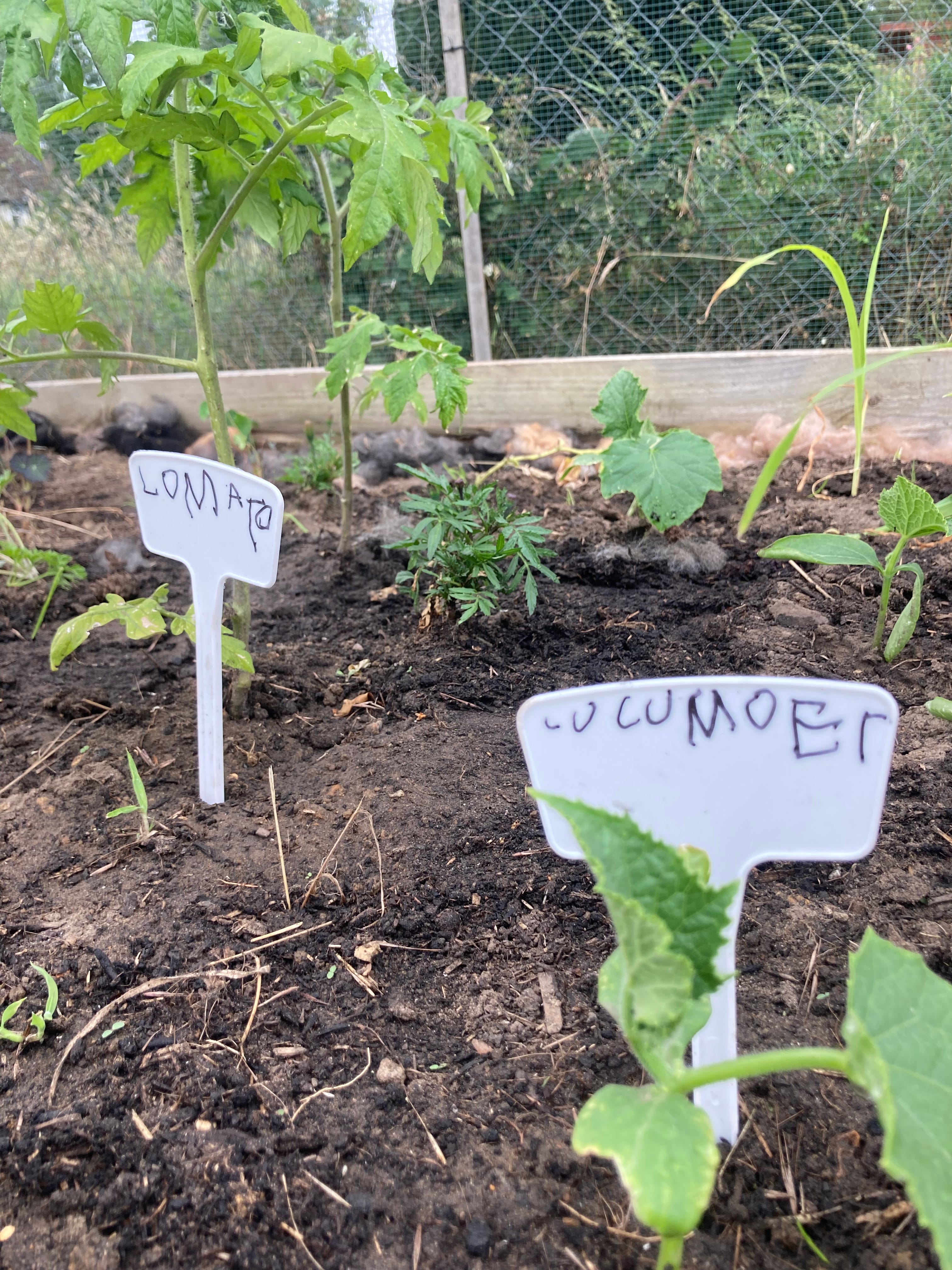
She wanted to write the labels for the vegetables in our vegetable garden.
She wants to sign her name in cards to family.
The milestones happen very suddenly and out of nowhere.
One day she shouted, ‘I just read Eso’ and I realised she had read the ‘Esso’ sign at the petrol station (how funny that this was her first read word).
This week she wrote a whole host of three letter words in her notebook. I was baking and she was sat on the floor ‘writing’ and then suddenly she was writing. ‘Hot cod’ was her first set of words followed by mat, rat, dog and cat. She then wanted to learn how to write hot choc so we did it together.
This is how our version of home education words. We both go about our days doing the things we need to do and enjoy doing and if she asks me to help with something I do and if she shows an interest in something I provide resources and opportunities.
So now when people ask me how she will learn without being taught I feel confident in my answer.
Because children are insatiable learners when given the chance.
Carly x
No posts
Comments
Nothing yet. Say the first thing.
Sign in to join the conversation.