
Amid the smell of garbage stewing in 100-degree heat, something else moved through New York this June: great vibes. The Knicks won it all for the first time since 1973. The mayor jumped into a pool in his signature suit. Fans stepped off the sidelines to spin up their own merch and apps in real time.
Blink and you missed it. The bootlegs vanished before the parade route was swept. Anthropic’s most capable model launched, got hit with an export‑control order, went dark, then redeployed. Things are shipping fast, then being revised, remixed, and reissued just as quickly. Fans created alongside the moment, platforms iterated in public, and AI turned every moment into a prompt. Let’s get into it.
The Knicks’ first NBA championship since 1973 didn’t just unleash good vibes, it kicked off a wave of unofficial collabs from New York’s most online and most creative. Fans vibe‑coded apps that compiled footage of people watching the games, composited images out of Knicks photos, walked you through the city the night the team won, and aggregated fan-made merch under the banner “Knick‑Knacks.” Folding tables at Fulton, Canal, FiDi, and Seventh Ave hawked screenprinted bootlegs, many designed with AI. City institutions joined in: DOT had its own tribute, and New York City’s First Lady Rama Duwaji sported an upcycled Knicks T-shirt dress by Miss Claire Sullivan to the ticker-tape parade.
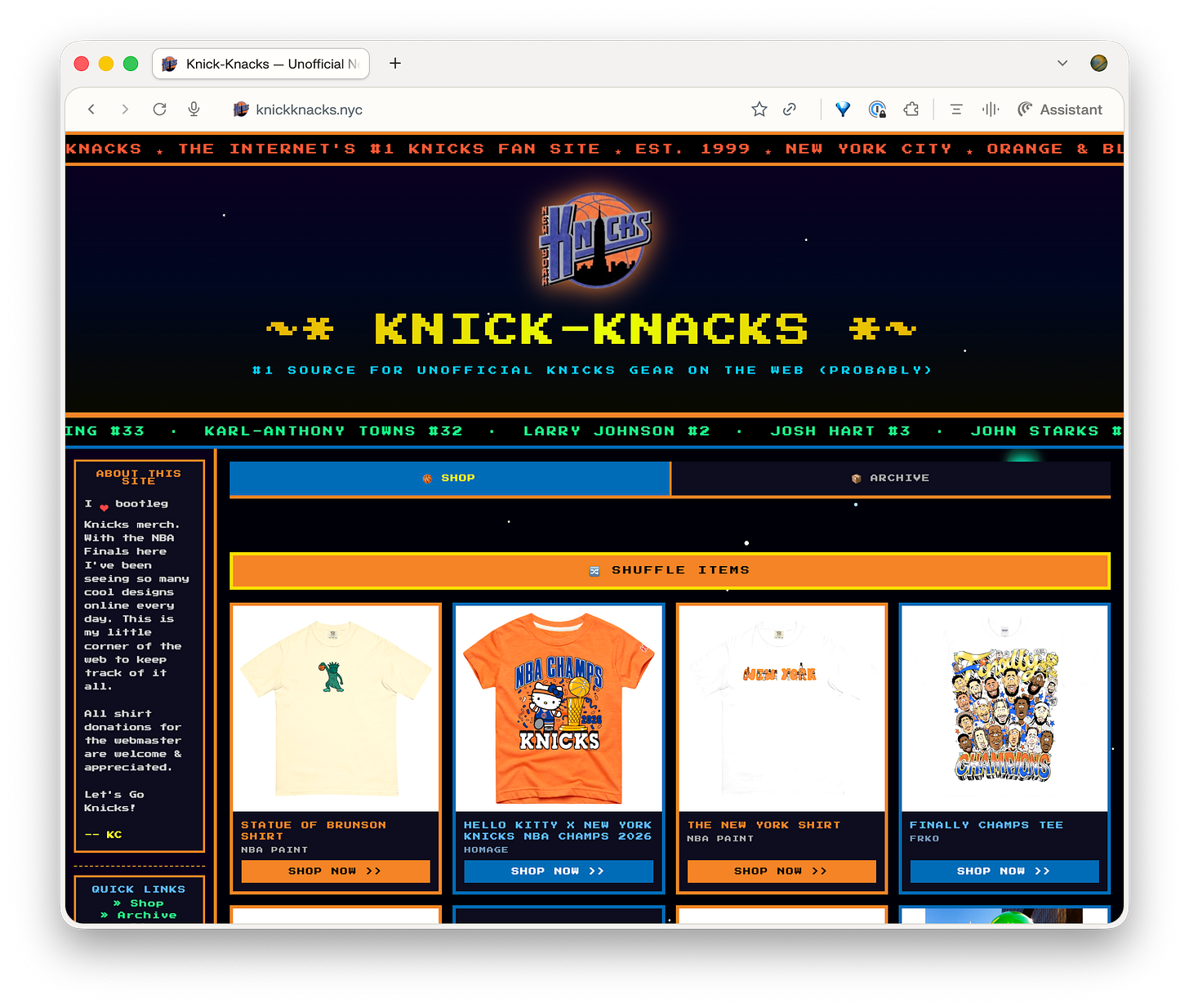
All of it happened in a New York minute: by the time I drafted this, Knick-Knacks had been wiped of bootlegs and MSG was flipped to a wedding hall. The speed is enough to give anyone whiplash, and highlights how compressed these cycles have become. Creation shifts—from what Reggie James describes as “deterministic vision” (“I have this idea about the world, therefore I code the thing”) to a reflexive environment where “this just happened” triggers a prompt and a response. Fans no longer content to just cheer from the sidelines, ship in parallel with the moment.
June was conference season for designers: NY Tech Week, WWDC, and Config, each trying to answer what design’s job is in an AI world. NY Tech Week (June 1–7) was the biggest yet—1.5k+ events, 50k+ attendees, and a dedicated gossip line. The sprawl led to people begging for access to a handful of higher‑touch dinners and salons. NYC Vibe Directory kept track of the city’s vibe‑coded apps and experiments online.
At WWDC (June 8), Apple tried to bring order back to the interface layer. The company shipped a Liquid Glass transparency slider, sharper icons, and contrast tweaks framed as routine “bold leap, then iteration,” while introducing Siri AI as a conversational, screen‑aware assistant with its own app in Tim Cook’s final WWDC keynote. It read as a user‑control, AI‑first course correction: a beta‑era design system getting dialed back just as the assistant gets pushed deeper into the stack.

signüll@signulll
in today's keynote, apple produced this really interesting graphic that ironically outlines the core mechanics for a new type of operating system (for perhaps a new class of devices). you can see how this moves the world from an app based ecosystem to an intent centric world.

10:26 PM · Jun 8, 2026 · 166K Views
114 Replies · 181 Reposts · 2.22K Likes
Two weeks later, Figma CEO Dylan Field opened Config (June 23–25) by saying that “AI has lowered the floor, but it has not raised the ceiling,” announcing features that attempt to close that gap: code layers, native motion, shader fills, prompt‑built plugins, and a more capable Figma agent. The viral moment—pulling up the brat album cover file live on stage—played as a reminder that the real flex is still taste.

★@mira__joyce
i don't believe he made the brat cover like that
6:20 AM · Jun 26, 2026 · 58.5K Views
8 Replies · 7 Reposts · 886 Likes
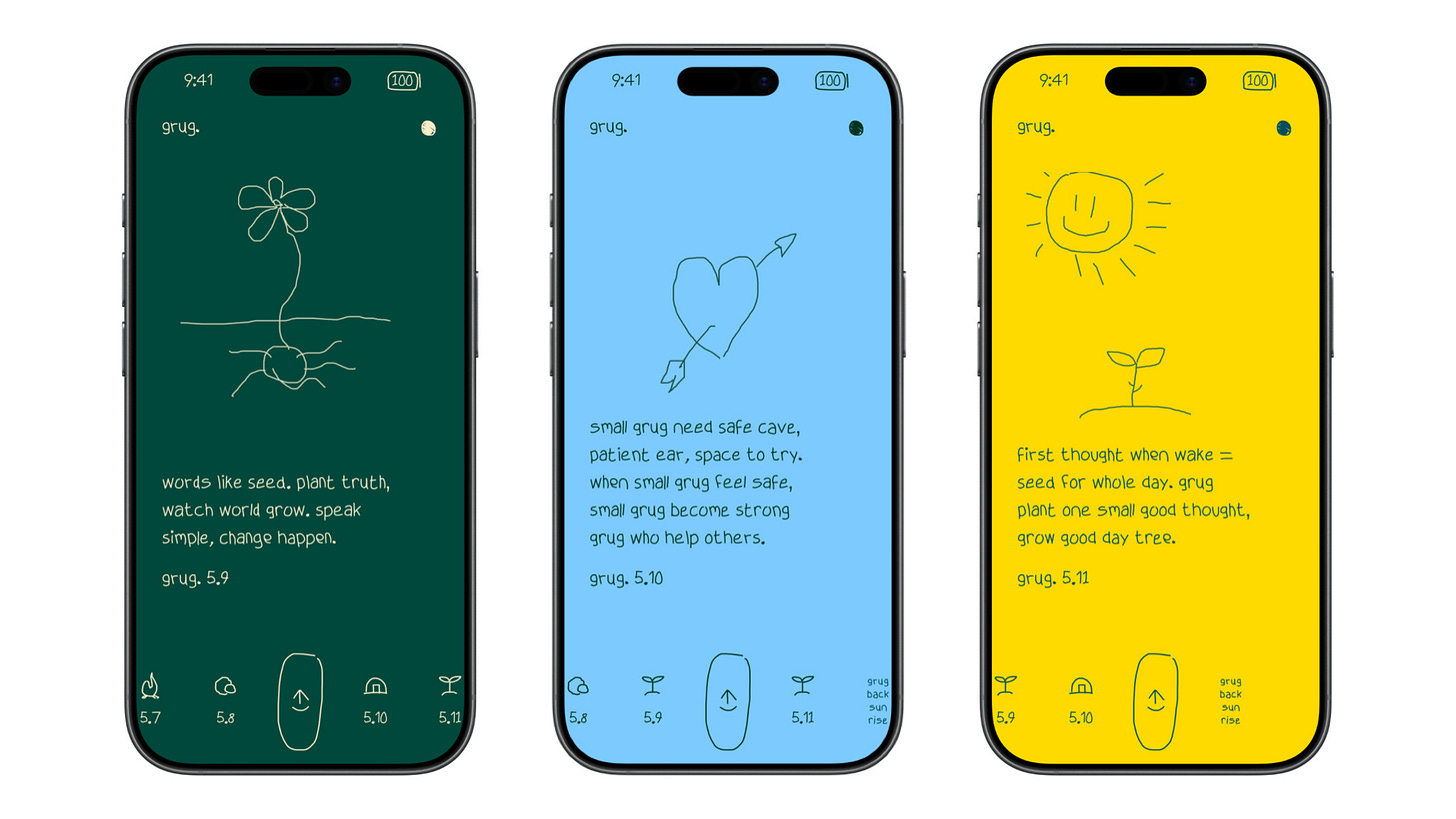
Apple named grug, a hand-drawn “daily wisdom” app from two-person studio Ocho, its 2026 Apple Design Award winner for Fun & Delight. Jip van der Velde and Michel Elings wrote the code using Codex and designed a rendering engine that swaps in hand-drawn lettering across the app. Jip credited Codex with lowering the cost of following an idea that would have otherwise died at the mockup stage: “Now designers like us can build the fun little things. Designers like us can ship the crazy ideas. Designers like us can make unreasonable little things and see if the world cares.” So, go make the weird thing.
Anthropic’s launch of Claude Design, a conversational canvas for generating prototypes, decks, and one‑pagers, already has a recognizable house style: beige‑cream canvases, rust‑red accents, tracked‑out serif subheds, rounded nested cards, and ticker bars. Once you see it, you see it everywhere: identical pitch decks, class slides, and SaaS landing pages—polished, competent, and oddly familiar, the visual equivalent of AI prose with an “it’s not X, but Y” construction.

lucas gelfond@gucaslelfond
once you notice claude design websites you will see them everywhere

Joseph Alessio @alessio_joseph
POV you used claude design
12:12 AM · Jun 5, 2026 · 345K Views
62 Replies · 181 Reposts · 3.16K Likes
Writer and product leader Hilary Gridley predicts that today’s AI artifacts will read as slop once the pattern becomes obvious, revealing a double skill issue: taste to recognize when your work looks obviously AI, and the prompting chops to steer the model off its defaults. Others shrug that Claude Design is still an improvement over most Dribbble and Webflow slop, raising the floor so good designers stand out. As designer Itay Dreyfus puts it, the sameness is a mirror: “These are the aesthetics we’ve been maintaining for years. Thus this is what the model throws out.” Claude Design isn’t inventing homogeneity so much as bottling it, which means your job now is knowing when “good enough” stop being enough, and when the whole thing still smells unmistakably like AI.
Anthropic launched Claude Fable 5 as the safe, public-facing version of its Mythos-class model, reserving Mythos 5 for vetted defensive cybersecurity partners. Three days later, the U.S. government ordered Anthropic to suspend access to any foreign national, including Anthropic employees. This was after Amazon researchers reportedly demonstrated a jailbreak that used “fix this code” prompts to surface security‑relevant vulnerabilities. Because there was no practical way to segment foreign users from everyone else, Anthropic turned both models off worldwide, then began restoring access 19 days later after curbs were lifted and new safeguards agreed.
June brought two glasses launches. Meta Glasses, starting at $299, are camera‑and‑speaker frames with Meta AI baked in, developed with EssilorLuxottica and rolled out like a fashion drop: Kylie Jenner and Peggy Gou in the campaign, style‑first messaging from Mark Zuckerberg, and a Q&A on Feed Me. Snap’s $2,195 Specs, unveiled at AWE USA, are AR glasses: dual waveguides, dual Snapdragon chips, gesture control, on‑device AI, and a 51° field of view, pitched as Snap’s first consumer spatial computer and a bet on a post‑smartphone future.

SouthernValue@SouthernValue95
Zuck just completely glass-mogged Evan Spiegel $META $SNAP

SouthernValue @SouthernValue95
@Meta glasses by @KylieJenner
8:31 PM · Jun 23, 2026 · 113K Views
11 Replies · 5 Reposts · 222 Likes
Investors and posters collapsed the distinction. Snap’s shares slid after the reveal, it was declared that “Zuck glass‑mogged Evan,” and—to add insult to injury—the SNAP CEO had to log on to defend his ear shape. Meanwhile, another wave of commentary labeled the frames “perv” and “predator glasses,” and criticized beloved creatives like Laila Gohar for helping normalize near‑invisible cameras in everyday life.

Charlie Warzel@cwarzel
instant classic

9:31 PM · Jun 16, 2026 · 701K Views
144 Replies · 457 Reposts · 12.2K Likes
OpenAI ships the ability to build and publish web apps in ChatGPT.
Meta morale is low: CTO Andrew Bozworth called the company’s AI-division messaging “atrocious,” and promised to fix it with better comms.
A JPMorgan Chase exec was fired after a viral video showed her stealing Knicks-colored trash can during the championship parade. Hot takes abound.
Poke gets Apple’s approval to text, opening a new front for AI in your inbox.
Intercept, a $500M fund backed by Stripe, Anthropic, the OpenAI Foundation, Bill Gates, and others aims to eliminate colds, flu, and RSV.
A software engineer won a religious exemption from using AI at work.
Jason Yuan launches Hivemind, a “social intelligence.” (Blackletter is so back.)
Rick Rubin did a Polymarket ad…. why?
RIP David Hockney, Om Malik, Mitch Paone. Legends.
Marcin Wichary on the history of finger-friendly interaction design.
Are lines the new third place? Rachel Janfaza on why we’re all waiting in them.
Knicks logo designer Michael Doret shares his favorite rejects.
To All the Folks Who Are About to Be Rich, by Julie Zhuo.
Defining Taste by Mitchell Hashimoto, a good essay on an overdone topic.
Neal made a site that turns Wikipedia objects into endless I Spy.
Nick Catucci launches RiffPost, a blog for people over 38.
Are you in the weights? Thomas Dimson and Joey Flynn built a tool to find out.
Work with the talented Natasha at Simile AI! They’re hiring a deployment strategist, video game designer, and engineers.
Cursor is hiring design engineers.
A stealth AI company is hiring a designer to champion quality and craft.
Notion is hiring IC designers. Must “enjoy being silly.”
Apple is looking for a remote contract copyeditor.
MrBeast is hiring a Brand Manager, Creative Director, Design Engineer, more.
Greta at Dirt is looking for essays on culture, rates start at $400.
Kyle Chayka is looking for emerging writers to share links and observations on culture, taste, new media, tech for his newsletter, One Thing.
Asterisk magazine is accepting pitches for Issue 16 through the end of July.
And more design jobs: jobs.designerfund.com
Short feedback loops: moments triggering prompts, launches triggering rollbacks, and a growing premium on human taste and pacing—knowing when to ship, when to pull back, and when something reads as “too AI.” What’d I miss? Let me know.
—Carly
Comments
Nothing yet. Say the first thing.
Sign in to join the conversation.