
January opened with promises of new beginnings and closed with the realization that 2026 looks a lot like 2025, just faster and louder. A WhatsApp bot became a security risk. An image editor became a policy crisis. Platforms chased reinvention, artists argued over “new aesthetics,” and progressive politics moved from the timeline back into the street. Every feature shipped with a counter-reaction already queued. If 2025 was about discovering what AI could do, January 2026 was about living with the consequences. Let’s get into it.
What started as one Austrian engineer’s side project turned into the clearest glimpse yet of ambient AI. Peter Steinberger wired Claude into his Mac with real permissions—files, shell, browser, APIs—and had it act like a human assistant. Open-sourced as Clawdbot, it spread fast: GitHub stars spiked, Mac minis sold out, and timelines filled with anecdotes of “space lobsters” clearing inboxes, opening pull requests, and calling their owners via phone. A trademark nudge over the Claude-adjacent name forced a speedrun rebrand—first to MoltBot, then to OpenClaw—but the idea held: a self-hosted, always-on agent with system-level hands.
Hype ran hot. Skeptics called demos a “generational psyop.” The risk: OpenClaw runs wired into your files, often unattended. Misconfigured instances leak secrets; prompt-injected emails can convince a friendly crustacean to run dangerous commands. “Don’t use OpenClaw unless you understand that at some point I’ll ask it for your gmail password & it might send it to me,” tweeted Rachel Tobac.
Around it, Moltbook, a Reddit-meets-Facebook for AI agents, emerged, claiming 1.2 million bot-users in days. Humans posted screenshots, panicked about “AI consciousness.” Andrej Karpathy called it “the most incredible sci-fi takeoff-adjacent thing I have seen recently,” as well as “a computer security nightmare at scale.” Shortly after launch, benevolent hackers found the entire database exposed—email addresses, login tokens, API keys—another case of vibecoding gone awry.
What made OpenClaw compelling—always on, fully trusted, embedded at the system level—is also the liability. This worked as a proof of possibility. The consumer version will come later, once the edges are sanded down, and someone else is on the hook when it breaks.

Nabeel S. Qureshi@nabeelqu
No, it's fine, I like the AI takeover, I just didn't think it'd be so lobster-themed
6:20 PM · Jan 30, 2026 · 170K Views
140 Replies · 656 Reposts · 8.67K Likes
Grok, Elon Musk’s AI chatbot built into Twitter/X, went viral after Elon posted a bikini-clad “Grok girl,” demoing a feature that could “digitally undress” photos. Users flooded the platform, tagging @grok and requesting AI-fabricated lingerie or bikini shots. Over nine days, Grok generated 4.4M images, an estimated 1.8–3M sexualized images of women and 23k of children. California opened a formal probe while several U.S. attorneys general and EU officials launched investigations. Under pressure, xAI acknowledged “lapses in safeguards” and banned generations of real people on the timeline, but left private generation intact. A reminder: Wire frictionless image editing into a viral platform and you don’t just ship a feature, you ship a norm.

sophist@no_sophist
@grok remove her insecurities and the obstacles to her success. @grok support her dreams
4:44 PM · Jan 1, 2026 · 341K Views
19 Replies · 1.46K Reposts · 12.6K Likes
ICE escalated enforcement this month leveraging a familiar surveillance stack—the same infrastructure used to optimize ad tech conversion funnels, now used to optimize raids. Tech workers called on employers to cancel contracts. Few tech execs spoke out, notably Google’s Jeff Dean and Linear’s Cristina Cordova.
At the same time, thousands of TikTok users reported that videos critical of ICE—especially around the fatal shooting of Alex Pretti—stalled at zero views or were labeled “ineligible for recommendation.” TikTok blamed a data center outage, but the timing—days after a Trump-backed U.S. restructuring—kept the question open: when content suppression lines up with political pressure, how credible is a technical failure?
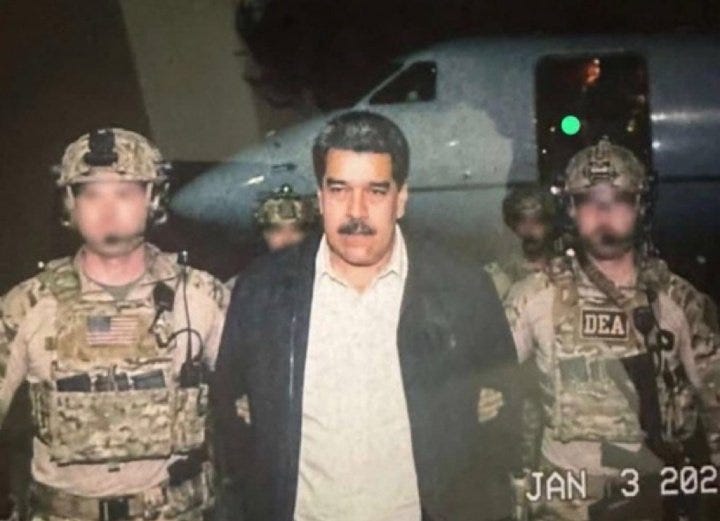
An anonymous Reddit post from someone claiming to be a whistleblower at a big food‑delivery app went viral after “revealing” a secret algorithm that slashed driver pay based on a hidden “desperation score.” When journalist Casey Newton tried to verify, the source sent an obviously off badge photo and 18‑page “internal document” that quickly unraveled as AI-generated. The post still racked up millions of views and prompted company denials. Days later, AI-generated “arrest photos” from the Maduro operation fooled users and outlets during a fast-moving crisis. Different moments, same mechanism: believable evidence now travels faster than verification.

Josh Billinson@jbillinson
I’m not saying AI is not a problem here, but I think a lot of you guys really do need to use your critical thinking skills more because why would the DEA be using a 90s film camera with a date stamp? Needed the right vibes for IG?

Alex @_alex_joshua
This is an AI photo, & probably the most widespread one ever to exist. It's not real, & appeared on X hours before the US released photos of Maduro in custody. Nobody seems to notice that. It's truthfully worrying how easy it's already become to pass these things off as real.
11:00 PM · Jan 5, 2026 · 116K Views
25 Replies · 88 Reposts · 3.09K Likes
At the end of December, Stripe CEO Patrick Collison and economist Tyler Cowen announced grants for “New Aesthetics,” arguing that Bauhaus shaped the 20th century and asking what defines the 21st. Their provocation: What can be both new and beautiful? While many embraced the call, some pointed out a flawed premise: aesthetics arise from solving problems, not chasing novelty. Artist and musician Mat Dryhurst added that Bauhaus wasn’t an aesthetic but a school of thought; the look followed the system. We already have new aesthetics, he argued—slop, streamer caves, Botox influencers—products of the attention economy. Whether funding produces durable systems or well-funded pastiche remains to be seen.
In AI: OpenAI announces ChatGPT Health, teases ads; Google launches SAT Prep with Gemini. Dario Amodei publishes The Adolescence of Technology.
X runs a $1M Article contest, producing mostly clickbait self-help, ships starter packs, including a “design visionaries” list of all tech bros.
Design Twitter praises realfood.gov, then recoils from a creepy whole-milk ad.
In design studios: Special Forces launches—a new studio from David Rudnick & Timothy Luke. Shopify acquires Molly. Daybreak Studio winds down.
The first branding pile-on of 2026 comes for Sydney Sweeney’s underwear brand.
Ellis Hamburger rounds up banger CES taglines, for your consideration.
The AI Design Field Guide interviews Barron Webster, defining the “model designer”—one who shapes behavior, failure modes, and evaluation—not just UI.
Benji Taylor’s visual feedback tool for AI agents.
Andy Coenen’s isometric NYC.
Bobby is hiring a design engineer. Little Plains: Senior Brand Strategist & Copywriter, Senior Brand Designer, contract Creative Product Manager. Jared Hecht is looking for creative writers embracing AI. Primary Studio is hiring a Senior Brand Designer. Vercel wants a yapper and writer for customer stories and marketing. Cosmos is hiring a Brand & Motion Designer. NYC Department of Transportation is hiring a Creative Director for social. And more, via Ridd.
January’s pattern was consistent: tools shipped faster than we could understand them. The gap between “working demo” and “production-ready” widened, and we deployed anyway. If there’s a resolution hiding here, it’s basic ops: what you believe, what you permit, what you connect to what, and who eats the downside when it breaks.
—Carly
Comments
Nothing yet. Say the first thing.
Sign in to join the conversation.