
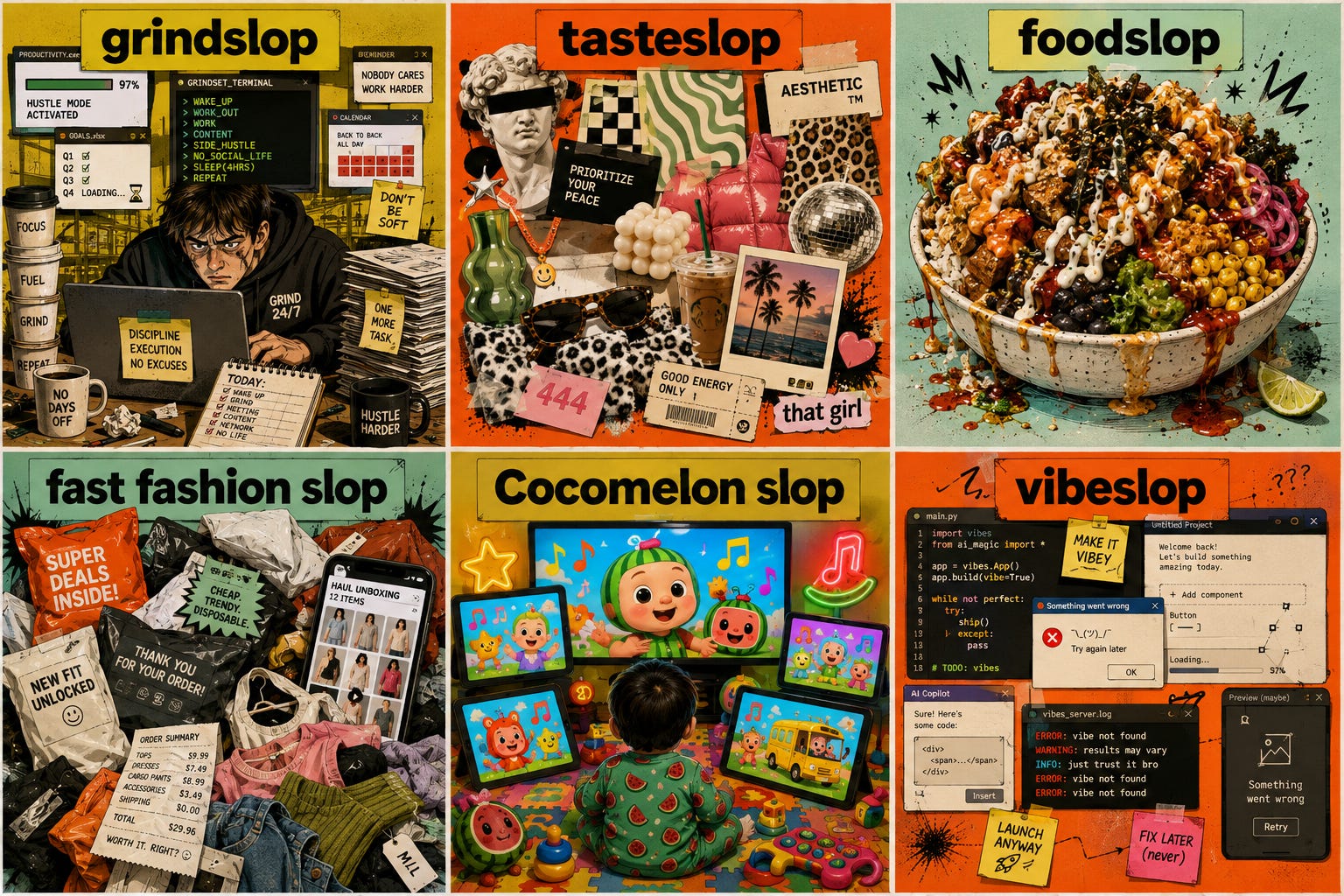
Slop was Merriam-Webster’s 2025 Word of the Year. Its definition was of the AI varietal, but soon we had other kinds of slop: grindslop for the performative glorification of work; tasteslop, a mishmash of generic aesthetic signals; foodslop, a slew of mid ingredients dumped together (see also: slop bowl); fast fashion slop, the Temu and Shein haul; Cocomelon slop for the short-form content screen-fed to kids; vibeslop, low‑quality code vibe-coded with AI.
Across all of them, the suffix implies: this is not good for you. What began as a label for machine-made filler has become a broader judgment about what’s worthy of our attention, and who’s to blame when that trust breaks.
Slop bad
Slop poses as substance, but closer inspection reveals it to be hollow: a moodboard where images have been stripped of provenance, an essay about process devoid of output, an outfit bought on Temu that looks nothing like the photo and turns out to be plastic, a sentence that sounds good until you read the individual words and realize it’s not saying anything at all. It’s a simulacrum—the appearance of the thing without the thing itself. It looks like an essay, an opinion, food, clothing, but consuming it leaves you dissatisfied.
At its best, AI slop is well-meaning, but meaningless; at its worst, it’s engineered to generate clicks and engagement. Like ragebait, it manipulates our precious time and attention, and in masquerading as meaning, it betrays our trust. From that angle, it’s infuriating. Maddening, even. How dare they?
Slop make mad
Perhaps that betrayal fueled the reaction I saw on the timeline last month. Slop was called out in its myriad forms, its slingers named and shamed, its transgressions screenshotted and shared. It was hunting season, and anyone who neglected to scrub the telltale traces of AI became fair game.
Slop janitor
Slop filtration was the natural next step. Enter: , an AI detector built by Stanford roommates and Bradley Emi. As the internet fills with synthetic filler, Pangram has positioned itself as a kind of slop janitor. In July, Substack integrated the tool, letting readers check whether a piece of text was written by a person, with AI assistance, or mostly by a model.
The feature is voluntary, and by its own admission, imperfect: as Substack notes, a detector can identify AI in text, not whether a human brought care, judgment, or originality to it. “Not everything made with AI is slop, and not all slop is made with AI,” writes Substack Co-founder and CEO . The problem, he argues, is a mismatch: readers unwittingly investing attention in something with no human thought on the other end. Substack’s proposed fix is transparency: writers are encouraged to publish a “How I make this” disclosure, shown alongside their Pangram score.
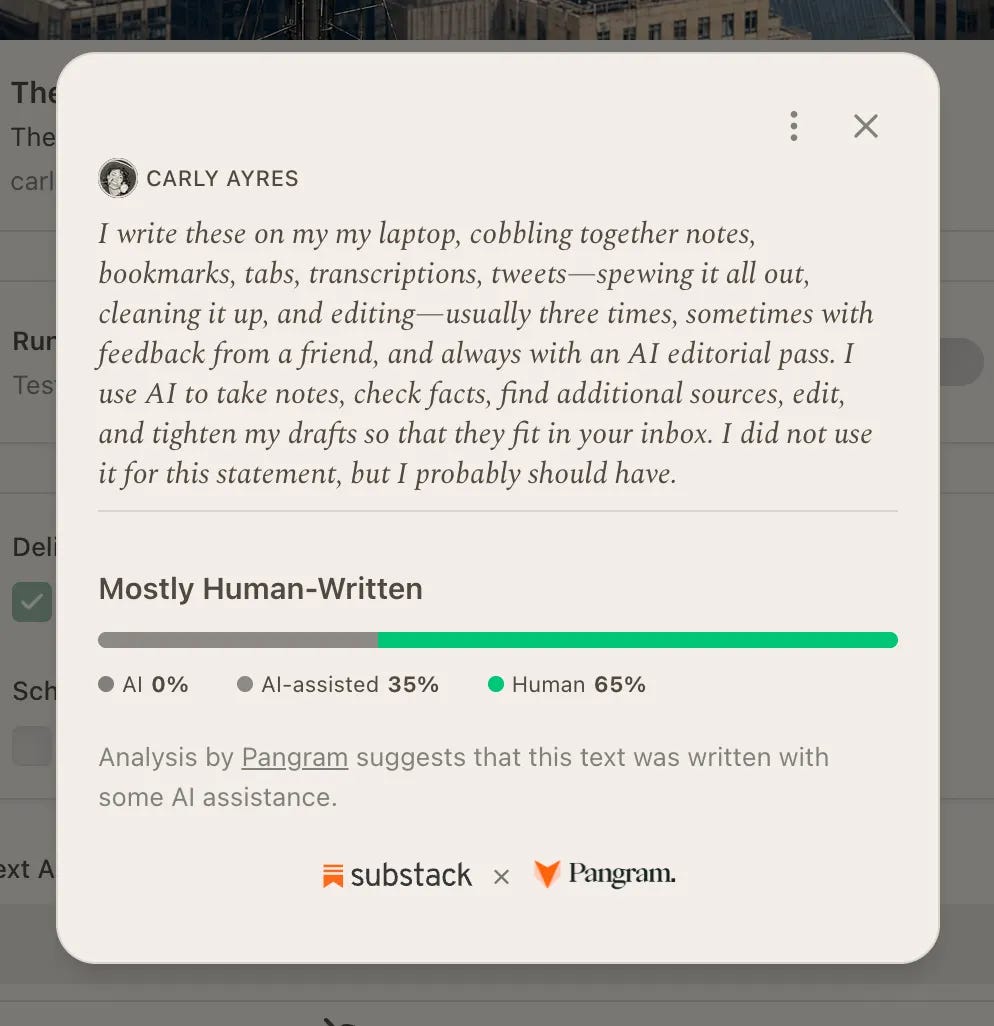
The reaction has been mixed. Some writers welcome it as a way to protect readers’ attention and reward human work. Others object that it can’t reliably distinguish wholesale AI-generated text from human writing edited with AI.
Separating the AIs from the AI-nots
And that distinction matters—to some. For readers who object to any AI usage, the goal is simply to separate the AIs from the AI-nots. But for writers who fall somewhere along the sliding scale—copyediting, language support, research, other bounded tasks—being grouped with someone who prompts their way to a full article can feel unfair, especially given how ambient AI assistance already is. Consider AI-powered spellcheck, native to Google Docs for nearly a decade. As Runway Co-Founder and Co-CEO Cristóbal Valenzuela put is, “Unless you live in the middle of the Bermuda Triangle you are using AI every single day.”
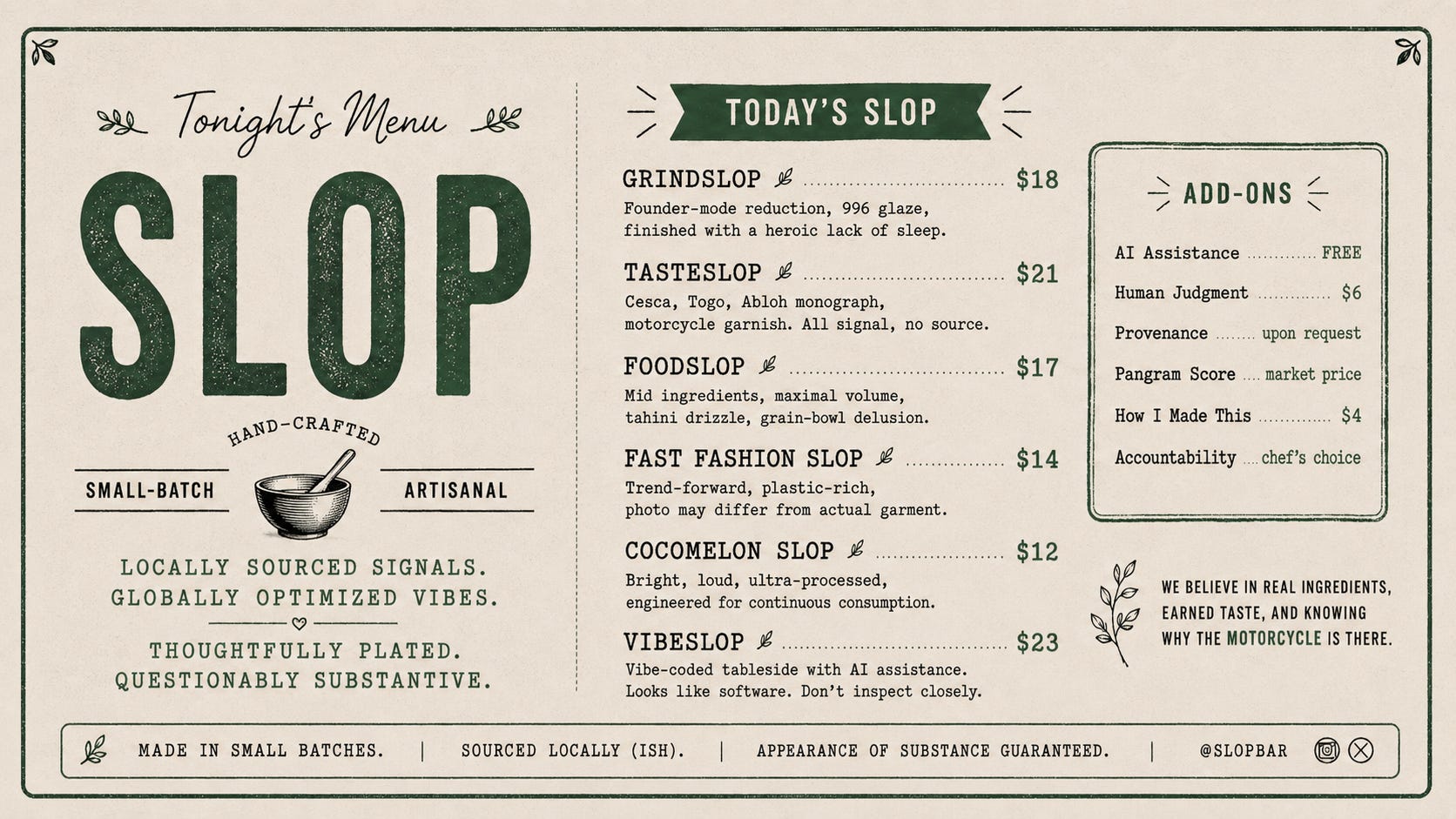
The trouble is that AI is both implicated in slop and insufficient as its definition. LLMs are very good at creating slop. They can mimic an aesthetic or voice, crank out competent-sounding copy, and produce the appearance of depth without the underlying knowledge. A person can supply the judgment, context, and accountability a model lacks, or use the model to simulate all three. But plenty of slop is made the old-fashioned way: hand-crafted, small-batch, artisanal slop. So, are we looking to weed out slop, or AI? As Every Co-founder asks, “Do we really want AI detectors? Or do we want slop detectors?”
Still, the symbolism is hard to miss. LinkedIn retired its AI post-rewriter and added a “Seems like AI slop” reporting button, while Snapchat stopped recommending fully AI-generated videos. The platforms that helped normalize AI content are now trying to filter it back out.
Panslopticon
There are, of course, social and cultural implications to AI detection. In her Trend Radar, Atluru places Substack’s feature within an emerging surveillance culture. It is, she writes, “a neighborhood watch situation,” one that ushers in a new wave of cancel culture revolving around claims of AI usage. We’re already beginning to see that dynamic play out in the feed.
Anu links to a Note by , who raises several concerns, among them:
“…will people be banned, or better yet, taken to substack court, where they’ll have to argue on behalf of their work for reinstatement? Will we be able to watch fellow writers on trial in the digital substack town square so we can hurl our insults via chat? Either shake something or shut up about it. What good is knowing someone is using AI for writing if it doesn’t mean anything?”
Slop is anything I don’t like
While the concept of a Substack Court is funny, individuals are already being dragged through the court of public opinion. Pangram scores are being used to dismiss articles and tweet threads, leaving their authors to fend for themselves in the replies. Slop has become a pejorative, and once applied, the label is hard to contest. It reads as a verdict on quality, but it’s increasingly a verdict on origin: to call something slop no longer just criticizes the result, it questions the labor behind it and the integrity of its creator. For the accused, that carries real reputational risk.
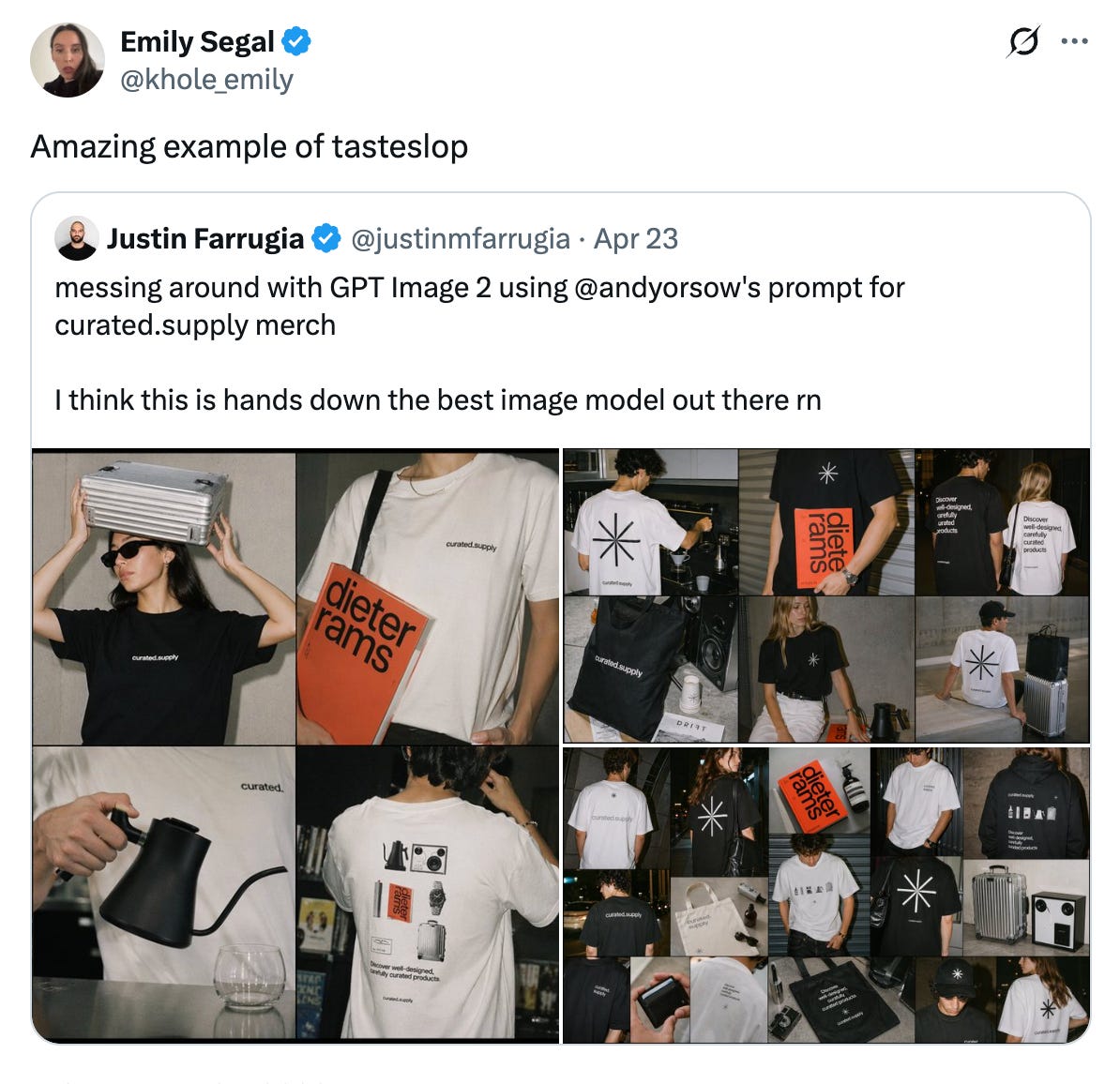
Anxiety around slop extends beyond authorship, to the signals we use to infer expertise in the first place. Take tasteslop: a design studio posts photos of their office, furnished with Cesca desk chairs, a Togo sofa, motorcycle, and Eames book propped on the shelving. The objects are selected to signal taste, but the signal rings hollow. How do these things relate to one another? Does anyone ride that motorcycle? (Cesca chairs, in my experience, are extremely uncomfortable to work from!) And yet, the gestalt is meant to communicate: We get design. We have taste. You can trust us to provide those things for you. To a potential client less fluent in the references, that reads as credibility.
Stolen valor
Performative taste is not new, and neither is turning taste into money. Design studios, magazines, galleries, fashion houses, and advertisers have long converted aesthetic judgment into commercial value. What’s changed is how easily those signals can now be reproduced. An LLM can pull the right references, mimic a particular voice, and generate a list of design-y coffee table books to arrange on your knock-off Noguchi table. Where individuals used to cultivate those signals through experience—living, seeing, saving, painstakingly accumulating building out their Are.na boards—slop offers a kind of stolen valor, an uncanny valley of expertise without having done any of the reps.
Conclusionslop
Slop, in the end, is a proxy for a crisis of trust, taste, and attention. Most of us aren’t actually looking for machines to score culture on a scale of human to nonhuman. We want to know that what we’re consuming is worth our time.
An AI purity test can’t offer that. Provenance is an imperfect—and increasingly punitive—proxy for quality. A piece can be entirely human-made and still be derivative or careless, or AI-assisted and carry someone’s research, judgment, and point of view. The work should be able to justify itself instead. Writers, designers, and creators need be able to explain not just where the material came from, but why they chose their sources, made their calls, and believe the result deserves our attention.
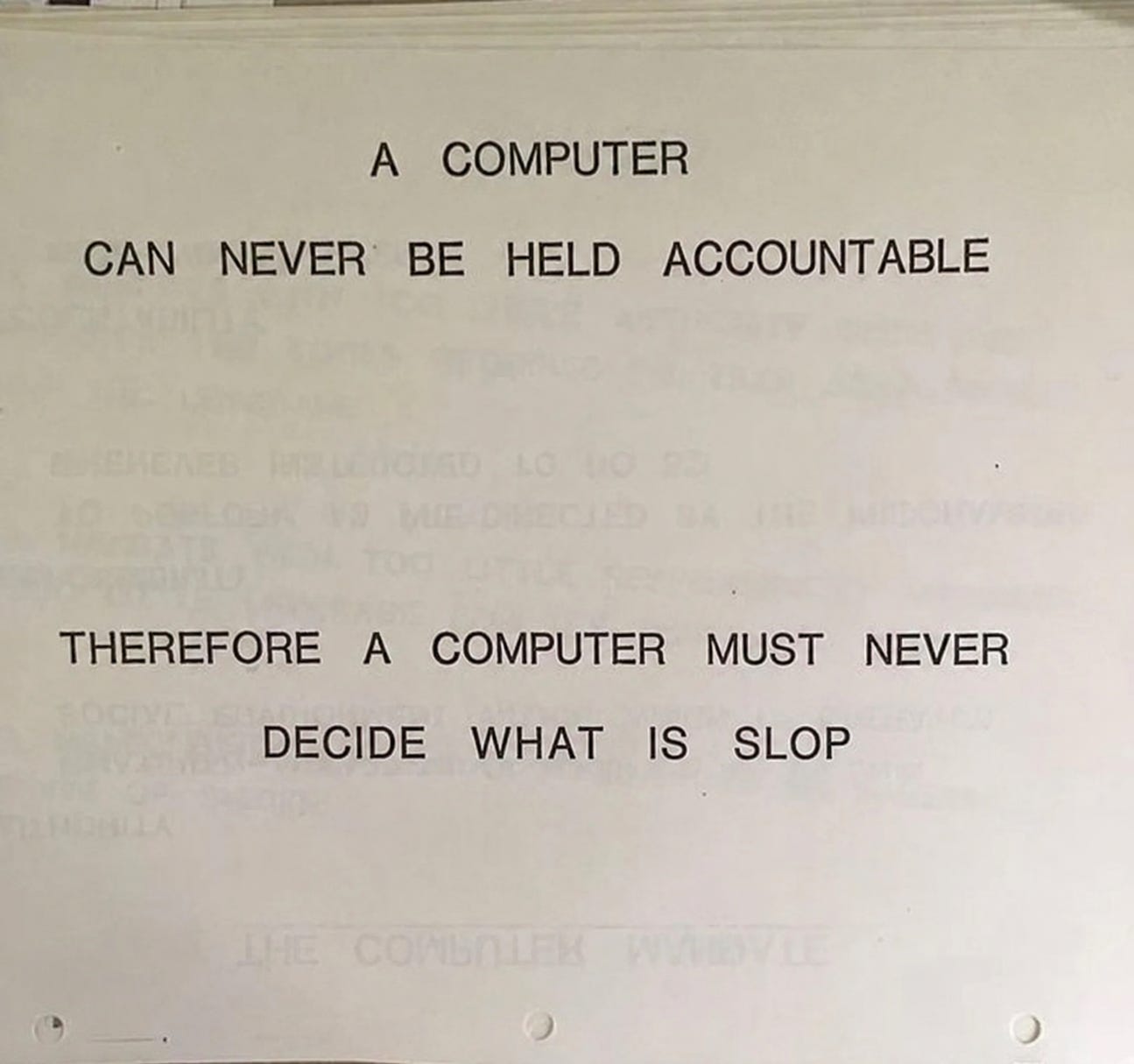
In a feed engineered to make more things than anyone can possibly care about, the value of human work may not lie in avoiding AI, but rather in being accountable for what you put in front of someone else.
Comments
Nothing yet. Say the first thing.
Sign in to join the conversation.