
The alarm siren echoed through the empty halls, closed offices, and idle laboratories of the Area 54 building designated Project Resurrection, reaching the ears of only five security personnel, an electronics technician, and the two project scientists still on duty. Sara Mundy reached the primary operations center half a minute before Keith Wells.
“What’s the alarm?” He asked.
“Just got here,” she replied. She switched off the alarm siren and quickly scanned the facility status screen. “Containment breach?”
“No.” Keith had joined her over at the console. “There cannot be a containment breach. It’s impossible.” He scanned the data on the LCD screen. “This has to be wrong.”
“Section Z, cells 205 to 225,” Sara said. “Twenty subjects, all from the South Florida outbreak of 2018. When was the last time you fed them?”
“205 to 225?” Keith echoed. “When was the last time I fed them? When was the last time you fed them? That’s not my section.”
“It is. Check the assignment list. Are you saying you haven’t fed them in almost a month?”
“No, no, no.” Keith tapped a series of commands into the keyboard and brought up the assignment list. It was generated after the shutdown of the federal government reduced the CDC monitoring staff at the Air Force’s Area 54 facility to just him and Sara. He scrolled to the list of containment cells. “I am 101 to two…” his voice dropped.
“Godammit, Keith.” Sara tapped another button on the console. “Security, we have a confirmed containment breach in Section Z, cellblock 2. Capture protocol is in effect. Proceed with caution, those things are hungry.” There was no answer.
“We need to call the Air Force.” Keith reached for the phone. “Five security guards can’t handle 20 of them on their own.”
“Are you crazy?” Sara grabbed the phone out of his hand. “How do you think they will respond to a potential outbreak of this size? You know the Air Force’s primary problem-solving methodology. It’s to drop high explosive devices from great altitudes.”
“What do you want to do? Catch them yourself?”
“We have the prototype.” She walked across the room to a glass case. Inside was what looked like a ray gun, a plastic rifle stock with an array of sophisticated electronics and a ceramic parabolic dish.
“Do you even know how to use that thing?”
“I watched the testing. Power up. Point. Pull the trigger.” She entered a code on the keypad under the case, and the front glass slid up. She lifted the weapon out.
“The cell blocks are locked down. One of us will have to stay here to open them for you,” Keith explained.
“Fine. I’ll go.” She powered up her weapon and moved into the corridor.
“Wait.” He ran out after her. “Take this.” He handed her a small walkie-talkie. “I can track the subjects as well as your weapon and let you know the relative positions of everything.”
“Thanks.” She grabbed the radio and continued down the hall.
Keith retreated to the operations center and called up a tracking map on the big screen above the main console. A green dot, representing Sara’s weapon, was inside an elevator 100 yards from the control room. He expanded the map to show the entire facility. Subject red dots were mainly located in containment cells in blocks one and two, with approximately 20 subjects shuffling around outside their cells near one of the entrances to block two.
“Sara,” he called over the radio, “escaped subjects are all pretty much bunched together near the southern entrance to block two. Once you get to the door, signal me and I’ll open it. You should be able to take down the entire pack with a single shot.”
“Good. I should be in position in about two minutes.”
“Roger that.” He watched as the green dot moved out of the elevator and through the corridors toward block two. There was no reason that the plan shouldn’t work. The prototype weapon was a sonic disruptor designed to knock as many as 100 infected subjects off their feet and incapacitate them for several hours. Once they were all down, he could call the Air Force and get a response other than high-explosive devices dropped from a great altitude. “You should be close.”
“Half a minute,” Sara reported over the radio.
“What’s going on?” Andy Becker, the facilities’ sole remaining electronic technician, asked as he entered the operations center.
“Partial containment breach,” Keith started.
“In position,” Sara reported.
“Opening door.”
“Why are you opening doors during a containment breach?” Andy asked as Keith completed the keystrokes necessary to open the door.
“Sara has the prototype weapon,” Keith explained. “She needs the doors to be open in order to use it on the escaped subjects.”
“No! No! Close the door!” Andy shouted. He was cut off by the sound of Sara screaming through the radio.
“Door closed!” Keith shouted. But it was too late. All of the red dots were now out into the corridor, swarming around the green dot. It wasn’t moving. “She was sure the prototype would work.” He pounded his fist against the console.
“It does work, when it’s properly calibrated,” Andy explained. “But the technicians who do that work have been on furlough for the last month. The thing needs to be calibrated every four days to work properly.”
“I knew this was a bad idea,” Keith sighed.
“And now they are moving into the building,” Andy observed. At that, another alarm sounded, and the doors to the operations room slid shut.
“Full containment protocol in effect,” an artificial voice echoed through the building. “Facility destruction protocols will be activated within 30 minutes.”
“Hell no,” Keith and Andy rushed for the door, trying for several minutes to pry it open. It wouldn’t budge.
“That’s it then,” Keith said. “No way out, and no way to contain the outbreak before the building goes into self-destruct mode. I guess the only good news is that the subjects are not likely to break out of the building before it all goes boom.”
“I wouldn’t be so sure about that.” Andy pointed to a cluster of red dots on the facility map that were pushing up against an exterior exit.
“Great, just great,” Keith sighed. “From government shutdown to civilization shutdown in just over thirty days.”
“Well, there is some good news,” Andy offered.
“Yeah, what’s that?”
“At least they can’t make us work without pay anymore.”
*There was a shutdown. That part was true.
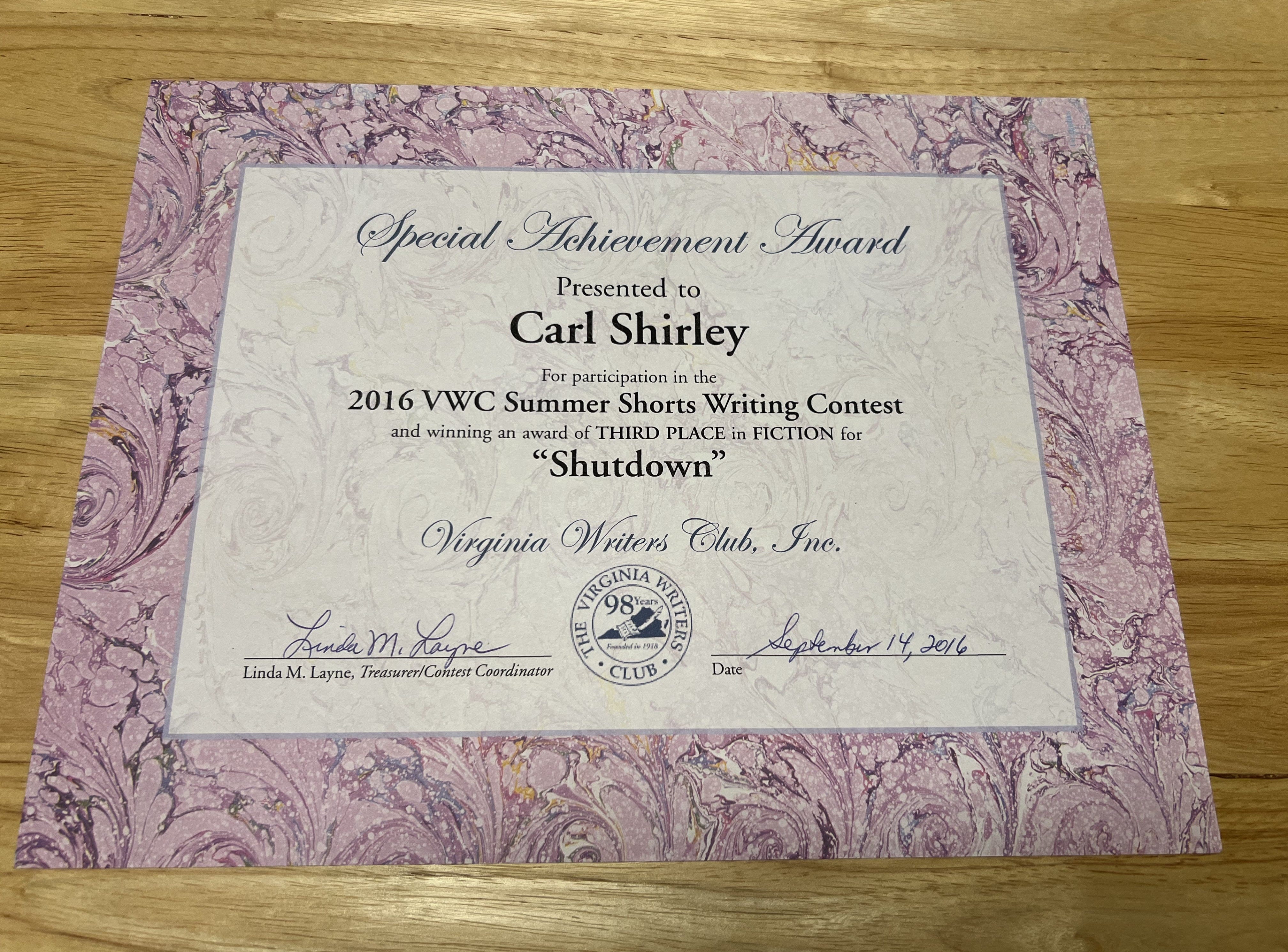
To commemorate the impending government shutdown, I have posted this story from 2016, which was written during an earlier shutdown. It won Third Place in the 2016 VWC Summer Shorts Writing Contest.
No posts
Comments
Nothing yet. Say the first thing.
Sign in to join the conversation.