
For most people, the hardest thing to understand about learning is that the strategies which pay off in the long run often feel like failure in the moment, while the ones that produce no lasting benefit often feel like success in the present. A new paper in Educational Psychology Review applies this uncomfortable truth to the most popular intervention in modern education, growth mindset, and finds it wanting: as a standalone treatment it produces effects on achievement that are vanishingly small and disappear entirely under proper scrutiny.
Growth Mindset strategies require little that is uncomfortable of teacher or pupil, which is exactly the type of idea that spreads regardless of whether it works. Belief only governs whether a student perseveres; but it cannot tell them what to persevere at, so they often persevere at ineffective habits they already prefer. However, the strategies that actually lead to learning such as retrieval practice and spacing, feel worse and therefore are not as popular.
Despite this, every parent and teacher knows that motivation and belief matters greatly. A child's conviction that she can improve does little on its own, but can do a great deal when it is supported by good mentoring and a genuine sense of belonging: the conditions that make her feel secure enough to bear the initial discomfort real learning demands.
There is a story I have probably repeated a little too often about Niels Bohr who was visited by a friend after winning the Nobel prize for his model of the atom. The friend, after seeing a lucky horseshoe over his door, asked him why an eminent man of rationality and reason would have a superstitious symbol over his door? Bohr replied that of course he didnt believe that it works, but that he was told that it works even if you don’t believe in it.
The growth mindset poster in schools is education equivalent of Bohr’s horseshoe. Most teachers instinctively know that showing children a video about brain plasticity, or telling them that mistakes help them grow, or adding ‘yet’ to a negative sentence, will not by itself make them better readers or help them solve quadratic equations. And yet we keep hanging them anyway, because the alternative, admitting we do not have a quick fix for how children learn, is far less comforting than a slogan on the wall.
The idea of a growth mindset remains one of the most successful ideas education has ever seen. It is short, intuitive, cheap, and almost too good to be true; an intervention can be delivered in as little as ten minutes through an online module, and it leaves both teacher and pupil feeling that something transformative has occurred. In a new paper, Anne Cleary and Daniel Robinson place it alongside learning styles and grit, in a small family of concepts that are quick to grasp, relatively easy to administer, and almost entirely resistant to disconfirmation or falsification. They borrow a useful term for this from Sinatra and Jacobson: the zombie concept, an idea that no amount of evidence can kill, because it keeps rising again merely on the strength of how right it feels.
However, there is a real dimension to growth mindset so why does it endure in its ineffective motivational poster form? And what does it tell us about how education chooses its ideas?

What the evidence actually says
The empirical picture is now difficult to argue with. Macnamara and Burgoyne’s meta-analysis found a mean effect of growth mindset training on academic achievement of d = 0.05; once you correct for publication bias, that already negligible figure falls to somewhere between 0.01 and 0.03, which is to say nothing at all. The result holds up under the most reasonable stress tests. When the authors restricted their analysis to studies in which the intervention demonstrably shifted students’ mindsets in the intended direction, the effect on performance vanished. When they restricted it again to the handful of studies meeting basic methodological standards, it vanished a second time.
This is not the verdict of a single hostile study either. Foliano and colleagues ran a randomised controlled trial across more than a hundred English schools and over five thousand pupils, and found no advantage for those who received the training. Bahnik and Vranka found no relationship between growth mindset and admission test scores among more than five thousand Czech applicants. And the studies that do report glowing results tend, on inspection, to often be correlational: Claro and Loeb’s much cited 2024 paper, which announced that students with a growth mindset learn more in school, can establish only that the two travel together, not that one produces the other. As Cleary and Robinson note, a growth mindset is just as plausibly the residue of prior success, or of an already acquired tolerance for the discomforts of effective study, as it is the cause of anything.
There is also the small, awkward detail that authors with a financial stake in mindset interventions were two and a half times more likely to report significant effects than authors without one. The for-profit programme Brainology was marketed to schools as an effective intervention, priced at several thousand dollars per school per year; and then, in 2015, the Institute of Education Sciences awarded a multi-million-dollar grant to investigate whether it actually worked. Cleary and Robinson give a great analogy; a pharmaceutical company selling a drug to patients first, and securing funding for the trial afterwards. This is not how serious science works and says a lot about why education is so prone to fads and bad ideas.
Why bad ideas travel so well in education
I’ve written before on why bad ideas like Learning Styles have been so successful despite the evidence against them, and I think the more interesting question is not whether growth mindset training works, but why its failure has done so little to slow its spread. Cleary and Robinson offer some really interesting thoughts on this. They scanned a year of journal articles and sorted the popular concepts from the well-supported ones by the kind of evidence each attracts. The methods that dominate classroom practice, (grit, growth mindset, learning styles etc), were studied almost entirely through observation: ninety per cent observational, but very few experimental. The methods that learning scientists actually recommend, retrieval practice, spacing, cognitive load theory, were tested overwhelmingly through intervention, with the majority experimental. In other words, the popular ideas are the ones we celebrate rather than test; while the effective ones are the ones we test rather than celebrate.
That asymmetry is not an accident, and here the paper connects to something deeper than mindset. Effective learning strategies share an unfortunate property: they feel bad initially. Retrieval practice, the single most robust finding in the field, is unpleasant in the moment, because the difficulty of dragging information out of memory is precisely the mechanism that strengthens it. Spacing out your practice feels worse than cramming the night before an exam. Re-reading feels productive and is largely useless. Learners, left to their own “metacognition”, reliably choose the strategy that feels like learning over the one that produces it, and they are wrong almost every time. Robert Bjork’s phrase for the useful kind of struggle, the desirable difficulty, captures the whole problem in two words: the desirable thing is, by design, difficult, and the difficult thing is often hidden.
Growth mindset is the mirror image of this. It is a feel-good method in a field where the things that feel good rarely work and the things that work rarely feel good. It propagates and flourishes for the same reason misinformation propagates: it makes sense at the level of gist, it fits a cherished cultural narrative about effort and self-authorship, and so it bypasses the scepticism we reserve for ideas that sound strange. Nobody properly interrogates an idea that confirms something which they have already decided is true.
Hard now. Easy later: why learning needs friction
There is a slide I use in almost every talk I give which features another quote from Anne Cleary which I think brilliantly explains the whole problem in a single sentence:
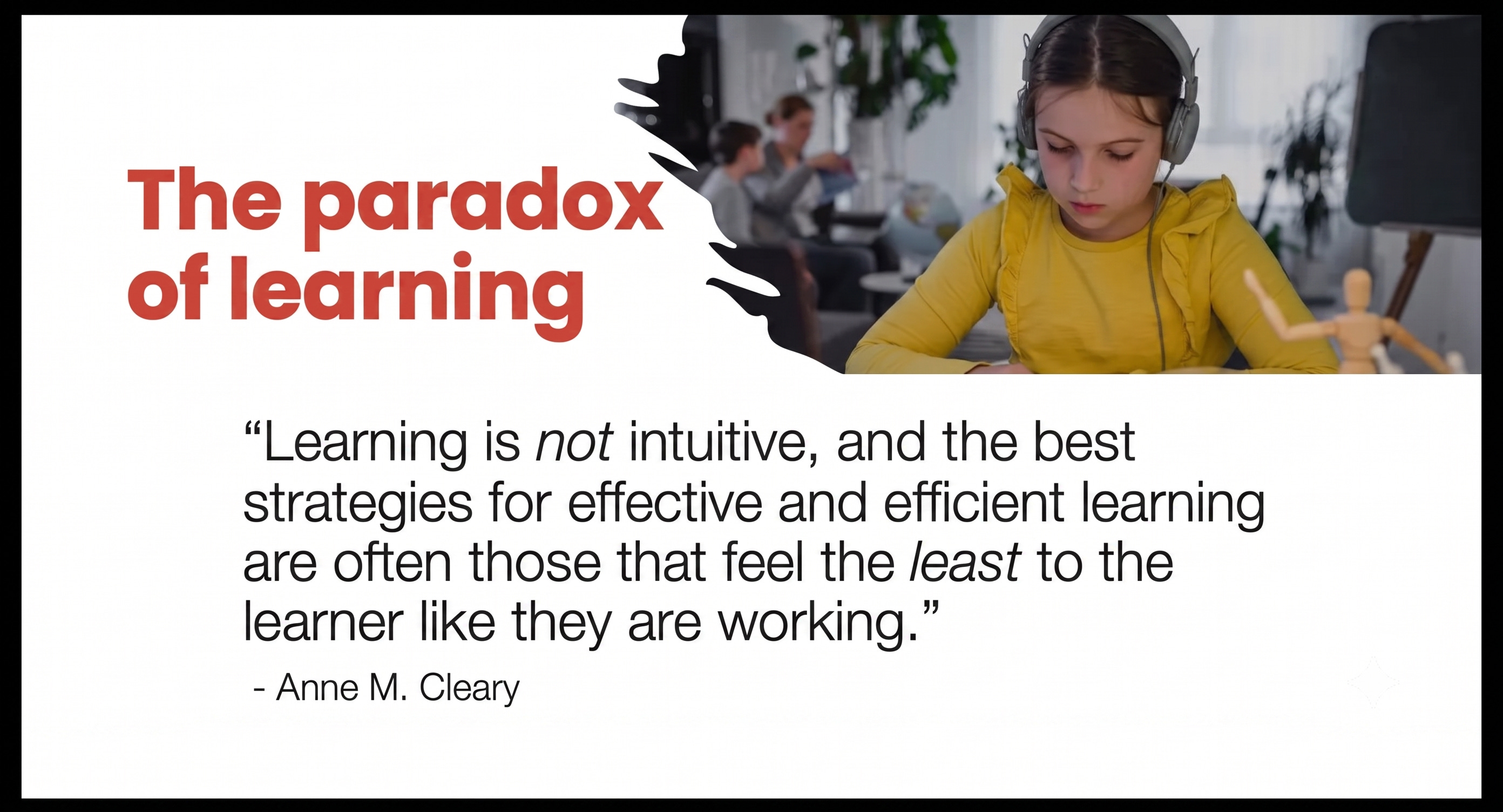
We treat the feeling of progress as evidence of progress, and so we gravitate towards the strategies that supply that feeling most generously: re-reading, highlighting, repeating comfortable routines, the warm glow of an assembly about the plasticity of the brain. Yet the sensation of fluency is precisely what genuine learning often prevents. In the short term, retrieval feels like failing; spacing feels like forgetting; difficulty feels like incompetence; and each of those uncomfortable signals is very often the mechanism actually doing its work.
This is the paradox the growth mindset can never resolve, because it operates entirely on the wrong side of it. Mindset is engineered to make learning feel better; but the things that genuinely lead to long term learning are (often) the ones that feel worse. You cannot growth-mindset your way around that trade-off, and you certainly cannot believe your way around it; you can only teach a student to recognise the discomfort for what it is, and to carry on regardless.
At the risk of contradicting myself, there is a wall decal at Alpha School's Spyglass campus in Austin which I think gets to the heart of what we should actually be saying to children. Fittingly, it runs along the wall above a stairwell, and it reads:

What I like about this (and particularly where it’s placed) is that the classroom growth mindset poster tells a child that her intelligence is hers to create, that she can somehow believe her way up the steps, but then leaves her at the foot of the stairs with no idea how to climb. "Hard now. Easy later." does the opposite. It makes no claim about ability and offers no flattery; it simply states the truth: some things are hard at first and then you get good at them with purposeful effort.
Slogans are usually nonsense but I like this because it tells a child that the discomfort she is about to feel is not a sign that something has gone wrong, but the price of the thing going right; that the path which feels worst in the moment is often the one that pays off later. This is not motivation in the familiar sense; it is honesty about the structure of learning. A slogan that tells children how easy initial learning ought to feel is simply dishonest. And we should be honest with children about how learning happens.
Does the causal arrow point the other way?
There is I think, a structural reason why standalone therapeutic interventions like this dont work and it’s not because ‘we’ve never tried growth mindset properly.” Suppose the training succeeds perfectly; suppose a child walks out genuinely persuaded that her intelligence is malleable and that effort will pay. What, precisely, is she meant to do next? Belief governs whether she persists but tells them nothing about what she should be persisting at.
A student convinced of her own brain plasticity but left to her own devices will simply persist harder at the ineffective strategies she already favours: re-reading, highlighting, the comfortable rituals of revision that feel like work and accomplish little. You cannot believe your way into knowing how to study, any more than you can believe your way into knowing how to swim.
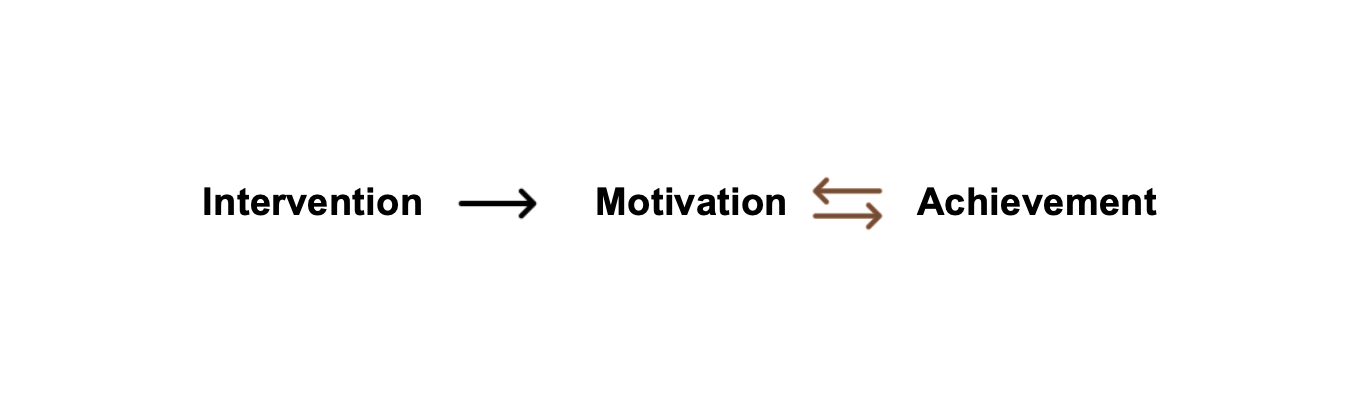
Motivation does not reliably produce achievement; but achievement often produces motivation. Self-belief is far more often the consequence of competence than its cause. Prepare a child to deliver a genuinely good speech, one built through explicit instruction, modelling, specific feedback,rehearsal, and caring mentorship and support, and you will have done more for her sense of her own capabilities than any number of assemblies about the plasticity of the brain or videos of Michael Jordan failing 99 times but then succeeding once. You cannot instil the feeling that competence produces, while completely skipping the actual competence.
Mentorship, motivation and belonging
One person who I think has thought about this better than most is David Yeager, who arrived at a version of the same conclusion long before the latest meta-analyses. I have written before about his important work on ‘stealth interventions’ and his work since the National Study of Learning Mindsets rests on the argument that belief moves achievement only where the surrounding context affords the behaviour it recommends. The intervention can change what a student thinks while changing nothing about what she does, unless peers and teachers already reward the seeking of challenge. He presents this as a defence of mindset, but it is closer to a concession I think, because it grants the structural point precisely: belief is inert without a vehicle to carry it.
Yeager argues that the near-zero averages in the meta-analyses are misleading, an artefact of pooling the contexts in which the effect is real with the many in which it is absent; the effects are heterogeneous, they argue, not absent. Grant them this entirely, and the case against the classroom product is stronger, because if belief pays off solely where the environment is already supportive, then the universal, context-blind deployment, the module, the assembly, the laminated poster, is exactly the condition under which the research predicts nothing will happen. The most authoritative case for mindset turns out to question the version that many schools were actually sold. What remains is not a disagreement about whether belief needs a complement, but about which one: Cleary and Robinson would attach retrieval practice; Yeager would attach a supportive context and the deliberate pursuit of difficulty.
It is telling, too, where Yeager has since taken his thinking. His recent work has migrated from the growth mindset, a belief lodged inside the student, to what he calls the mentor mindset, a stance adopted by the adult: high standards paired with the support that makes meeting them possible. He sets it against two failure modes a teacher will recognise instantly, the enforcer who demands rigour without any help, and the protector who offers warmth while quietly lowering the bar. His exemplar is a physics teacher who sets genuinely hard problems, refuses to simply hand over the answer, scaffolds the task until students can attempt it, and lets them revise when they get it wrong.
This dovetails nicely I think with ’s thoughtful work on belonging. You cannot do belonging, Hutchinson argues, any more than you can believe your way into learning; it is earned by a child actually doing something that counts as membership of the group. A great point he makes is that the harder you push a child academically, the more her sense of belonging matters, because difficult material makes her struggle, and struggle is exactly what prompts the anxious question of whether she belongs here at all; a question that depletes the very cognitive resources the work requires. I like both these ideas because they are really the support that makes difficulty bearable, and so makes rigour possible.
Dweck deserves great respect
To be clear, I have the utmost respect for Carol Dweck, (the pioneer of the whole movement), I see her as a serious scientist who has genuinely and honestly tried to examine a real psychological effect and her work has pushed the field of motivation and beliefs of intelligence forward immeasurably. I think the negative attitudes to her work as more a result of lethal mutations of growth mindset rather than the work itself. In fact Paul Kirschner and I dedicated a chapter to it in our book How Learning Happens.
So it’s important to say that recent criticism is not a complete demolition of her work; it is more a redirection, and the interesting part to me is what work like Cleary and Robinson’s suggest. Unlike learning styles, which is simply false and deserves to be buried, growth mindset may yet have a defensible role, not as a learning mechanism, but as a kind of antechamber to one. Their hypothesis worth looking at I think is that mindset training does not act on learning directly at all; it acts on a student’s willingness to tolerate the discomfort of strategies that do actually work. A 2024 study by He and colleagues found that growth mindset influenced mathematics achievement only indirectly, through self-efficacy and reasoning. Fink and colleagues found that the training helped disadvantaged students while leaving advantaged ones untouched, which is exactly what you would expect if its real function is to supply a tolerance for difficulty that more advantaged students have already acquired elsewhere.
If that is right, then the problem wasn’t the belief itself; it was deploying the belief alone, as though pure resolve were a substitute for knowledge and technique rather than a precondition for acquiring it. Add the mindset with a knowledge-rich curriculum, explicit instruction, retrieval practice and spacing, and with honest training about the gap between how learning feels and how learning works, and you might have something: a way of getting students not merely to want to improve, but to endure the specific, unglamorous difficulty through which improvement actually happens. The belief then becomes a stepping stone rather than a destination. Whether this survives contact with a real classroom is, of course, an empirical question, and the field’s record on scaling laboratory effects makes me skeptical but it is the right question I think, which is more than the last fifteen years of mindset enthusiasm managed to ask.
Ultimately then, the lesson is not that belief is worthless. It is that belief is often downstream of other stuff. You cannot believe your way into learning, because learning is not a state of mind; it is the residue of particular things done in a particular order, most of which feel worse than the alternatives while they are happening. The most useful thing we can give a child is not just a conviction that she can improve, but the specific means by which she actually does, at which point the conviction often arrives on its own as a by-product, earned and durable and longer lasting because she has the real sense of accomplishment. The sense that she has achieved something that she first thought impossible. At the risk of repeating myself; perhaps then, the best way to achieve a growth mindset might just be not to mention growth mindset at all.

Comments
Nothing yet. Say the first thing.
Sign in to join the conversation.