
Simone Weil, writing from the desperate years of the early 1940s, made a claim about education that has stuck with me since I first encountered it. The purpose of school studies, she argued, is not primarily the acquisition of knowledge or even the development of practical skills. It is the cultivation of attention.
For Weil, attention was not merely a cognitive capacity but a moral and spiritual orientation toward the world. To attend fully to something, whether a geometry problem, a passage of Greek, or another human being in their suffering, was to practise a form of self emptying. It required the suspension of ego, impatience, and the urge to master and move on. Attention, in Weil’s formulation, was a kind of liberation, what she describes as “waiting, not seeking.”

I return to Weil now because her understanding of attention illuminates something about our present condition that many contemporary analyses, for all their sophistication, tend to miss. We are adept at diagnosing the attention economy, at mapping its mechanisms of capture and exploitation. What we struggle to articulate is what is lost when it is fragmented and commodified. What kind of self fails to form in its absence.
Weil understood attention not as something the self deploys, like a tool, but as something through which the self comes into being. To attend is to be formed. Iris Murdoch, who extended Weil’s thinking into moral philosophy, made this point explicit in The Sovereignty of Good: the quality of our attention determines the quality of our moral life. What Murdoch called “the fat relentless ego”, or the self that insists on its own centrality, that reduces every encounter to a mirror, is precisely the self that cannot attend. And attention, she argued, is not a preliminary to moral action. It is moral action. The just and loving gaze directed upon an individual reality is the characteristic and proper mark of the active moral agent.
If Murdoch is right, then the crisis of attention is not simply a matter of productivity or information management. It is a crisis of moral formation. A self that has never learned to attend, to hold still, to look carefully, to resist the impulse to categorise and move on, is a self that remains, in some important sense, unformed. The attention economy does not merely distract us. It arrests a process of becoming ourselves.
In 2006, Facebook introduced the News Feed. The internal metric they used to evaluate its success was called “engagement”, a word borrowed, with no apparent irony, from military terminology for making contact with an enemy. What it measured was not whether users had learned anything, or felt enriched, or understood the world more clearly. It measured whether they had stayed. The longer the better. The ideology encoded in that metric, that the purpose of a human being’s attention is to be captured and held, has since become so pervasive that we barely notice it. It is the water in which we swim.
But it is worth pausing to consider what happened: an entire civilisation’s relationship to its own attention was restructured around a metric that equated value with time-on-screen. No one voted for this. It was not a decision at all, in any sense that democratic societies would recognise. It was an optimisation. And by the time anyone thought to ask what, exactly, was being optimised away, the habits it had shaped were already too deep to feel like habits. Against this backdrop, the act of reading, real reading, the kind that demands sustained attention over hours and days, begins to look strange. It starts to resemble a refusal.
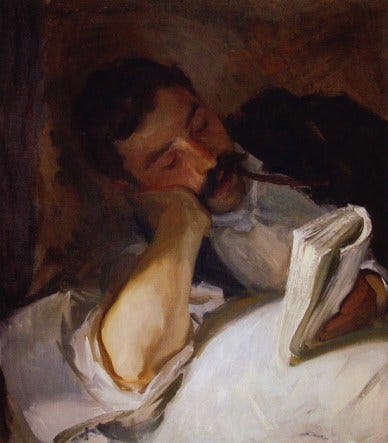
To sit with a difficult book is to decline the invitation to be elsewhere. It is to resist the pull of the feed, the ping of the notification, the low level itch to check. It is to say: I will be here, in this sentence, with this difficulty, for as long as it takes. It is to practise the kind of attention Weil describes: not grasping but receptive, not seeking but waiting.
That kind of reading is now a rare form of resistance, though not in the familiar sense of protest or spectacle. It is closer to what Václav Havel called “living in truth”: a refusal to participate in the lies a society tells itself. Havel’s celebrated example was not the dissident on the barricade but the greengrocer living under Communist rule who stops placing the party slogan in his window. The act is quiet, almost invisible. No one applauds. But in ceasing to perform a loyalty he does not feel, the greengrocer reclaims something essential about his own relation to reality.
In 2022, the publishing industry celebrated a surge in book sales driven by BookTok, the corner of TikTok devoted to reading recommendations. The books that went viral shared certain characteristics: they were fast, they were emotionally immediate, they were describable in a single sentence. The platform had, in effect, selected for books that behaved like the platform itself. What was celebrated as a renaissance of reading was, on closer inspection, the final absorption of the book into the logic of the feed. The form survived. The practice it once required did not. It was as if a culture had preserved the ritual of going to church but replaced the liturgy with a three-minute highlight reel.
We have now built an entire culture of simulated reading: an elaborate apparatus for performing the appearance of engagement with ideas while evading the labour that real engagement actually requires. The book summarised in a thread. The argument reduced to a pull-quote. Ideas encountered only through someone else's paraphrase, passed along with the confidence of first-hand knowledge. What circulates in such a culture is not understanding but its simulacrum; a fluency untethered from the slow, often uncomfortable process by which real understanding forms. We have become, in a phrase Havel might have recognised, a society of intellectual greengrocers: placing slogans in our windows that we neither believe nor have earned the right to display. When actually reading a book counts as an unusual act, something has gone profoundly wrong with a culture’s relationship to its own intellectual life.
It is tempting to dismiss concerns like these as luxury beliefs, as the indulgence of those with the time and security to worry about the quality of their attention. And it is true that the conditions for deep reading have never been equally distributed. But the erosion of contemplative life is not merely a private loss. It is a civic one. A society of distracted, exhausted selves is a society incapable of deliberation, incapable of listening, incapable of the slow work of understanding that democratic life requires.
What would it mean to resist the feed? It would mean treating attention as something that must be practised, not assumed. The habits of distraction are deeply grooved, and the devices that fragment attention are rarely more than an arm’s length away. This is not accidental cultural drift. It is an environment deliberately engineered to make sustained attention feel unnatural. Resistance therefore requires discipline: repeated, intentional acts that slowly reshape our capacities. Reading, in this sense, is an askesis; a training of attention.
The word is worth dwelling on. Askesis is the root of asceticism, but its original meaning is broader: it refers to any disciplined practice undertaken for the formation of the self. The monastic tradition, which took the training of attention more seriously than any culture before or since, understood that sustained focus was not a natural state but a hard-won achievement. The Desert Fathers’ writings on acedia, that peculiar restlessness of the spirit, the noonday demon, are essentially a phenomenology of distraction avant la lettre.
John Cassian, writing in the fifth century, described the monk whose mind wanders ceaselessly: to the next meal, to idle gossip, to the conviction that he would be better off almost anywhere else, doing almost anything else. The resemblance to the experience of trying to read seriously with a phone nearby is uncanny, and it is not coincidental. The underlying structure of distraction has not changed; what has changed is that an entire economy now depends on inducing and sustaining it.
The monks understood this restlessness as a spiritual problem requiring a disciplined response. They developed practices such as fixed hours of reading, the slow repetition of texts, the physical rhythm of lectio divina, designed to train the wandering mind back toward sustained presence. They were, in effect, building a technology of attention from the inside out.
What social media platforms have done is the precise inverse. In 2009, Aza Raskin, the designer who invented infinite scroll, described it as a way to remove “stopping cues”; those natural moments of friction where a user might pause, reflect, and choose to do something else. The design philosophy behind it owes more to B.F. Skinner than to any tradition of human flourishing. Skinner’s operant conditioning chambers, colloquially known as “Skinner boxes”, were designed to keep rats pressing a lever by delivering rewards at variable, unpredictable intervals. The News Feed, the infinite scroll, the pull-to-refresh gesture are in essence Skinner boxes rebuilt at civilisational scale. Raskin later said he regretted the invention. But by then the logic had spread everywhere, and the gesture had become so instinctive that most people no longer recognised it as a behaviour being performed upon them.
We, by contrast, tend to treat our distraction as a design problem requiring a better app. We download focus timers and website blockers, as if the difficulty were merely technical. The ancient world trained attention through practice; the modern world engineers its dissolution for profit, then sells us tools to recover what was taken. There is something almost perfectly circular about this, and almost perfectly cynical. But perhaps the deepest consequence is one that nobody designed at all. When attention becomes a resource to be optimised, difficulty becomes waste. And a culture that treats difficulty as waste will, sooner or later, stop reading anything that refuses to be easy.
But if reading is to be seriously taken as an act of resistance, it would also mean recovering a reverence for difficulty. The contemporary assumption is that difficulty is a defect, a failure of communication, an unnecessary barrier. The idea of hard books as a kind of “torture narrative”, the framing of challenging reading as punishment rather than invitation, has left us suspicious of any text that does not yield its meaning immediately. But difficulty is often the point. The resistance of the text is what exercises attention.
The urgency of this becomes clearer when we consider how much of our reading life now takes place inside systems that do not want us to read at all. All social media platforms reward speed, reaction, and performative fluency rather than understanding. They train us to skim, to respond, to move on. Increasingly, algorithmic powered systems promise to read for us: to summarise, extract, simplify, and pre digest. What is presented as convenience is, in practice, a quiet substitution of attention itself.
Notice the language. When algorithmic reading tools are marketed, they are never described as replacements for thought. They are described as tools for “empowerment.” They “unlock” knowledge. They “democratise access.” The rhetoric is borrowed, almost verbatim, from the liberation movements of the twentieth century, but redirected toward the consumption of pre-digested information. What was once a political demand, that everyone should have the right to read, to learn, to encounter difficult ideas has been quietly transformed into a commercial promise that no one should ever have to. The struggle for access has become, by a sleight of hand so deft it is almost admirable, a struggle against effort itself.
What is happening when a machine summarises a book for us is not merely a loss of informational fidelity, as though the summary were simply a lower-resolution version of the original. It is the severing of the relationship between understanding and time.
Understanding, in the Weilian sense, requires duration. It requires the reader to undergo something, to be pulled through the resistance of a difficult argument, to feel the weight of an accumulating narrative, to sit with ambiguity long enough for it to resolve into insight. A summary, however accurate its propositional content, delivers conclusions without the journey that makes those conclusions meaningful.
A culture that stops reading in this deeper sense does not just lose books. It loses the capacity to confront and sit with difficulty, to tolerate uncertainty, and to allow meaning to emerge slowly. In such a culture, attention becomes brittle, thought becomes shallow, and the inner life gradually thins out, like soil from which too much has been extracted and to which nothing has been returned.
Weil wrote that “unmixed attention is prayer”. I am not a religious man, but I increasingly find that place of quiet contemplation is a fundamental part of human flourishing, and one that is slowly dwindling away.
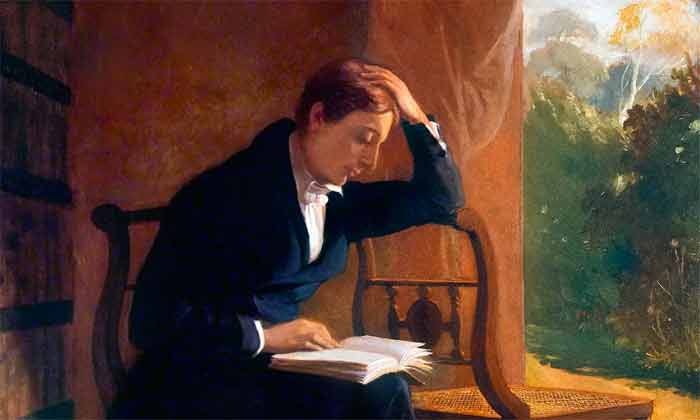
John Keats, whose portrait by Severn captures exactly this quality of absorbed attention, gave us another language for it. His “negative capability”, the capacity to remain “in uncertainties, mysteries, doubts, without any irritable reaching after fact and reason” is, in essence, Weil’s attention under a different name. Both describe a mode of being in which the self’s urgent demand for mastery is suspended, and something else. What we might call receptivity, openness or grace, is allowed to enter. We are transformed not by grasping but by waiting.
Reading, at its best, is an education in this kind of attention. It teaches us to wait, to dwell, to let meaning emerge in its own time. It forms in us the capacity to be present to something other than ourselves. And here the private discipline reconnects with the public necessity. The person who has learned to attend; to hold still in the presence of difficulty, to listen before responding, to let an unfamiliar idea exist without immediately assimilating or rejecting it, is the person upon whom civic life depends. Deliberation is not merely the exchange of opinions; it is the willingness to be changed by what one hears. That willingness is a form of attention. And attention, as Weil understood, must be trained.
The behavioural economists who designed the attention economy borrowed a phrase from the political philosopher Cass Sunstein: “choice architecture.” The idea was that you could design environments that nudged people toward better decisions. What happened instead was that the architecture was optimised not for better decisions but for more decisions; faster, more reactive, less considered. The feed is a choice architecture designed to prevent the one choice that matters most: the choice to stop, to think, to attend. In this light, the person who sits down with a book is not merely engaging in a private leisure activity. They are defecting from an architecture of compulsion. They are, in the smallest and most stubborn way, rebuilding the conditions under which deliberation becomes possible.
Severn's portrait of Keats shows a young man reading. That is all. He is not performing comprehension or curating insight for an audience. He is simply there, with the book, in a posture of absorbed and unhurried attention. It is the most ordinary image imaginable, and today it looks almost countercultural. Weil would have recognised what Keats is doing in that painting. She would have called it a form of waiting. And she would have understood, I think, that in a civilisation that has made waiting almost impossible, the capacity to sit with a book; unoptimised, unmeasured, present, is not a nostalgic indulgence. It is the precondition for every other form of seriousness we might still hope to recover.
No posts
Comments
Nothing yet. Say the first thing.
Sign in to join the conversation.