
One of the things that cognitive science keeps discovering about learning is that much of the most important work happens invisibly, beneath conscious awareness, in the silent labour of long-term memory consolidating and connecting representations. We tend to think of reading as a visual act: the eye meets the word on the page, the brain decodes it, and meaning follows. But a growing body of research suggests that by the time a child encounters a word in print for the first time, their mind has already been preparing for that encounter. The bones of the word’s spelling have been quietly assembling themselves in memory, guided by nothing more than the sound of the word spoken aloud.
A new paper I’ve just read has introduced me to a fascinating term which describes this process in reading and spelling. The study by Ataman, Beyersmann, Castles, and Wegener, explores a simple question; when we hear a new word, do we start forming a guess about how it is spelled before we ever see it written down? The authors call these guesses “orthographic skeletons”. Using a novel word learning paradigm, adult readers were trained on spoken versions of made up words that included either inflected forms (e.g. past tense) or derived forms (e.g. agent nouns). They were then tested on how quickly and efficiently they processed the written stems of those words for the first time.
The Ghost Before the Word
The concept, first proposed by Wegener and colleagues in 2018, is based on a deceptively simple insight: when a child learns a new word orally, hearing it spoken, understanding its meaning, using it in conversation, their knowledge of how sounds map onto letters (phoneme-grapheme correspondences) allows them to generate an expectation about how that word might be spelled. Not a complete, fully formed spelling, but a partial sketch; a skeleton.
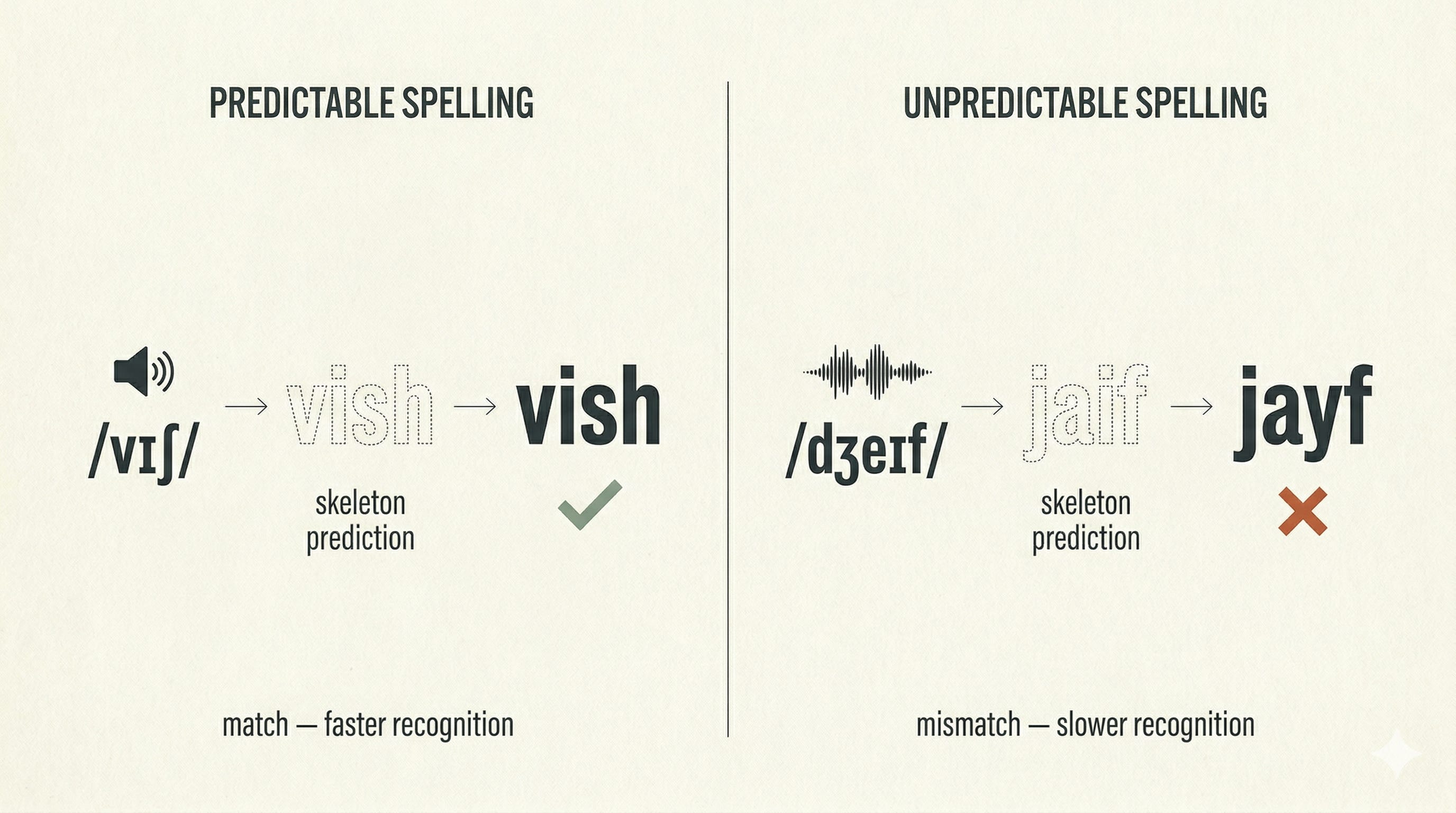
To test this, researchers use invented nonsense words like "vish" or "jayf," words that no participant has ever encountered before, so the experimenters can be certain that any spelling expectations were formed purely from oral training rather than prior reading experience. So take a reader who has been taught the spoken word "vish," its meaning and its use in sentences, but has never seen it written down. Their knowledge of English spelling patterns tells them that the /v/ sound is typically written as "v," the /ɪ/ sound as "i," and the /ʃ/ sound as "sh." Without ever seeing the word in print, they have already begun to assemble its orthographic form.
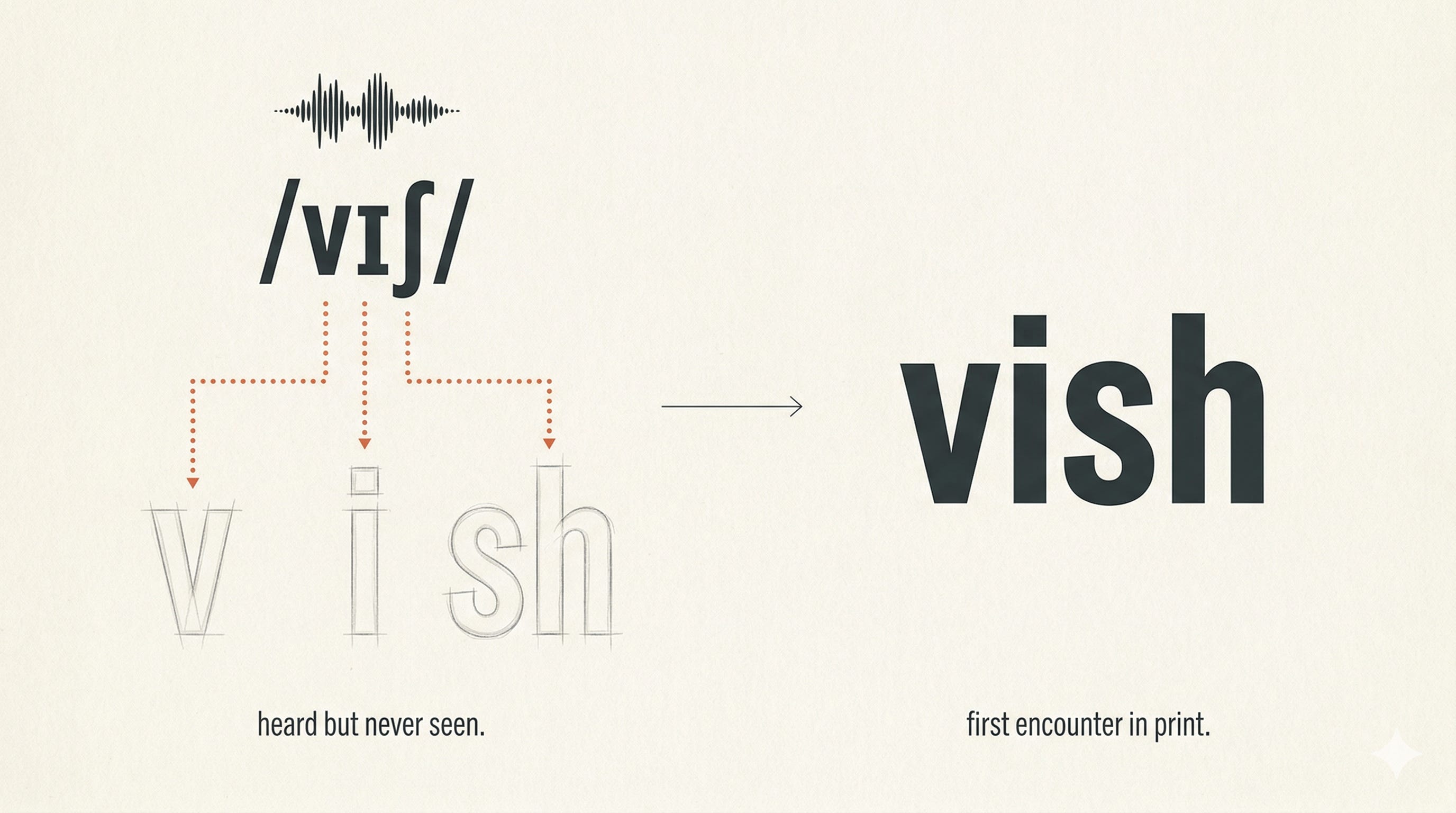
When that reader later encounters “vish” written on a page, the word is not entirely novel. It arrives into a cognitive space that has been prepared for it, a space where expectation meets confirmation. The result, demonstrated across multiple studies using both lexical recognition tasks and eye-tracking, is faster processing, shorter fixation times, and more efficient reading. The skeleton has done its invisible work.
What makes this more than a laboratory curiosity is the growing evidence for its robustness. Wegener et al.’s original 2018 study demonstrated the effect in Grade 4 children. Beyersmann et al. (2021) replicated it in adults using eye-tracking during sentence reading and extended it to morphologically complex words; those with inflectional endings like “vished” or “vishing.” Beyersmann et al. (2022) then found the same skeleton effect in children in Grades 3 to 5.
The previously mentioned new study pushes the finding further still. Using the same paradigm with over 160 adult readers across two experiments, one using a lexical recognition task measuring response latencies and the other using eye-tracking during sentence reading, they show that orthographic skeletons form not only when participants are trained on inflected forms but also when trained on derived forms (e.g., "visher," "vishist"). Crucially, the size of the skeleton effect did not differ between inflected and derived conditions. The absence of that difference is itself a key finding: it suggests the mechanism operates with equal facility regardless of morpheme type.
This last point is particularly interesting I think. Inflectional affixes like "-ed" and "-ing" are frequent, productive, and grammatically transparent. Derivational affixes like "-er" and "-ist" are less common, change the syntactic category of the word, and alter its meaning more substantially. One might reasonably expect that the more familiar inflectional forms would produce stronger skeletons. But they do not: the effect is equivalent.1
This suggests that the mechanism is not dependent on the familiarity or regularity of the affix. The mind is not merely memorising high-frequency patterns; it is generating predictions based on its deep knowledge of the sound-spelling system. As Stuart and Coltheart proposed as early as 1988, readers draw on their phoneme-grapheme knowledge to form expectations about the spellings of words they have heard but never seen. The skeleton is not a snapshot; it is an inference.
The Hidden Return on Vocabulary Instruction
Now dear reader, a caveat is important here. There is a huge limitation with this paper which needs to be addressed. The Ataman et al. study, like Beyersmann et al. (2021), uses adult skilled readers in a tightly controlled novel-word paradigm. It does not directly demonstrate that young children form orthographic skeletons for derived words. However, the child evidence from Wegener et al. (2018) and Beyersmann et al. (2022) shows the skeleton effect for simple and inflected words in primary-age readers, and the broader programme of research on the causal relationship between oral vocabulary and reading acquisition converges on the same, if not very similar conclusion. The adult paradigm just isolates the mechanism with more precision; the child studies confirm it operates in developing readers. Together I’d argue, they present a compelling picture, even if the full story is still being assembled.
The important implications for teaching converge on a point that the science of learning has been making for decades: knowledge in long-term memory is the engine of further learning.
Consider a primary school classroom where children are being taught about the water cycle. They hear the word "condensation" used repeatedly in context: the teacher explains it, models it, returns to it across lessons. They hear "evaporation" and "precipitation." These are words most seven-year-olds will not encounter in print for some time. But if the orthographic skeleton hypothesis is correct, those oral encounters are not merely building scientific vocabulary; they are laying down orthographic scaffolding. The child's phoneme-grapheme knowledge is quietly sketching the spellings of words they have never read, preparing the ground for a future encounter with text that will, when it arrives, be measurably easier to process.
This reframes to a certain extent, the relationship between oral vocabulary and reading. We have known for some time that the correlation is strong. Duff and Hulme (2012), Lee (2011), Nation and Snowling (2004), and many others have shown that early oral vocabulary is a significant predictor of later reading ability. Novel word training studies have demonstrated the causal direction: teaching a child the spoken form of a word facilitates the reading of that word when it is first encountered in print (Castles and Nation, 2006; Ricketts et al., 2016). But the orthographic skeleton hypothesis gives us the mechanism underneath the correlation. It tells us how oral vocabulary feeds reading: not through some vague process of “language enrichment,” but through the specific, measurable generation of spelling expectations in long-term memory.
Phonics Without Vocabulary is Half a Bridge
This finding also illuminates something that the reading wars, in all their acrimony, have often obscured: systematic phonics instruction and rich oral vocabulary are not competing priorities. They are two halves of the same cognitive mechanism, operating at different timescales and converging at the point where the orthographic skeleton is formed.
Phonics gives children the grapheme-phoneme correspondence rules: the systematic knowledge that /sh/ maps to “sh,” that /tion/ at the end of a word is typically spelled “-tion,” that a long vowel before a final consonant often signals a silent “e.” This knowledge is the skeleton’s building material. Without it, no amount of oral exposure will generate spelling expectations, because the child has no principled way to translate sound into letter.
But vocabulary gives them the words those rules will be applied to. A child who has been taught the phonics rules but possesses a thin oral vocabulary has the decoder but nothing to decode towards. The skeleton cannot form because there is no oral representation to generate expectations from. The child knows that /k/ maps to “c” or “k,” but has never heard the word “catastrophe,” so no skeleton of that word’s spelling exists in memory. When they later encounter it in a text, they must build the word from scratch; every letter a surprise, every syllable an act of effortful assembly.
Conversely, a child with a rich oral vocabulary but no systematic phonics instruction has the raw material for skeletons but no reliable way to construct them. They have heard “magnificent” a hundred times, but without systematic knowledge of how sounds map to letters, the mind cannot sketch even a partial spelling. The oral representation sits in memory, rich and available, but orthographically inert.
The skeleton forms at the intersection of these two bodies of knowledge. It is the product of phonics and vocabulary working in concert. This is why, as the evidence from Ataman et al. and the broader programme of research demonstrates, the effect is strongest for words with predictable spellings in the trained condition: the match between what the phoneme-grapheme rules predict and what the eye subsequently encounters is what produces the facilitation. When the spelling is unpredictable (when “jayf” is spelled “jayf” rather than the expected “jaif”), the skeleton actually creates a mismatch, a momentary surprise that the eye registers as longer fixation times and slower recognition. The skeleton, in other words, is not a passive residue of oral learning. It is an active prediction, and like all predictions, it can be confirmed or violated.
The Gap That No Reading Test Detects
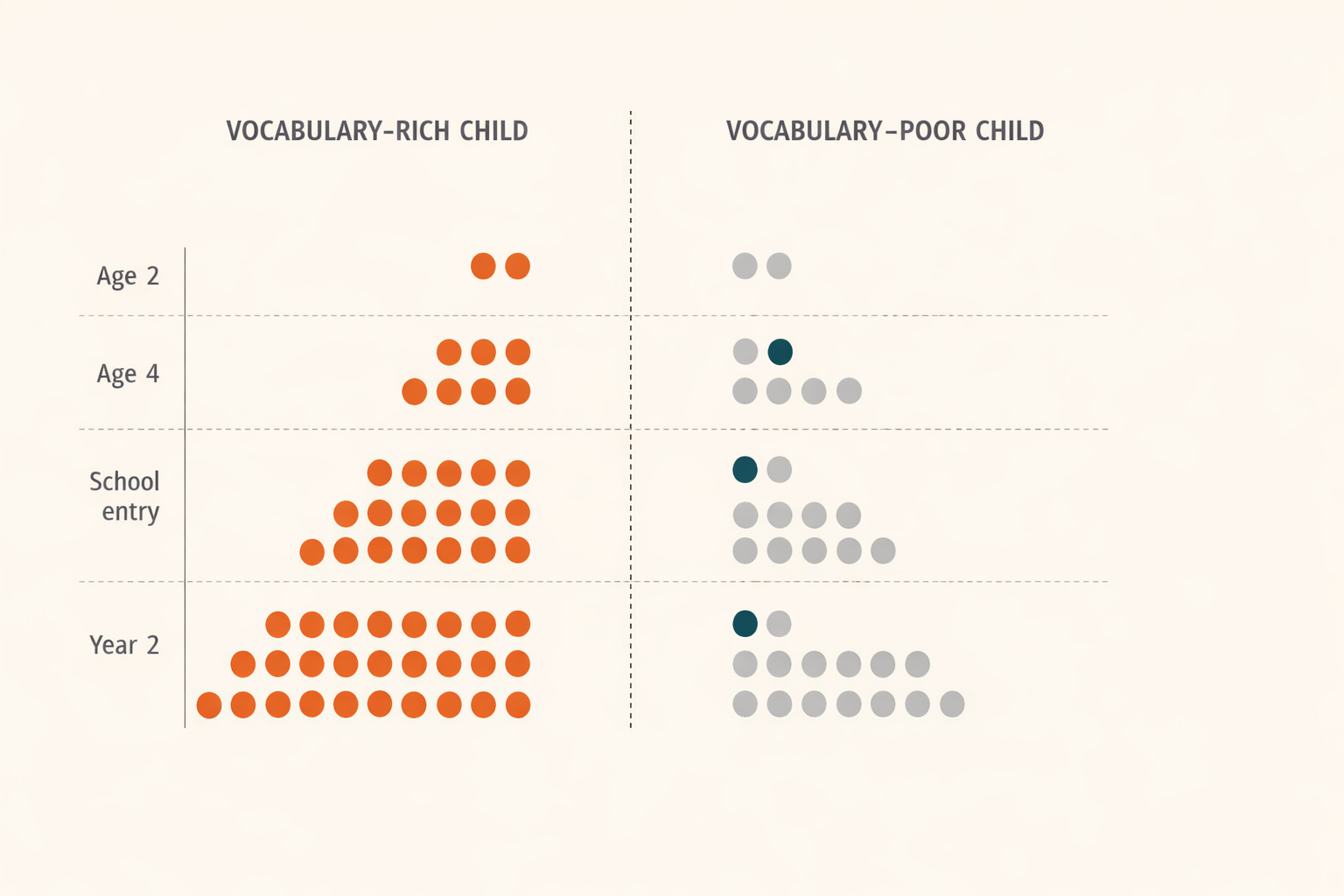
There is a darker implication here, one that bears directly on questions of equity which I’ve touched on before. If orthographic skeletons are real, (and the converging evidence from multiple research groups using different paradigms, tasks, and populations suggests they are), then vocabulary-rich children arrive at school with a hidden cognitive advantage that no reading test will detect. They have heard “ridiculous” and “extraordinary” and “investigation” at the dinner table, in bedtime stories, in the overheard conversations of articulate adults. Their minds have been silently sketching the spellings of hundreds of words they have never read. When they open a book in Year 1 or Year 2, they are not starting from zero; they are reading into a prepared landscape.
Children from language-poor environments arrive without those skeletons. Their oral vocabularies are thinner, not because they are less capable, but because they have had fewer opportunities to hear and use complex language. When both groups encounter the same text, one group is reading words their minds have been quietly preparing for. The other is meeting each word cold, with no prior expectation, no skeleton to ease the recognition process.
This is the Matthew Effect in reading, but observed at a level of granularity that the usual discussions of “word gaps” and “literacy-rich environments” rarely achieve. The gap is not just one of exposure in the vague sense; it is a gap in the number of pre-formed orthographic representations stored in long-term memory. It is a gap in prediction. And it compounds: the child who reads more easily reads more, hears more words in the context of text, forms more skeletons, and reads still more easily. The child who struggles reads less, encounters fewer new words, forms fewer skeletons, and falls further behind.
This makes the case for early, intensive, explicit vocabulary instruction in schools with a precision that hand-waving about “word-rich environments” cannot match. It is not enough to surround children with language and hope for the best. The orthographic skeleton is not formed by ambient exposure; it is formed by the interaction of specific oral knowledge with specific phoneme-grapheme knowledge. Both must be taught, and both must be taught with the deliberate, sequenced, cumulative logic that characterises effective instruction.
What the Mind Does Before the Eyes Arrive
The thing that I think is so interesting about this idea of the orthographic skeleton is that it tells us that reading does not begin when the eye meets the page. It begins earlier, in the ear, in the mouth, in the rich associative networks of a mind that has been listening and speaking and building representations of language long before it encounters its written form. The skeleton is a testament to the generative power of well-organised knowledge: give the mind enough of the right building blocks, and it will begin constructing things you never explicitly asked it to build.
This is, in miniature, the story of all learning. The student who knows a great deal about the French Revolution does not merely recall facts; they generate inferences, make predictions, notice patterns that a novice cannot see. Their knowledge is not a static warehouse but a living architecture, constantly projecting forward, anticipating what comes next. The orthographic skeleton is simply this same principle, operating in the domain of written language: prior knowledge does not wait to be activated. It reaches out to meet the world halfway.
For instructional design, the practical takeaway is both simple and far-reaching. Every science lesson in which children hear and use the word “photosynthesis,” every history lesson that introduces “parliament” and “revolution,” every story in which a character is described as “reluctant” or “courageous” is doing double duty. It is building domain knowledge, yes. But it is also, invisibly, preparing the child to read those words when they next appear on a page. The skeleton is being formed. The bones are being laid down.
A key question for schools is whether we recognise this invisible work and design our instruction accordingly, or whether we continue to treat vocabulary and reading as separate line items on a curriculum plan, unaware that the mind has long since woven them together.
Though it is worth noting that the authors’ own power analysis suggests larger samples are needed to confirm this null result with full confidence, and that exploratory accuracy data hinted at greater processing difficulty for derived forms, the key theoretical measure, response latency, showed no difference.
Comments
Nothing yet. Say the first thing.
Sign in to join the conversation.