
It’s not often that something on social media stops me in my tracks, but this week I was transfixed by a recent interview with Bob Odenkirk. He was describing a near-death experience, and the strange way a particular novel was able to describe what he himself could not identify, and help him make sense of what had happened to him.
This, I think, is what novels are for. Not, in some abstract sense, to tell us who we are, the way self-help and personality tests pretend to, but something rarer and stranger. To hand back to us experiences we have been unable to articulate ourselves, sometimes for years, sometimes for a lifetime, in the shape of someone else's sentences. C.S. Lewis put it plainly: we read to know we are not alone. Harold Bloom puts it like this:
The reason why I think reading novels meant so much to me as a kid was that I was placed inside someone else’s struggles and so my own seemed not only manageable, but understandable by comparison. What saddens me about our current reading culture is not simply that people are reading fewer books. It is that we are increasingly surrounded by forms of text that ask almost nothing of us; summaries of summaries, extracts, feeds, generated prose, convenient fragments. Language stripped of any resistance or ambiguity. Reading remains everywhere, but often in a form that no longer trains attention, patience, or inwardness.
Notice how exact the mechanism is in Odenkirk's case. Balle did not give him a new experience. The experience was already his. What she gave him was the language for it, and language, as Heidegger insisted, is the house of being1, the room in which a feeling becomes available to thought. Without the words, the experience drifts in some vestibular space below cognition, still real, still present, but not quite had.
The experience happens to you, but you cannot inhabit it. At its best, I think the novel restores the experience by at least naming it, and in naming it, gives you back to yourself. This is why Proust, in the line I borrowed at the end of a previous post, called the truest books "mirrors": not because we see the writer in them, but because, with luck, we see ourselves.
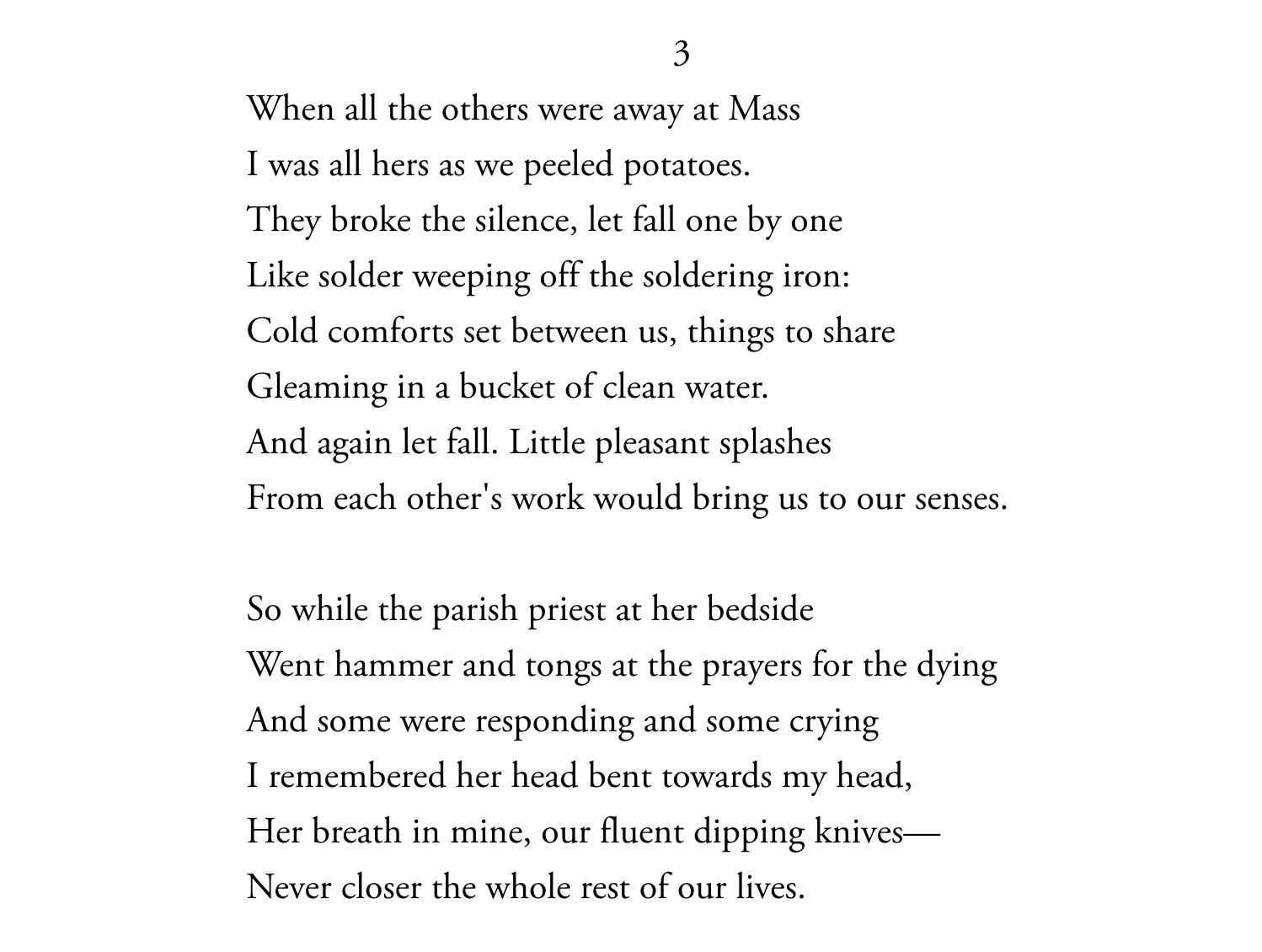
There is a reason I think why this kind of recognition is hard to come by elsewhere. I am in Belfast this week and I am reminded of a passage from a poem by Seamus Heaney which many years after my mother died, suddenly made me feel the grief I had been unable to feel.
It has also happened to me watching certain films but not in the same way as it does when you are buried in a novel. The novel requires sustained, unhurried, recursive contact with a sensibility not your own; the kind of contact that is not sadly all too rare (in my most despairing moments, I worry that my daughters will not have the same formative experiences I had with reading.) Only the novel runs long enough, and slow enough, and intimate enough, to let your inner self time to coincide with another's.
Which brings me, uncomfortably, back to Ultra-Processed Minds. I argued there that we are losing not reading itself but a particular kind of reading: the slow, vertical, devotional sort that allows meaning to accumulate, the sort that Maryanne Wolf calls cognitive patience and Sven Birkerts called an "engagement with thought that deepens it." I worried about what this loss does to attention, to civic life, to interiority. I want now to add something more specific, because the Odenkirk clip clarifies it.
This, to my mind, is the most underrated cost of what is happening to reading now. Not the loss of a certain kind of expression or erudition, (which was always patchily distributed anyway). Not the loss of a “preparation for the workplace”. It is the loss of a specific form of grace: the kind in which a stranger's sentences arrive carrying the precise words you had been missing for what you yourself had felt.
In listening to Odernkirk talk about his experience of facing death, I was reminded of Kafka’s observation that “the meaning of life is that it stops”. It gave me such hope to hear him say this and that the novel still has this power to help us understand ourselves in 2026.
Wegmarken, manuscripts and lectures written between 1919 and 1964, first published between 1929 and 1973, collected 1967, expanded and published in GA in 1976; translated as: Pathmarks, William McNeill (ed.), Cambridge/New York: Cambridge University Press, 1998.
No posts
Comments
Nothing yet. Say the first thing.
Sign in to join the conversation.