

In Part 1, I traced Kinect’s journey from Israeli military laboratories to living rooms worldwide, showing how depth-sensing technology emerged from defense research to become a consumer phenomenon. In Part 2, I explored how I used these same technologies for musical performance, mapping skeletal data to spatial audio and discovering both the creative possibilities and unsettling implications of making bodies machine-readable.
Now I want to examine what happened when these technologies returned to their origins, with capabilities far beyond what their creators originally imagined.
Walk into an Amazon Go store today, and you experience something that would have seemed like science fiction when Kinect launched in 2010. You grab what you want from the shelves, and simply walk out. No checkout, no scanning, no human interaction required. Overhead cameras track your every movement, weight sensors monitor what you pick up, and algorithms charge your account automatically. Amazon claims they don’t use facial recognition, relying instead on “other visual cues” and “continuity between cameras,” but the distinction between tracking individual humans and tracking individual faces has become meaninglessly narrow.
This exemplifies what I’ve come to think of as technology’s “boomerang effect”: innovations emerge from military and intelligence research, get packaged for consumers, perfected through mass adoption, and then flow back into systems of monitoring and control that surpass their original capabilities.
Yes, Big Brother is watching us… through infrastructure we built for our own convenience. We didn’t just accept the surveillance state, we funded its development.
Every time you unlock your iPhone with Face ID, you’re participating in the largest facial recognition training program in history. When Apple launched Face ID on the iPhone X in 2017, it was clunky. You had to position your face just so, wait for the scan, hope it worked or try again... But by 2019, with iOS 13, Apple announced “up to 30% improvement in speed” that made facial recognition feel seamless, almost invisible. Today, you probably unlock your phone dozens of times daily without thinking about it. That fluid gesture feeds data back to Apple’s machine learning systems, training them to recognize faces faster, from more angles, under more conditions.
This pattern isn’t unique to Apple or facial recognition. The same depth sensing that revolutionized gaming now enables behavioral biometrics. GPS began as a U.S. military navigation system before becoming the blue dot on our phones. The internet itself was DARPA-funded decades before social media existed.
The insidious part is that our enthusiasm moves technology faster than any defense budget. We’ve become investors in our own surveillance, funding it not just with money but with our data, all in the name of convenience.
Consider what happened to the specific technology stack that powered Kinect:
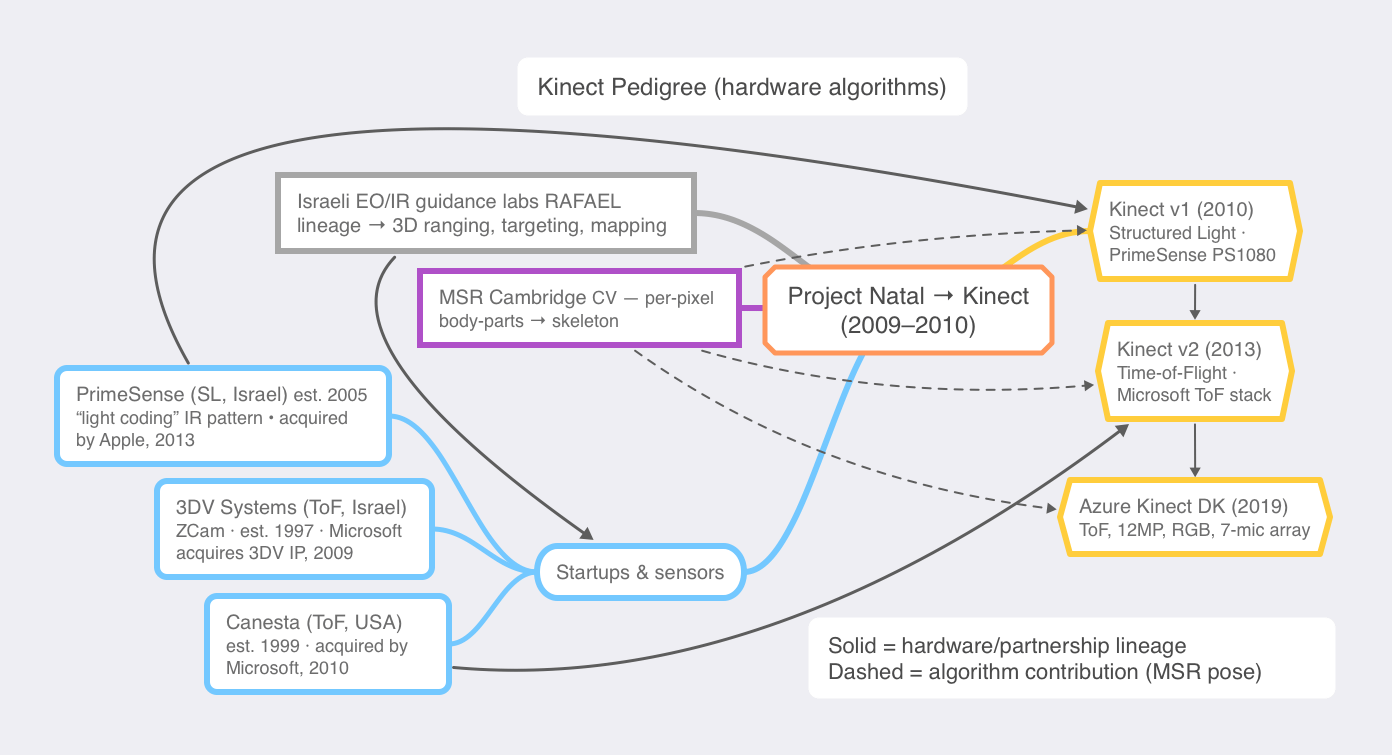
Structured Light Sensing (from Kinect v1’s PrimeSense technology) evolved into Apple’s TrueDepth cameras, which now appear in billions of devices worldwide. But the same dot-projection technology that lets you unlock your phone also powers facial recognition systems deployed in airports, border crossings, and surveillance networks globally.
Time-of-Flight Sensors (from Kinect v2) became commonplace in smartphones for improved photography. Yet ToF sensors are also used in autonomous weapons systems for target identification and ranging.
Skeletal Tracking Algorithms that turned our bodies into game controllers now enable behavioral analysis systems that can identify individuals by their gait, posture, and movement patterns, even when their faces are obscured.
Voice Recognition developed for Kinect’s speech commands has evolved into always-listening devices that process billions of conversations, ostensibly for our convenience, but with the technical capability for comprehensive surveillance.
As someone who has spent years exploring the creative possibilities of these technologies, I face an uncomfortable question that many artists and technologists must grapple with: Am I complicit in advancing surveillance capabilities by promoting and demonstrating these tools’ potential?
When I map skeletal data to spatial audio in my performances, am I showcasing the same technologies that enable automated crowd monitoring? When I demonstrate how depth sensors can create invisible interfaces, am I providing a blueprint for covert tracking systems?
The answer is nuanced, and it’s taken me time to develop an ethical framework around these questions. The technologies exist regardless of how artists use them. Our choice is whether to engage critically with these tools, understand their implications, and model responsible practices, or to cede the entire conversation to those who would use them solely for commercial or surveillance purposes.
Through my practice, I’ve developed what I call “consent-first sensing” principles that guide how I work with surveillance-capable technologies:
Visible Operation: In my performances, participants can see exactly how their movements translate to sound. When someone waves their arm and hears a corresponding shift in the spatial audio, they develop intuitive understanding of what the system is capturing and how it’s being processed. This demystification is crucial for informed consent.
Local Processing: The most responsive and privacy-preserving systems I’ve built process sensor data locally, in real-time, without storing or transmitting personal information. Everything happens in the room, in the moment. No clouds, no databases, no persistent records of who moved how.
Agency Preservation: The best human-computer interactions preserve human agency and choice. In my setups, people can opt in, opt out, or modify how the system responds to them. They maintain control over their participation and can see the immediate effects of that control.
Purpose Clarity: Participants know they’re being tracked, understand how their data will be used (to make sound), and can see that no other processing is occurring. There are no hidden layers, no secondary uses, no data collection beyond the immediate creative purpose.
These principles emerged from practice, but they represent broader questions about how we can engage responsibly with surveillance-capable technologies.
One of the most revealing aspects of this technological cycle involves markets we rarely discuss publicly: the adult entertainment industry. This sector’s influence reveals a profound paradox about how consumer demand for privacy often creates the very technologies that erode it.
The adult entertainment industry has consistently been an early adopter of cutting-edge technology, driven by consumers seeking both quality and discretion. This demand didn’t just drive bandwidth improvements, it created the entire infrastructure model for modern digital content delivery. The industry pioneered streaming video protocols, secure online payment systems, Content Delivery Networks (CDNs) for global distribution, and virtual reality platforms that push immersive technology development.
The CDN infrastructure is particularly relevant to our surveillance story. These networks, originally built to deliver private content efficiently and anonymously, now form the backbone of global data collection and distribution systems. The same infrastructure that protected viewer privacy became the foundation for comprehensive behavioral tracking across all digital platforms.
Today’s VR adoption follows the same pattern. The adult industry has been at the forefront of experimenting with VR and AR technologies, but VR platforms collect unprecedented amounts of biometric data (eye tracking, head movement patterns, physiological responses) creating detailed behavioral profiles that extend far beyond their original entertainment purpose.
This creates the central paradox: industries seeking privacy and anonymity often drive the development of technologies that ultimately become surveillance tools. The infrastructure built to protect intimate behavior becomes the foundation for monitoring all digital activity.
The transformation has accelerated dramatically in recent years. From 2021 through 2023, venture capital firms reportedly pumped nearly $100 billion into defense tech startup companies: an amount 40 percent higher than the previous seven years combined. According to research by Brown University’s Costs of War Project, three of the world’s biggest tech corporations were awarded approximately $28 billion from 2018 to 2022, including Microsoft ($13.5 billion), Amazon ($10.2 billion), and Google’s parent company Alphabet ($4.3 billion).
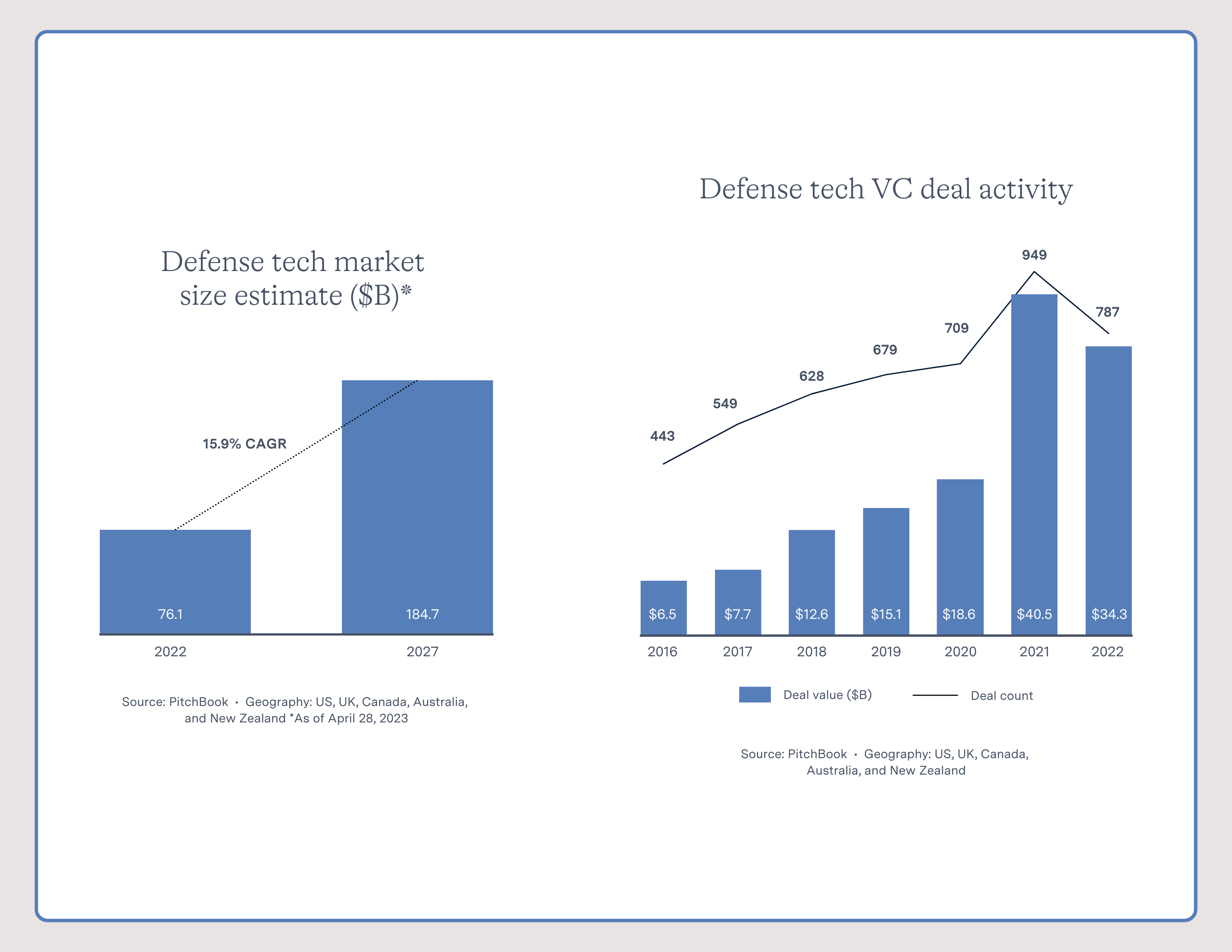
This isn’t just about money, it’s about the complete integration of consumer technology development with military applications. The Pentagon established its Defense Innovation Unit, a Silicon Valley-based DOD outpost in 2015 to boost collaboration with tech industry companies, especially startups. Meanwhile, tech companies have become increasingly aggressive about pursuing military contracts.
The message from Silicon Valley leadership has become unambiguous. As Palantir CEO Alex Karp stated at the 2023 World Economic Forum: “We want [employees] who want to be on the side of the West. You may not agree with that and, bless you, don’t work here.” When Google employees challenged the company’s involvement in Project Nimbus to supply the Israeli government with tech services, “Google terminated over 50 employees for participating in the protests.”
Given the reality of technological surveillance, what can we do to protect ourselves while still benefiting from useful innovations? Rather than generic privacy advice, here’s the framework I’ve developed through my creative practice:
Question the Stack: Before adopting any sensing technology, I ask five questions: What does it infer about human behavior? Where does the data flow? Who can say “no” to its collection? What happens when the system fails or misidentifies someone? Who audits its decisions?
Default to Local: Choose tools that work on your device rather than in the cloud whenever possible. The same technological sophistication that enables surveillance also enables resistance—Signal provides encrypted messaging, Tor enables anonymous browsing, TAILS offers secure computing environments.

Design for Agency: Whether I’m building a creative system or choosing consumer technology, I prioritize tools that preserve human choice and understanding. Can users see what’s happening? Can they opt out? Can they understand and modify how the system responds to them?
Support Alternatives: Artists and technologists have developed creative countermeasures—CV Dazzle makeup patterns that fool facial recognition systems, adversarial fashion that confuses computer vision, and open-source alternatives that prioritize user control over data extraction.
Practice Informed Consent: In my creative work, this means transparency about what technologies I’m using and their implications, prioritizing local processing and data minimization, and supporting communities working on privacy-preserving alternatives.
We cannot uninvent depth sensing, facial recognition, or behavioral analytics. These technologies are here to stay, and they will continue evolving whether we engage with them or not. We didn’t just fund these systems… we rehearsed them, trained them, and normalized them until they felt inevitable. Our choice is whether to participate consciously and deliberately, or to sleepwalk into a surveillance state.
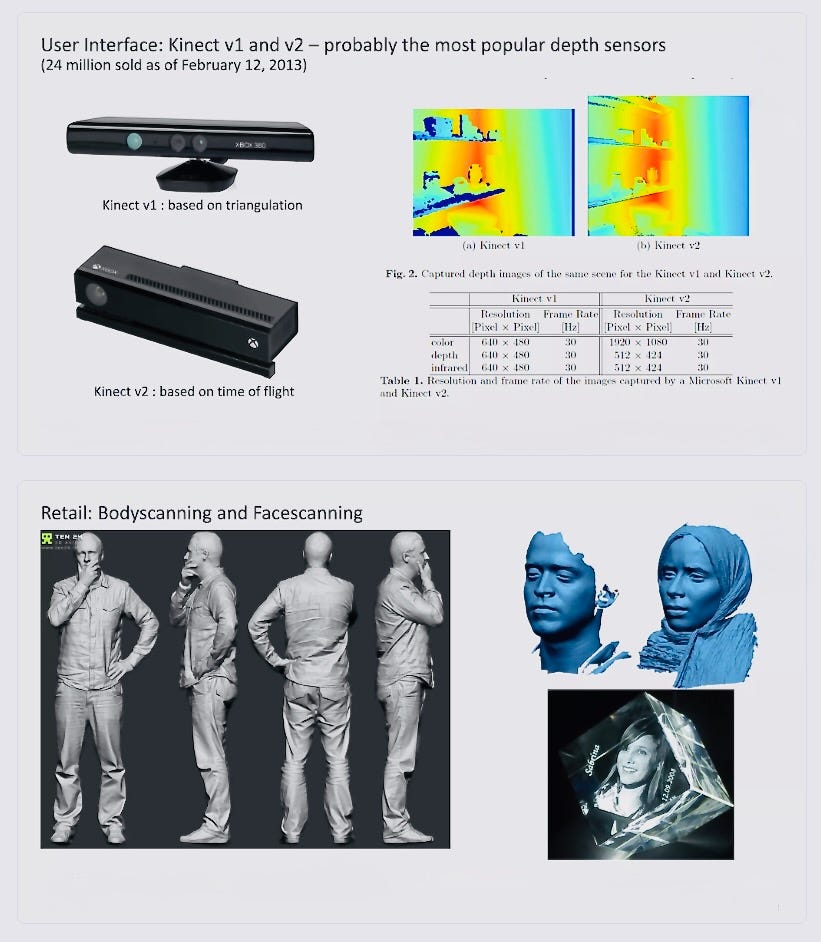
I continue to use Kinect successors in my work (including my 3D printing creations) because I believe understanding these technologies is essential for maintaining human agency in relationship to them. When I see someone navigate a spatial audio environment with natural gestures, or watch a performer control complex soundscapes through movement, I’m reminded that these tools can serve human creativity and expression.
But I’m also reminded that the same gesture recognition that enables musical performance can enable behavioral tracking, that the same depth sensing that creates immersive art can create pervasive monitoring, and that the same human enthusiasm that drives creative innovation also drives surveillance capitalism.
The challenge of our time isn’t choosing between technology and privacy, it’s consciously shaping how technologies develop and deploy. Every time we choose tools that respect user agency over those that extract data, every time we demand transparency from technology companies, every time we support open-source alternatives, we’re participating in this shaping process.
The story of Kinect teaches us that technologies have multiple possible futures. The same depth-sensing capabilities that emerged from military labs could enable either unprecedented creative expression or comprehensive surveillance... or both simultaneously. The difference lies in the choices we make about how to build, regulate, and use these systems.
As I write this, new sensing technologies are being developed in labs around the world. Some will undoubtedly emerge from military research, be adapted for consumer use, and eventually return to surveillance applications. But their ultimate impact will depend on whether we approach them with awareness, intentionality, and commitment to preserving human agency.
The dance between creativity and surveillance will continue. Our responsibility is to remain conscious participants in that dance, rather than passive subjects of it. In the concert hall, a raised arm can send sound spiraling through space; in the street, the same arm can trigger a surveillance alert. What matters is who listens, and to what end.
This concludes the three-part exploration of Kinect’s journey from military laboratory to creative tool to surveillance infrastructure. While the specific device has been discontinued, its technological DNA continues to shape our world in ways both seen and unseen. Understanding this legacy is crucial for navigating our sensor-saturated future.
Privacy Protection Tools:
Electronic Frontier Foundation Privacy Guides
Surveillance Self-Defense (EFF)
Creative Technology Ethics:
Technical Security Resources:
TAILS Privacy Operating System
Research and Analysis:
How the Pentagon Built Silicon Valley - Responsible Statecraft
Center for Strategic and International Studies
No posts
Comments
Nothing yet. Say the first thing.
Sign in to join the conversation.