
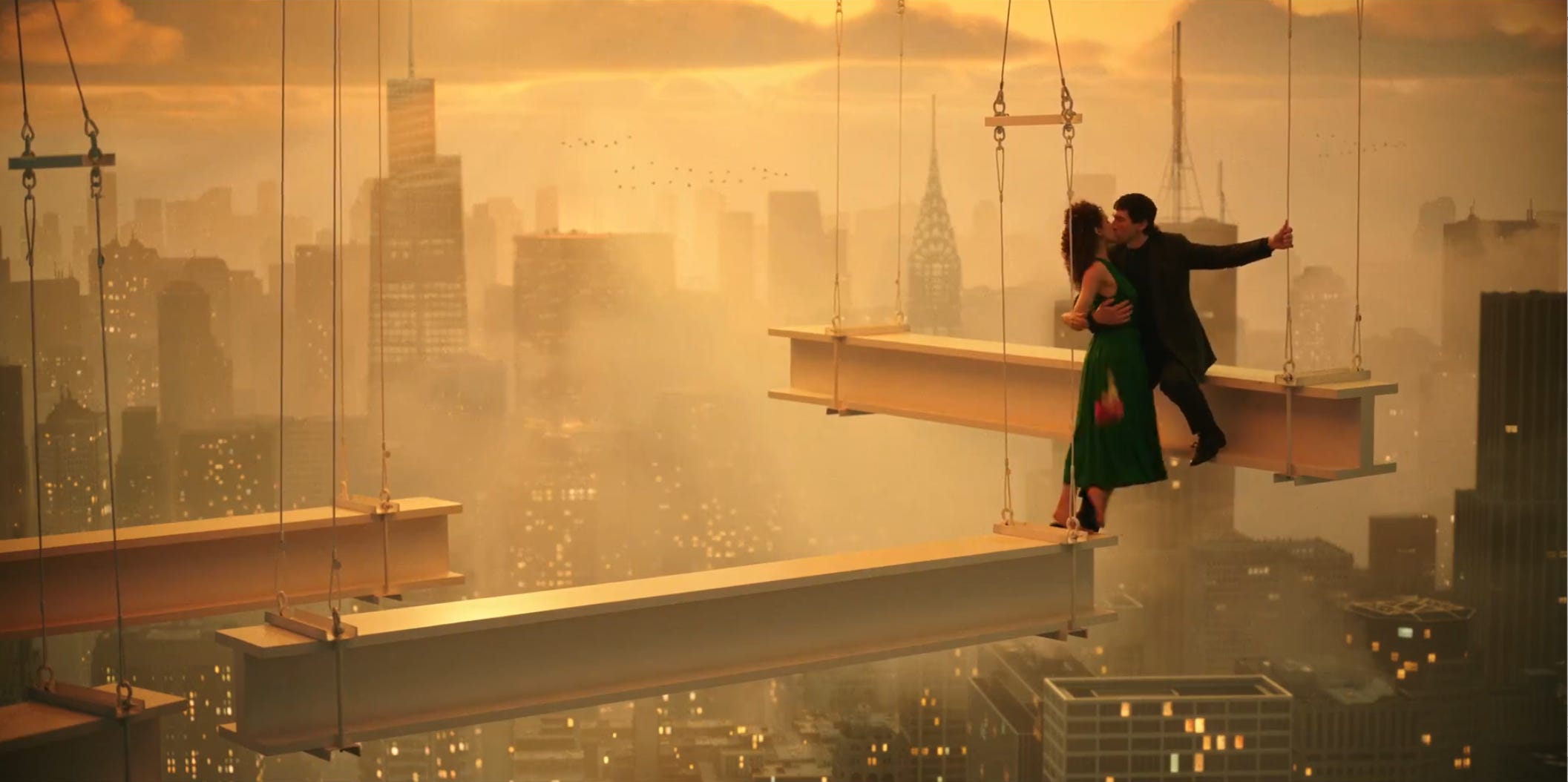
After months of dismissive reviews and bewildered criticism, I finally watched Megalopolis. I didn’t catch it in the cinema, unfortunately, and I only saw the film itself, not the “audience participation” experiment Coppola staged at some screenings. When it premiered here in France at Cannes, Coppola was interviewed several times. It was obvious that he has a special place in France, a kind of reverence, but even the French seemed a little lost with this one.
I put it off for a long time, in part because of all the bad press: the scathing reviews, the rejections, the talk of excess. But eventually I decided to make up my own mind. My wife jokes that I can get her to watch any film by describing it as a romance, but honestly, beneath all the Roman allegory and utopian rhetoric, it is a romance.
What I found wasn’t a failed movie at all, but something closer to an epic poem in cinematic form. Rough, rhetorical, uneven… but pulsing with ambition and meaning.
At the heart of Megalopolis lies the idea that “only artists can stop time.” Coppola has circled around this idea his entire career. In The Godfather, the weight of history presses on every ritual and gesture; in Apocalypse Now, time unravels into delirium on the river; in Youth Without Youth, it becomes the literal substance of the plot.
Here, time is not just a theme but the architecture of the film itself. Roman history overlays modern New York; utopian visions collide with present decay; personal grief fuses with political catastrophe. The film moves in cycles and tableaux rather than neat narrative arcs. It’s history, myth, and memory collapsing into one another.
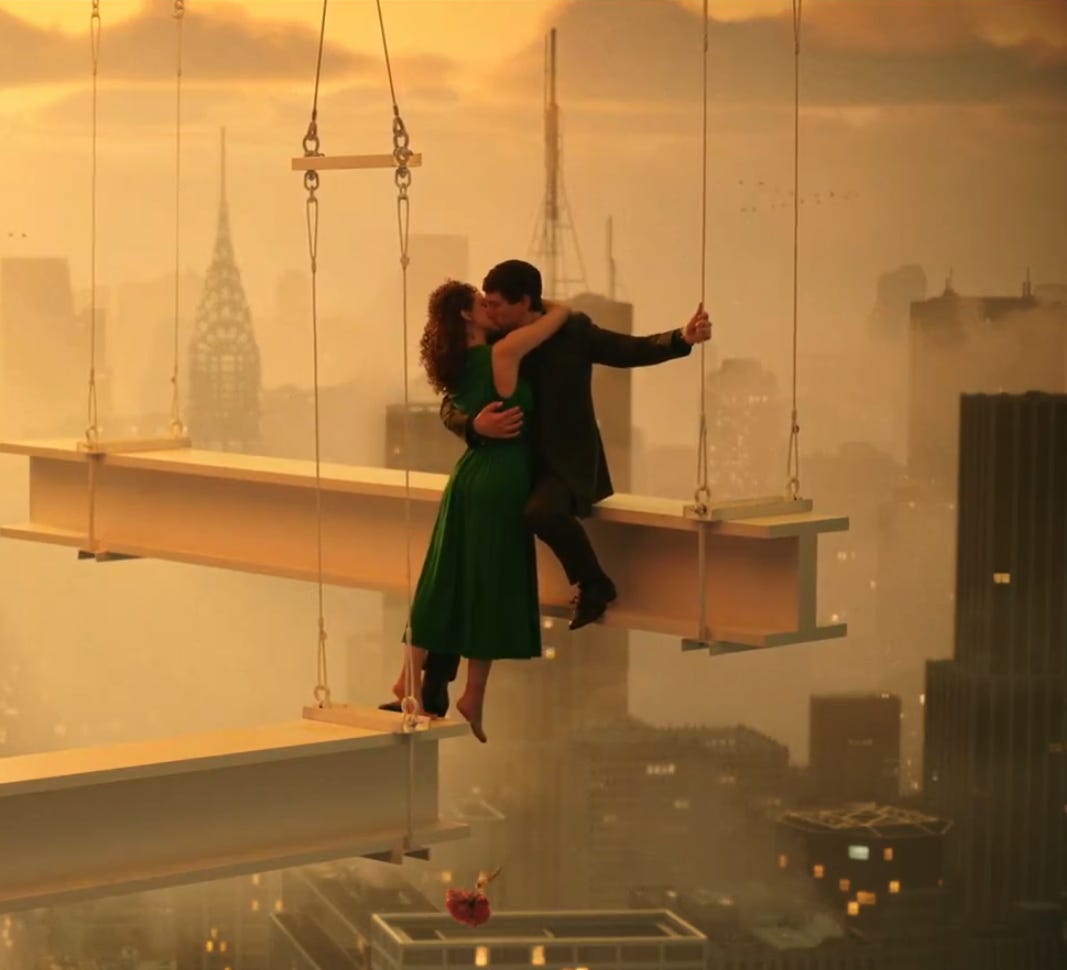
And Coppola doesn’t just talk about stopping time, he shows it. Cesar (Adam Driver) literally halts the world around him, freezing a moment in place. But he also loses that ability, like an artist who has lost faith in his vision, before finally finding it again. It’s a fable of artistry itself: doubt, crisis, rediscovery. This temporal manipulation becomes most powerful in the love story between Cesar and Julia. Their romance lives in these suspended moments, outside the chaos of politics and collapse.
Watching Megalopolis, I was reminded of Umberto Eco’s novels. Eco often made his first hundred pages deliberately dense, even dry. A test of the reader’s seriousness. If you endured the theological debates at the start of The Name of the Rose or the endless catalogues in Foucault’s Pendulum, you “deserved” the labyrinth of delights that followed. Eco was testing not just patience, but the reader’s relationship to time: could you slow down, linger, and accept delay as part of the experience?
Coppola does something similar, but with cinema. The opening of Megalopolis feels fractured, disorienting, even alienating. Then, suddenly, Adam Driver launches into Hamlet’s soliloquy. Not a sly quotation, but the whole thing. Narrative time stops. Clock time halts. We are suspended in pure rhetoric, pure art.
It’s Coppola’s Eco-like filter. If you sit up in that moment, as I did, and recognize the gesture — this is the register of the film: poetry, myth, history, philosophy colliding — then you’ve passed the test. If not, the film will leave you behind.
But here’s the thing my wife would appreciate: once you pass that test, what you get is fundamentally a love story… that happens to be dressed up in togas and utopian architecture.
In this sense, Coppola isn’t just quoting Shakespeare; he’s doing what the film itself claims: stopping time. The story pauses, but the meaning deepens. The viewer who surrenders to that suspension is rewarded with the ride that follows.
People fault Megalopolis for being incoherent, but what if that’s the point? We expect our stories to follow familiar patterns: three acts with clear beginning, middle, and end; protagonists facing defined conflicts (man against man, man against nature, man against himself); the polished, formulaic satisfaction of Marvel’s endless iterations. These are the rules that have governed mainstream cinema for decades, refined to a glossy perfection that prioritizes comfort over challenge.
But like his earlier masterpiece Apocalypse Now—which wasn’t really “about” Vietnam but, as Coppola himself said, is Vietnam (chaotic, overwhelming, morally destabilizing), Megalopolis doesn’t represent our fractured world so much as embody it. Coppola deliberately breaks those traditional storytelling rules because they can’t contain the contradictions of our moment.
Scenes feel chopped, abrupt, contradictory, a lot like the way we experience life now, bombarded by media and social feeds, pulled between the intimate (love, grief) and the collective (politics, collapse). Coppola uses cinema not to smooth this chaos over, but to make us feel it in our bones.
This is where the film’s roughness becomes part of its music. Coppola has never been a filmmaker of polish. Apocalypse Now is famously messy; even The Godfather, now remembered as a classical masterpiece, was stitched together from chaos. His films breathe, sprawl, and crack at the seams.
Watching Megalopolis, I kept thinking of the old saying: it’s close enough for rock and roll. You don’t need perfection when you’ve already achieved the essential effect… when it already sounds good enough. That’s how the film feels like a poem, not prose, not neat storytelling, but stanzas, riffs, crescendos, sometimes bum notes, always aiming for resonance over perfection. Scenes hit their mark emotionally and thematically, then we move on. The effect is achieved, we don’t need it polished to a Marvel sheen.
Megalopolis is Shakespeare meets Roman history meets Metropolis, but refracted through the contradictions of today. Its characters are archetypes, its city a metaphor, its structure a mirror of our time: intimate and political, future and past, utopia and ruin, all colliding.
The film is overwhelming, yes. It doesn’t resolve neatly. But that’s not failure that’s fidelity to the world it reflects. And at its center, anchoring all the grand gestures and mythic sweep, is the oldest story artists know: two people falling in love while the world transforms around them.
So yes, it is a mess. But it is also a vision. And in a film culture that too often prizes polish and safety, Coppola has given us something braver: a rough epic poem that dares to stop time.
I’ve read some reviews that insist on decoding Megalopolis as if every name, every gesture has a fixed symbolic key. Platinum must mean this, Cicero must mean that. I find those readings interesting, but limiting. I wouldn’t want to imagine Coppola’s film as a crossword puzzle to be solved, but rather as a work of art to be lived with, or even lived in.
There will never be a single “best explanation,” at least not until the critical dust settles. And maybe that’s the point: its richness lies in resisting premature closure. My reflections here are less about locking down metaphors than about following the currents that swept me along.
No posts
Comments
Nothing yet. Say the first thing.
Sign in to join the conversation.