
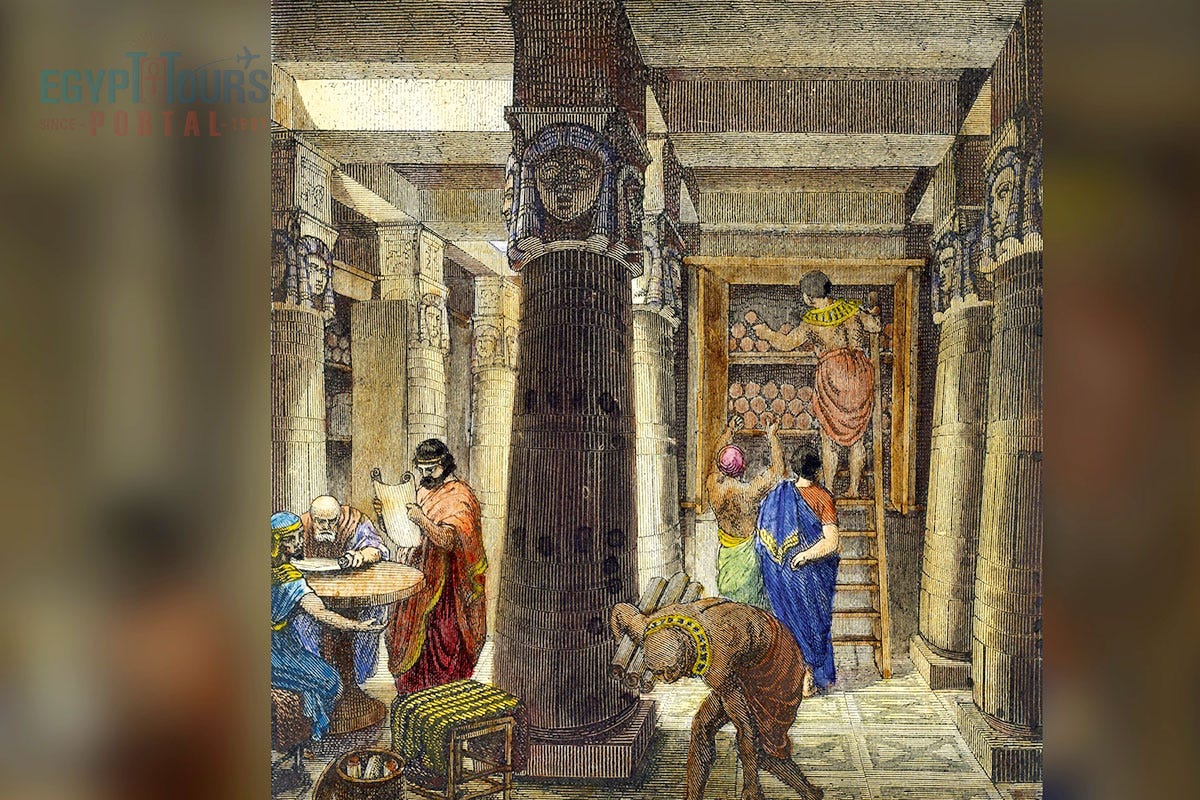
Illustration: One Room In The Vast Library of Alexandria
Our Weekly Editorial
By Carl Davidson
LeftLinks Newsweekly, August 21, 2026
This week we return to why AI and data centers matter. But to understand that best, we need to go backward - far backward - to the origins of human knowledge, human labor, and human power. The story begins long before silicon chips, long before electricity, even ong before capitalism. It begins with the first time human beings tried to store meaning outside their own bodies.
Here we turn to Ella Al Shamahi, a prominent British paleoanthropologist of Yemeni and Syrian descent, who does an amazing job of bringing us to see things in new and revolutionary ways. Her 2025 PBS documentary on Curiosity Stream, Human, offers an instructive lens. She takes us to Göbekli Tepe, the 10,000-year-old stone temple in southeastern Turkey, built not by early farmers but by hunter-gatherers.
Dozens of small bands gathered there, perhaps to intermarry, perhaps to share rituals. When agriculture emerged soon afterward, some farmers settled in these Tepes, with their fields outside, or, in the case of animals, brought inside at times, in shared interconnected quarters. But this proximity to animals brought disease and violence; the settlements collapsed. Some groups returned to gathering; others rebuilt agricultural life along major rivers, allowing for cleaner, more stable living.
Here Al Shamahi shows us the first markings appear: etched price tags and tallies for grain. As goods multiplied, the tallies became painted glyphs, produced by a caste of painter-scribes. Over centuries, glyphs became hieroglyphics. Writing on this scales made the pyramids possible - not because writing is decorative, but because writing is organizational power. Someone had to keep track of stone deliveries, workers’ schedules, and all the rest. These collected writings were the first data center.
Then comes the turn that matters most for Marxists - and for us.
The Egyptian elite wanted more than pyramids. They wanted copper and turquoise. They sent their enslaved workers far into the Sinai desert to mine them. These mines were hellholes: blistering heat, toxic dust, brutal overseers. But those workers wanted something of the rulers’ power, which they saw in the ability to put their orders and instructions in hieroglyphs. They couldn’t read these, but they knew the aleph sign meant “ox,” but instead of drawing the ox, they recorded only the initial sound - ah. Then ba for beta, the glyph for house. On and on, until the symbols for their sounds could be put together as spoken words. Full sentences, then, could be turned into strings of symbols, written down and respoken. Al Shamahi shows us the ‘graffiti’ scratched on the walls in the mines.
The alphabet - the foundation of writing as we know it - was invented not by kings or priests, but by enslaved migrant laborers in a miserable desert mine.
This is the first great contradiction of human knowledge: the ruling class hoards power, but the enslaved working class invents the tools that make deeper civilization possible.
And here is where we introduce the Epstein class - not as a scandalous footnote, but as a structural category. The Epstein class is the modern incarnation of that ancient ruling stratum: a fusion of capital, political power, intelligence networks, and patriarchal impunity. It extracts labor, hoards knowledge, and uses secrecy as a weapon. It is the class that treats human beings, especially women, as commodities, whether in Bronze Age mines or on today’s private islands and ranches. It is the class that benefits from knowledge but rarely produces it.
The Sinai miners created the alphabet. The Epstein class uses the alphabet to produce contracts, shell companies, blackmail dossiers, and the architecture of elite impunity. The contradiction persists.
But writing does more than transmit messages. It can store them. Greek plays were not only performed; they were written down and collected in libraries like Alexandria. Anyone literate could learn from them, extend them, contradict and debate them. Knowledge thus became cumulative. The Library of Alexandria was the first class data center of the ancient world - and when it burned, humanity lost centuries of stored know-how.
Today, our libraries are often digital. Our Alexandria is the global network of data centers. And once again, the ruling class wants to control the storage.
But let’s look deeper. Paul Romer, a Nobel Prize economist, gives us a simple model of any economy: draw a circle, then divide it into three sectors: hardware, software, and wetware. Hardware is smokestack mills, machine tools, power grids, trucks. Software is apps, manuals, books, poetry, recorded music and film - all stored in libraries, hard drives, and data centers. Wetware is the “software” between your ears - the human capacity to generate new knowledge.
Wetware is the most important of all. It is what allowed enslaved miners to turn glyphs into letters, letters into words, words into knowledge. It is what allows workers today to build AI models, write code, design chips, and imagine new worlds.
Some on the left, in this context, argue for an ecological “degrowth” in our economies. With that view alone, they remain prisoners of an old idea: that an economy is primarily “white guys moving heavy stuff around,” movements that also require fossil fuels. Strategically, we may want to curb and restrict one or even two sectors of the economy.
But not the third. The knowledge between our ears must grow toward infinity. Only through its infinite growth do we gain the know-how needed to humanely curb the other two. And if you ignore or are blind to the third sector, your political economy is flawed.
Buckminster Fuller explained this in Operating Manual for Spaceship Earth. He divided the universe into two: Matter in motion is finite. Energy obeys conservation laws. But know-how is unlimited. The more you use it, the more it grows. And once digitized - once stored, copied, transmitted - its growth approaches the speed of light.
Which brings us back to AI.
AI is simply the newest, fastest engine for generating know-how. And all that know-how must be stored somewhere - in data centers. The Epstein class wants to own the data centers, just as ancient elites wanted to own the mines. They want to own the storage of knowledge because storage is power. Then they want to rent it out to us in dribs and drabs. They are not wealth creators, but a new rentier class, landlords of access to information.
Our task is to break that monopoly grip and take popular control.
We do well to build data centers - but as Bucky would say, with “high design” - in ecological harmony with everything else. But we must also design them in political harmony with democracy, labor, and human dignity. Because the alternative is to let the Epstein class privatize the very infrastructure of human knowledge.
Welcome to the new world of AI - and to the ancient struggle over who controls the library, who controls the alphabet, and who controls the future.
No posts
Comments
Nothing yet. Say the first thing.
Sign in to join the conversation.