
By Carl Davidson
LeftLinks Newsweekly, July 31, 2026
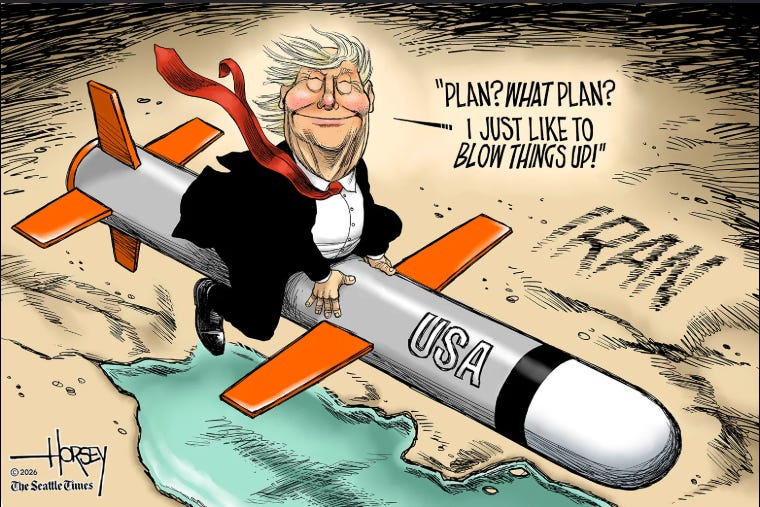
Our understatement of the week is that President Donald Trump is intensifying the dangers of wider wars abroad and fascist measures at home.
Fortunately, resistance is already forming and growing—across institutions, courts, and civil society—but to grasp the full scope of the travails ahead, it’s worth stepping back and tracing the pattern emerging from his recent danger-laden actions.
Trump and his newly installed ‘War Secretary,’ Pete Hegseth, have embraced a politics of spectacle. Their preferred medium is violent broadcasts as entertainment. They reveled in circulating videos of U.S. aircraft blowing up fishing vessels allegedly carrying drugs.
In any prior administration—Republican or Democratic—the U.S. Coast Guard would intercept suspicious boats, search them, seize any contraband, and, if warranted, arrest suspects. That is what ‘law and order’ actually looks like. But Trump’s team is not interested in legal procedures or evidence. They want live-fire ‘snuff’ reels on our cable news, a steady drip of destruction to cultivate the image of ‘tough guys’ and ‘real men.’ In reality and a just world, these murderous theatrics expose the United States to potential war crimes allegations under international law.
The escalation didn’t stop there. Trump moved on to a super-spectacle: an aerial kidnapping of Venezuela’s president and first lady, killing dozens of Cuban security personnel in the process. He made no pretense of supporting democracy in that country. He left the Maduro regime intact as a subordinate client and immediately maneuvered to seize Venezuela’s oil. It was a gangster’s coup dressed up as foreign policy.
Trump has long admired the methods of the mafia, having been groomed early in life by Roy Cohn, lawyer to the mob. Former FBI Director James Comey explicitly noted that Trump’s private demands for absolute loyalty, or personal fealty to him, and not the Constitution, felt exactly like a Cosa Nostra induction ceremony.
But Trump’s inflated ego has now carried him into far more dangerous terrain. He appears to have believed Iran was simply Venezuela with turbans—a fragile state run by goofy mullahs easily decapitated by precision strikes. Remove two layers of leadership, he thought, and the regime would collapse into America’s lap.
This is what happens when a nation is led by a narcissist who refuses to read the daily CIA briefings placed on his desk. He insists he is a ‘stable genius’ who knows more than the country’s generals and spies. Fox News placed him in front of a camera, fed him a series of leading questions, and he obligingly blustered his way into a crisis, threatening Iran with genocide.
His core mental deficiency was simple: the ‘stable genius’ knew next to nothing about Iran. It is a large nation of roughly 96 million people, many of whom are highly educated and rooted in a civilization stretching back millennia. It has a diverse economy, significant industry, and substantial agricultural capacity. Yes, its major wealth comes from oil, but the Islamic theocratic regime currently in charge also possesses a capable military and intelligence apparatus. Despite internal democratic, Kurdish, and feminist opposition in its civil society, it is not a pushover. It is not Maduro’s Venezuela.
Bombings and sanctions have battered Iran’s economy. In Tehran and across the country, families are seeing meat and dairy vanish from diets, medical treatments postponed, school blown up, rents paid late, and salaries stretched to the breaking point. But hardship does not equal collapse. Trump ignored the first rule of war: the enemy gets a vote. The Islamic regime voted by striking back—at every U.S. base surrounding it, and with intensified missile and drone attacks on Israel. More importantly, the regime understood that time was its ally. If it endured long enough for the United States to exhaust itself, the Islamic Republic would win by default. Washington had no strategy. Tehran does.
Iran’s trump card was the Strait of Hormuz. Its ability to shut down the world’s most critical oil artery meant that even mere survival was a form of victory. Moreover, as Trump’s bombings brought great harm to the Iranian people, growing numbers sided with the regime in defense of their sovereignty and their ability to subsist.
So, where does this leave Trump and his tirades?
First, Trump could ramp up air and missile strikes. But the list of viable military targets is likely exhausted, along with U.S. air weapon supplies. Further escalation would mean hitting civilian infrastructure—energy facilities, power grids, bridges, roads, communications networks. The outcomes are uniformly grim.
Trump would face accusations of war crimes. Iranian public opinion would harden even more against the United States. The regime’s ability to retaliate would remain intact, and it could strike Gulf desalination plants and energy infrastructure, triggering a humanitarian disaster. No contingency plans exist for such a scenario. Oil prices could spike to $150 or even $200 a barrel, plunging the global economy into crisis.
Second, a ‘boots on the ground’ invasion is even more unrealistic. Current U.S. forces in the region are too small to achieve meaningful objectives. A Marine Expeditionary Unit numbers about 2,500 personnel, of whom only 800 are infantry capable of limited operations. Airborne units deploy with only a few days’ worth of supplies—bullets, beans, and batteries. They require constant resupply.
Retired Army General Barry McCaffrey has noted that even 150,000 troops might not be enough to secure the Strait of Hormuz along Iran’s coastline. Attacking Kharg Island would require a long, vulnerable transit through the western Strait, exposing U.S. forces to heavy casualties.
The third and most catastrophic option is the use of a nuclear weapon, even as a “demonstration shot.” This would open a Pandora’s box of severe and unknown consequences. Trump has long mused about the tactical use of nukes. But he would be declared a war criminal or worse. Whether detonated in the air or on the surface, the weapon would cause mass destruction, political isolation, and global panic. It would shatter the nuclear taboo that has held since 1945. Only Trump can deliver an order to use a nuke, but it must pass through a string of generals likely to view it as illegal and refuse it. A ‘No Kings’ insurgency would go global and dwarf those we have already deployed.
So we turn to the domestic front. While escalating abroad, Trump is also tightening his grip at home. He has attempted to use the proposed SAVE Act to regulate—or effectively take over—local elections, despite clear constitutional limits. A federal court in Massachusetts recently struck down key components of an executive order that sought to restrict mail voting through federal oversight of the Postal Service. Judge Indira Talwani ruled the order “unlawful, null, and void,” emphasizing that the Constitution grants election authority to states and Congress, not the president.
“The Constitution does not grant the President any specific powers over elections,” she wrote, underlining the phrase for emphasis.
More than twenty Democratic state attorneys general brought the challenge, underscoring the breadth of institutional resistance forming against Trump’s attempts to centralize electoral control.
The Pattern Is Clear. Taken together, Trump’s actions form a coherent pattern: escalating violence abroad, eroding democratic norms at home, and relying on spectacle to mask strategic incoherence. His foreign policy is driven by impulse, grievance, and the pursuit of dominance rather than any rational assessment of national interest. His domestic policy is shaped by the same instincts—control, intimidation, and the dismantling of constraints.
The dangers are real. But so is the resistance. Courts are pushing back. States are asserting their constitutional authority. Civil society is mobilizing. Even within the national security establishment, alarm is rising.
The challenge now is endurance. Iran understood that time was its ally. Americans must understand the same. Trump thrives on chaos, but chaos is not a strategy. His bluster cannot substitute for planning. His spectacles cannot erase the consequences of his decisions.
For our part, we are defeatists in this unjust and irrational war. We demand that all U.S. military forces withdraw from their encirclements and restrictions of Iran. Desired changes in Iran, which we support, will come from within its civil society.
The United States is entering a period of profound risk—military, constitutional, and moral. But the country has weathered several storms before. Today, contradictions are sharpening within the MAGA bloc, making wider tactical alliances more likely. Our task, as a socialist left, is not simply to block Trump’s actions, but to both broaden the common front and build our own ranks by articulating and defending a vision of democratic governance that cannot be bent to the will of any single man, no matter how loud his threats or how grand his delusions. We reject fealty. We are not medieval serfs or mafia underlings. We are progressive democrats and socialists, and we see a new order rising on the horizon.
No posts
Comments
Nothing yet. Say the first thing.
Sign in to join the conversation.