
Through the rollercoaster twists of fate, I’m spending a chunk of America’s 250th birthday summer in rural Southern Illinois. My youngest, Nic, is doing a ceramics apprenticeship in Alto Pass (pop. 400), so we’re living in a house in the woods with one of my oldest friends, Katherine, and spending about an hour every day driving through the backroads of the Illinois branch of the Ozarks.
St. Louis-born myself, I’ve spent a lifetime trying to disabuse people about Midwestern stereotypes (“Missouri?!” sputtered a New Englander fresh from a posh boarding school when I rolled up at my East Coast college. “I didn’t know anyone came from Missouri!”)
Still, I’ll admit that when I came to stay in Jackson County, where the median household income is $48,763 (compared to the national median of $83,730), I’d packed a few stupid stereotypes of my own. I arrived as a die-hard urbanite, certain that the rural Midwest was great for hiking, but that I wouldn’t learn much, except perhaps lessons about American decline.
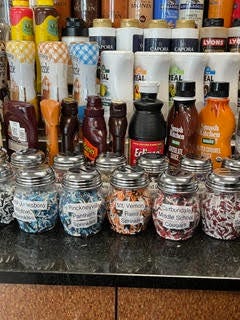
Three weeks in, some of my expectations still hold. The poverty is palpable; there are rows of rusting trailer homes, and rickety porches littered with broken toys. Towns boast thickets of church steeples; on the radio, I hear men pushing investment in gold and silver, because the Bible says they’re “God’s wealth.” The local frozen yogurt shop offers sprinkles mixed to match the colors of area high school sports teams.
If you’re just passing by, it can seem America is one nation under a White Christian deity, powered by lost causes, fossil fuels and six-packs of Busch Light. “Keep Calm and Kiss My Rebel Ass!” read the words over a Confederate flag I saw on someone’s front door today, as I walked the sidewalk-less streets of a small town, trying to get my steps in.
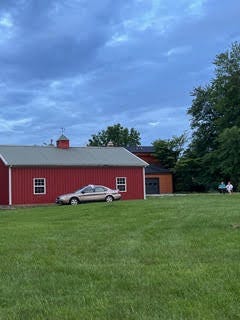
Coal was long a big industry around here—the area’s largest city is Carbondale, geddit? But environmental protections killed the mines, and the mining made rubble of land near them. “Without a drop of coal here, we would have been better off, because we would have had productive corn ground, soybean ground,” a Southern Illinois coal-miner’s descendant told a journalist in 2017. “We’re not going to have productive nothing here. It won’t be until the Lord come back.”
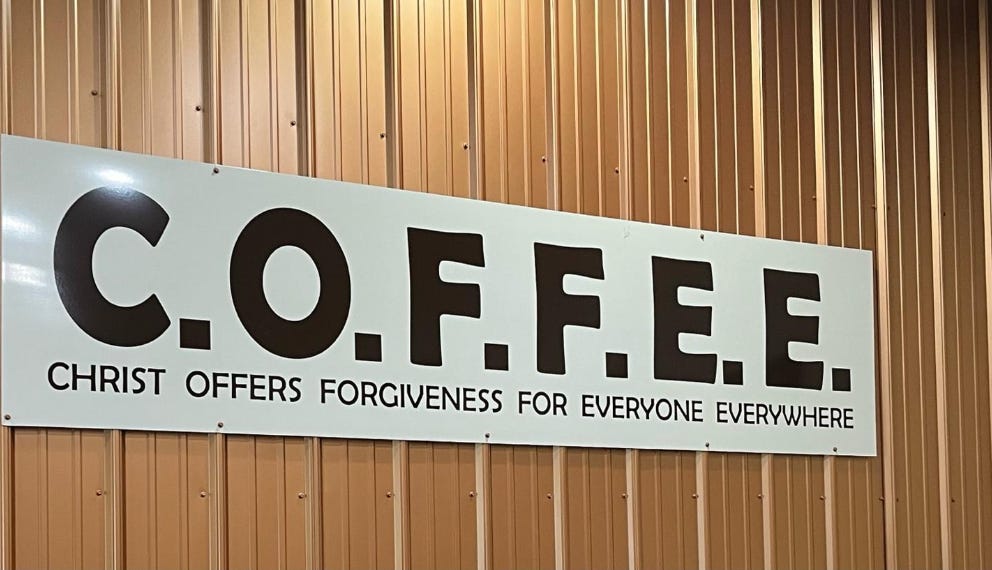
Many await the return. Every day, on the way to Nic’s pottery gig, we pass a roadside billboard from the local Pentecostal church, with a giant cross and the slogan: “I’ll Be Back!” I sometimes work at a coffee shop called Hebrewz, where the wifi password is “Jesus Saves.” Etymologists say the word “coffee” derives from Turkish, Arabic, or a region of Ethiopia. According to a wall decoration at Hebrewz, they’re wrong:
And yet, reality has shaved away all the lazy assumptions I could make about the rural southern Midwest as an unworldly place, whose population faces a poverty of choice. That’s true for some, of course, but I keep meeting people who explode that notion. Autodidacts and self-starters seem to thrive here. Thoreau famously left Concord, Massachusetts for the woods “to live deliberately… and see if I could not learn what it had to teach.” In rural Southern Illinois, I keep meeting people able to live deliberately in ways time-pressed metropolitans seldom can. Consider these scattered learnings from my short time in the house in the woods:
In the hills near former coal mines and abandoned railway tracks, vineyards produce award-winning Chambourcin, and eminently drinkable Vidal Blanc and Seyval Blanc.
A mile down the road from Hebrewz, my other “office”—where I can bogart the wifi and air con—is the stained-glassed and oak-shelved Anna’s Stinson Memorial Library, a noted example of Prairie School architecture designed by Walter Burley Griffin, who trained in Frank Lloyd Wright’s studio.
The area boasts its own Sufi community. The other night, above the din of the bullfrogs in a rural forest, I chatted with a local about South Asian strains of Islamic mysticism.
On a recent hot night, Katherine took me to a humble one-story track-house in suburban Carbondale. Our host Michael took us out through the back. Where I had expected a paved patio stood an oasis grown from seed and twigs. A fountain splashed, and we walked along the shaded paths, among weeping willows and maples, admiring the mulberry bushes and chewing on sprigs of lemon balm from his edible garden. Michael commutes once-weekly from the country to Chicago. Once off the Amtrak, he trains people in poor neighborhoods to build urban farms, teaching families living amid tarmac and brick to grow their own food.
As I listened to his stories of growing vegetables in vacant lots, it struck me that I needed to reexamine my old ideas about the city and the country. The assumptions that cities are dynamic, and that rural America is stuck, if not outright dying, needed tweaking. Here in Southern Illinois, I can see the laid-back lifestyle and low costs serving as mulch, enriching soil for creativity. In my parents’ day, places like New York or London were meccas for the ambitious, creative, and innovative. But today, urban housing crises mean that it’s mostly the uber-rich or the retired who can afford to be curious, iconoclastic, or creative. The rest of us have to concentrate on making rent.
In Carbondale—where, let’s face it, you have to make your own fun—and workaholism isn’t so much a thing, I keep meeting people with the energy to expend on personal passions and projects. A high school teacher who has a mobile zine-making business. A plant biologist who birds and flies hot air balloons. A mathematician-turned-ceramicist. On Katherine’s wall is a giant home-made chart of penciled notes on French history, which she’s decided she’s going to study this year, before she takes on World History in 2027. At dawn, she’s up to swim. Then she drives the ten minutes to her small business, which sells an invention for mapping rivers, sold everywhere from China to Harvard. At night, she practices her viola.
Katherine and Michael are living deliberately. In London or New York, who has the space to plant their own oasis, or the time to make their own music? In the city, woods and green space are luxuries, as are creativity and community. Out here, in the so-called middle of nowhere, American dreamers still have a shot at them.

Barnes & Noble | Bookshop.org | Amazon | See more options at PRH.com
No posts
Comments
Nothing yet. Say the first thing.
Sign in to join the conversation.