
What the hell can one possibly write after your president has threatened genocide of the Iranian people, warning that “a whole civilization will die” if Tehran doesn’t agree to his terms?
“Drunk with victory, the Devil Celebrates our wake,” wrote the 20th century Iranian poet Ahmad Shamlu. Though 2500 years old, Iranian civilization has never had a wake, thanks in part to writers like Shamlu. (See his life as a dissident, as well as devastating lines on courage in his prison poem Nama here.) Iranian civilization remains in rude health for many reasons. Among them, particularly since a CIA-backed coup toppled its democratically elected President Mohammad Mosaddegh in 1953, a growing number of female artists and intellectuals have been talking back beautifully to power-drunk dictators. They’ve resisted bullies and despots, from household or neighborhood dictators to the Shah. They’ve deployed their creativity against murderous regimes, be they Donald Trump’s or the current Islamic Republic’s.
Below are some links to Iranian women’s voices on the subject of erasure, proof that Iran’s civilization hasn’t been snuffed out by repressive governments, and it certainly can't be extinguished by Israeli-American warfare.
The Devil can cut short his celebrations.
In the 1960s, the pioneering poet Forugh Farrokhzad wrote fierce poems about the erasures women face through societal pressures.
Filmmaker Maryam Tafakory discusses erasure as a force in Iranian cinema, where censorship has shaped what gets seen, what’s left outside the frame, and what gets fetishized.
Fariba Amini at Informed Comment delivers this bracing reminder of Iranian resilience: “This land which has gone through many invasions, from the Arab invasions of the seventh century to the Mongol invasions of the thirteenth, but which has endured.”
And for a nuanced discussion of the pressures of erasure and inclusion in the production of the Israeli spy thriller Tehran, now on Apple TV, check out this piece by the Los Angeles-based Iranian filmmaker Anisa Hosseinnezhad.
Since President Trump’s genocidal threat, I’ve kept thinking about my last contact with Iranians within Iran, just over a year ago. Out of the blue, I’d received a gracious email from a lecturer at a university in the city of Qom, the center of learning for Shi’ite clerics. The woman I’ll call Fatema, a lecturer in Islamic law, was a member of a group of international Islamic Studies professors who held monthly talks on Islamic texts. She had read my first book, a memoir of studying the Qur’an with a madrasa-trained sheikh called If the Oceans Were Ink, and wondered if I would give a talk about my insights on the scripture to the group.
The idea of a secular American journalist raised by a Jewish mother and Quaker father lecturing a group of Qom clerics about the Qur’an seemed equal parts presumptuous and preposterous, a toe-curling case of West-splaining. I wrote back to say that I wouldn’t feel comfortable giving a lecture, but would love a discussion. “We would love an informal discussion,” came Fatema’s swift reply. “I’m sure it will feel as captivating and cozy as reading your book does.”
Since US sanctions complicated using Zoom, she explained, we would need to use either Google Meet or Skype for the event. I didn’t have to wear a headscarf, the organizers assured me, but said that my ideas might get a better reception from the clerics if I did. I always wear a headscarf when I go into mosques, and am even happy to wear it when I’m in Muslim-majority societies. This time I opted not to, figuring that Article 638 of Iran's Islamic Penal Code shouldn’t dictate what I wore while Skyping from our spare room in London.
On the appointed day, hopping on Skype to connect with Qom, I found that Fatema turned out to be a very young woman in a natty black-and-white striped hijab and matching sequined robe. In the lead-up to the talk, I watched her as she bustled setting up ; she radiated warm intelligence, and spoke fluid, fluent and idiomatic English. Had she studied abroad? I asked her, though thinking that she didn’t seem to fit the mold of the wealthy Iranian students I’d seen in the US and UK.
“I’ve never been abroad,” she said lightly.
“So how did you learn your incredible English?”
“By listening to boy bands,” she said with a grin.
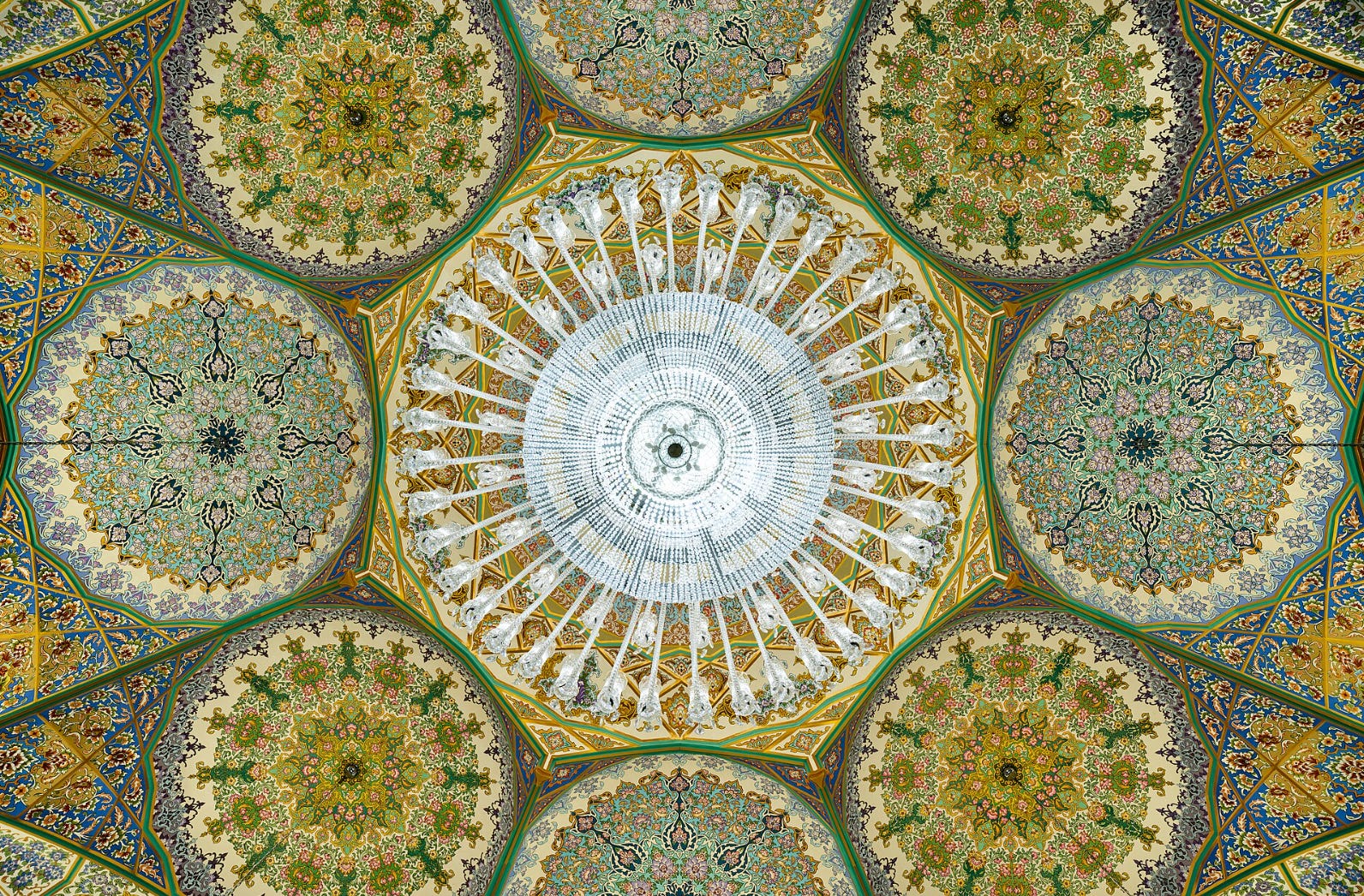
Mind blown by the notion of One Direction as a language tutor to Shia legal scholars, I watched as students and clerics in white turbans and camel-wool cloaks filed into the hall. I’d imagined Qom’s Qur’an lectures would be delivered in rather spare surroundings, but the lecture hall was downright lush, with white columns, flower arrangements, and sumptuous drapes in plum and gold.
The audience was as gracious as the surroundings. They politely listened as I talked, with Fatema deftly translating into Farsi every five minutes or so. Eager to skirt Islamic topics, I stuck to talking about why American media portrayals of Islam can be crude. Too often, Islam isn’t presented as a faith or spiritual practice, but a geopolitical force. With Muslims making up just one percent of the US population, most Americans have never met a Muslim, I explained. Unfortunately, all they had to rely on were headlines about terrorists, fake news about creeping Sharia, and Hollywood movies about Islamic sleeper cells. In the decades after 9/11, stereotypes of terrorists and women in burqas were useful shorthand for the so-called Islamic world, a misnomer for the variety in a population of 1.2 billion people covering people from Qashqai nomads to Houston heart surgeons.
I couldn’t tell for sure, but I suspect I was droning on about things they only knew too well. (While Fatema translated, I peeped out at the crowd, and caught a couple of bored-looking clerics gazing at their phones.)
My nerves that day mean I can’t remember much of the discussion that followed. I do remember being relieved that when questions came. Tellingly, they weren’t about media portrayals or politics but rather about the Qur’an. What were some of my favorite parts?
I told them I loved the earthy empathy of the description of the labor pains Maryam endures when giving birth to Issa, as Muslims call Jesus. And for sheer poetry, I loved Surah al-Rahman or “The Merciful,” evoking all that Allah had done, from placing the sun and moon into orbit, to creating palm trees with dates, fragrant plants, and humankind.
After the talk, Fatema thanked me. Her mother wanted to translate my first book, and both women said they hoped they’d see me one day in person in Qom. I’d been there once as a child, having lived in Iran when I was five, and having visited a couple of times in the late 70s, just before the revolution. I so wanted to come, I told them. I’d try.
Inspired, I joined a tour to go to Iran last fall. Or rather, I signed up, but didn’t expect to get a visa, having tried and been refused several times in the past. My expectations sunk to nil the day after sending in the visa application, since it was then the US began its June 2025 bombing campaign. Miraculously, however, the visa came through in late summer. At the last minute, a family matter meant I couldn’t use it.
The Israeli-American war means it will be a long time, if ever, before I’m granted another visa. Though I’m uncertain whether I’ll ever see Iran again for myself, I’m certain that its civilization will endure.
Barnes & Noble | Bookshop.org | Amazon | See more options at PRH.com
No posts
Comments
Nothing yet. Say the first thing.
Sign in to join the conversation.