
Raise your hand if someone sent you a document last week that took two hours to decode and should have taken ten minutes.
Or perhaps your inner ick detector went off while reading a LinkedIn post about the “load-bearing idea” you need to “sit with.”
You know the document. It has headings, frameworks, perhaps a suspicious number of colons where those em dashes used to be. It appears finished. Then you start reading and wonder if you’ve stumbled into a high school essay hellscape.
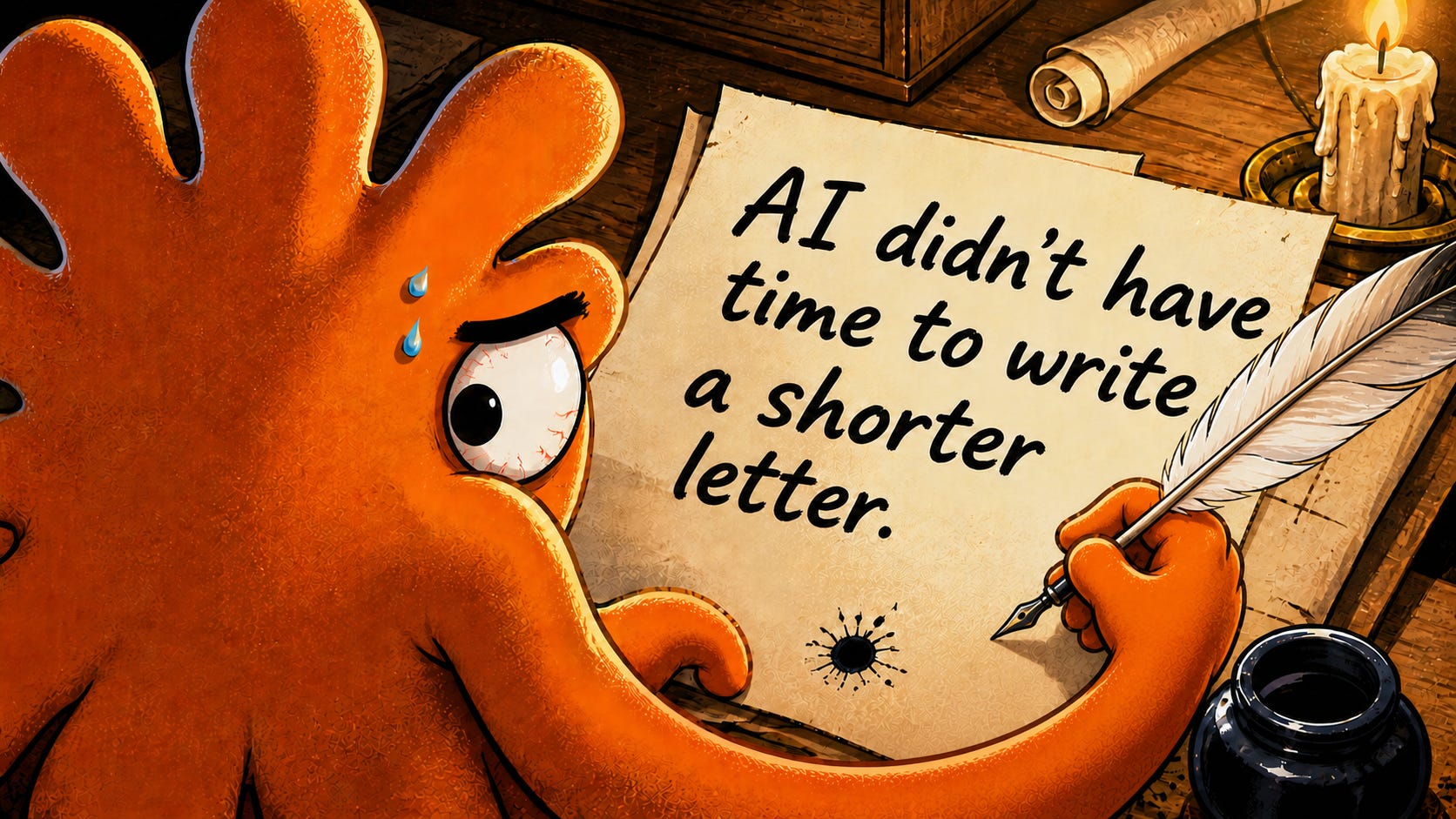
In 1656, Blaise Pascal ended the sixteenth of his Lettres provinciales with an apology:
“Je n’ai fait celle-ci plus longue que parce que je n’ai pas eu le loisir de la faire plus courte.”
I have made this letter longer only because I did not have the leisure to make it shorter.
(It gets attributed to Twain constantly. He didn’t say it. Not Churchill either.)
What interests me is not just Pascal’s observation. It’s the apology.
Pascal understood that he had moved the cost of processing information off his desk and onto his reader’s. He didn’t have time to compress his thinking, so the reader would have to spend more time unpacking it.
Brevity is expensive. Writing something short requires knowing which parts do not matter, and knowing what does not matter is hard.
Writing has costs. Three fall on the writer: generation (getting the words down), compression (deciding what matters and what to remove), distribution (getting the result to someone else). A fourth falls on the reader: comprehension (turning what was written into understanding and action).
AI has dramatically reduced the cost of generation, but it has not eliminated the cost of compression. Compression (or editing) is the writer’s investment in the reader. Skip it and the cost does not disappear. It moves, because compression and comprehension are linked.
When the writer spends less effort on compression, the reader usually spends more effort on comprehension. If ten people receive the document, that cost is not merely transferred. It is multiplied.
Compression remains expensive because it is not merely a language problem. It requires knowing
who will read the document
what they already understand
what they care about
what they need to do next.
It requires a mental model of the reader.
When that context is missing, AI tends to produce the safest kind of answer: one that covers everything. Length also continues to look like effort, so our systems reward the very behavior we claim to dislike. AI can produce your required 1,000 words without breaking a sweat.
To be fair, many of us were trained for this. Remember the school essay where you had to turn in an outline, a first draft, a revised draft, and finally 1,000 words on a subject that needed perhaps 400?
The point was understandable. Teachers wanted evidence that we had done the thinking. But the lesson many of us absorbed was that process should be visible, length signals effort, and the assignment is not complete until every box has been filled.
AI is exceptionally good at filling the boxes. It can produce the outline, the five-paragraph essay, the transition sentences, and the obligatory “In conclusion” before you have decided what you think.
The problem is that some of us are now sending those forced first drafts to our coworkers.
Your colleague does not need proof that you completed the assignment. They need the point.
Length is not the metric that matters. Comprehension is.
So what can you do?
Pushing back can be difficult. Even carefully phrased feedback can be heard as a judgment about someone’s competence, effort, or character.
Still, unspoken expectations tend to become resentment. When you can give feedback, focus on the artifact and the effect it has on the work.
Ask for the goal: Before I dig in, can you give me the two-sentence version and tell me what you need from me? I want to make sure I’m reading this the right way.
Clarify what you need: This covers a lot of ground. What I need to do my part is your recommendation and the one tradeoff you’re most concerned about. Can you send those? Feel free to keep the long version attached for anyone who needs the detail.
Describe the impact: The last few documents have required me to do the summarizing on my end, and I don’t think that is the best use of either of our time. Going forward, can we default to one page with the recommendation at the top? If something genuinely needs more space, flag that and I’ll make time for the longer version.
Sometimes you cannot have that conversation. You may not know the writer well enough, or the organizational dynamics may make direct feedback impractical.
In those cases, AI can help you extract the missing clarity. It may also miss important context, so treat its answer as an aid rather than a substitute for your own judgment.
PS: Only upload workplace materials to tools approved for the information involved. Do not paste confidential or sensitive material into an unapproved consumer AI product.
Some prompts to try:
Extract a decision: Below is a document I received. Answer only these questions, in fewer than 100 words total. What is the author actually recommending? What do they need from me? What is the deadline or trigger, if any?
Find the substance: Below is a document. Identify every sentence containing a specific claim, number, commitment, date, or decision. Quote those sentences verbatim in a list. Ignore everything else.
Surface what is missing: Below is a proposal. List what a skeptical reader would still need in order to evaluate it, including missing numbers, unstated assumptions, unaddressed risks, and undefined success criteria. Be specific about each gap. Do not praise or summarize the proposal.
Good teams usually have established formats for proposals, pre-reads, product requirements, and decision memos. AI can quietly change how those formats are used, even when nobody explicitly changes the rules.
Teams should discuss that shift directly.
A useful starting point is to agree on three things:
Define the purpose and audience. Every document should identify the decision, intended reader, requested action, and deadline. If the writer cannot state the point in one sentence from memory, they may have a topic rather than an argument.
Set an expected reading cost. Use templates, word limits, or estimated reading times. If a pre-read should take 30 minutes and most of the team cannot finish it in that time, revisit either the document or the expectation.
Define AI’s role. Be explicit about which tools are approved, what information may be entered into them, and where human review is required. Revisit these expectations regularly as tools and working habits change.
The goal is not to punish people for using AI. It is to make clear that the sender still owns the thinking, the recommendation, and the effect on the reader.
The best ways to promote comprehension is to intervene before generation.
I wrote about this in Think Before You AI: spend a few minutes clarifying what you think and what you want before asking a model to produce anything. Otherwise, AI can help you elaborate an idea you have not actually formed.
That becomes especially dangerous when the output is intended for someone else. A confused prompt can become a polished draft, and a polished draft can become someone else’s problem.
Before writing, prompting, or pressing send, ask:
What is the one-sentence version?
What do I want the reader to understand or do?
Which claims do I personally stand behind?
Where do my own eyes glaze over?
If I had to retype this from scratch, what would I keep?
What can the reader safely ignore?
If you use AI to edit AI-generated writing, start with a fresh conversation so the editor is not anchored to the assumptions that produced the original. Give it an adversarial role:
You are a busy executive who will spend 90 seconds on this document and then make a decision. What do you take away? What do you still not know? What would make you send it back?
Pascal apologized because he knew his lack of time would cost his reader their time.
AI makes that cost easier to forget. It can produce ten pages before you have decided what you mean, then make those pages look finished enough to send.
But the reader still pays full price.
Before you press send, ask one question:
Have I done the thinking, or have I handed it to someone else?
If it is the latter, the document is not finished.
It is only long.
Comments
Nothing yet. Say the first thing.
Sign in to join the conversation.