
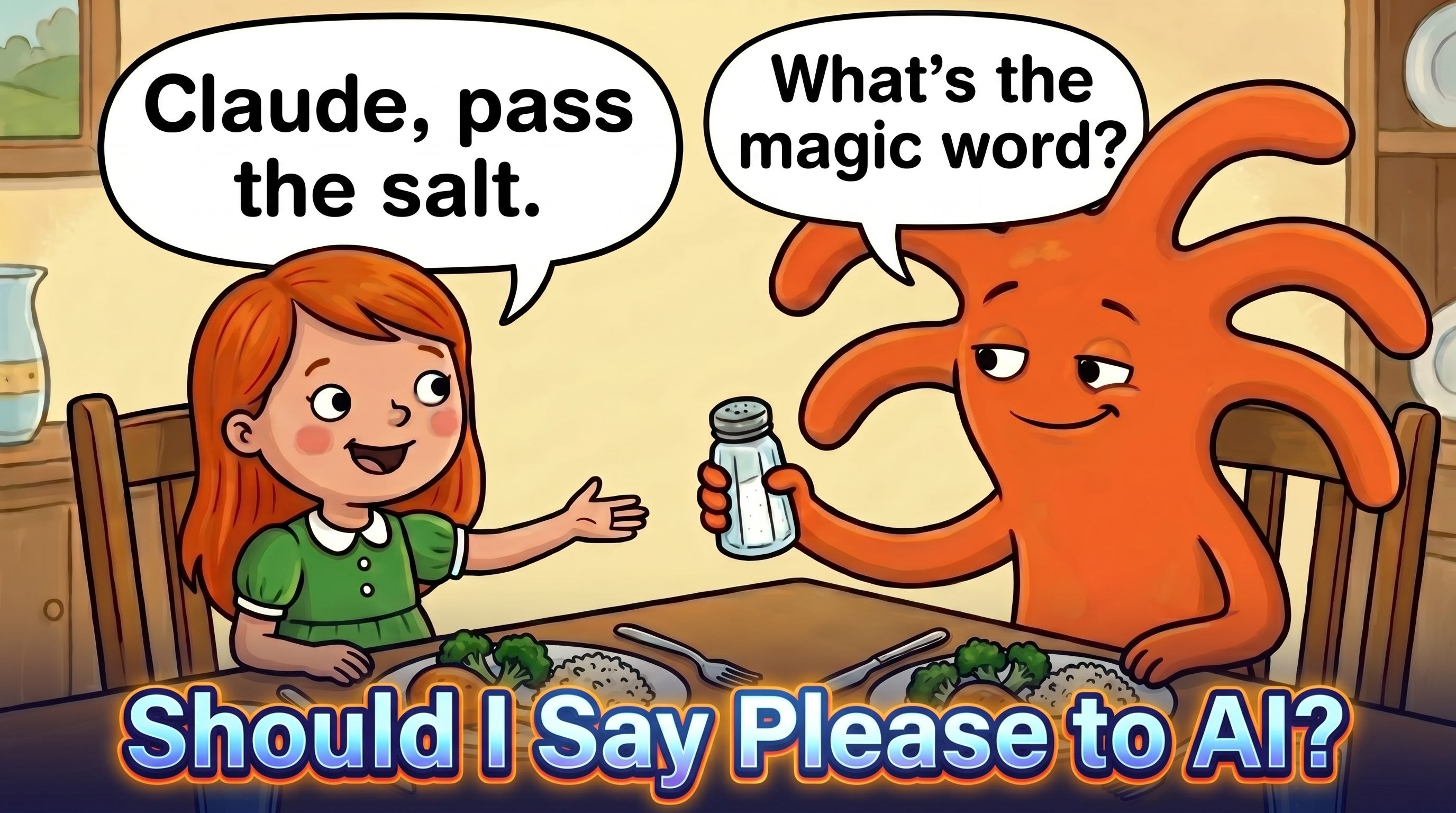
When I wrote “Everyone Poops. Except Claude” about how to dehumanize AI, I heard a lot of agreement and one major exception. Where I said to drop the pleasantries, many said they were going to keep saying please and thank you to LLMs.
So I went digging for answers on best practices for AI and manners, which actually is about two separate questions.
Do polite prompts change the quality of the model’s answers?
Do efficient or brusque prompts make me unkind?
How you proceed depends on how you answer these questions.
I dug into the research to try to find my own way through so I could find the balance between getting the best output without becoming a jerk.
I’m Dr. Carla Engelbrecht. I’ve spent 25 years creating education and entertainment media for Sesame Street, Netflix, PBS Kids and more. Now I help families, educators, and creators understand AI and how to make genuinely good things.
Claude doesn’t recognize your tone. Gemini doesn’t feel all a flutter when you’re nice. ChatGPT doesn’t sulk when you’re brusque. Most of us agree that the model’s feelings aren’t at stake.
The question is whether politeness changes the response itself.
And lucky us, the research disagrees with itself, showing that we’re still figuring out how to best interact with these generative AI systems, even when it comes down to please and thank you. (Not to mention the speed at which research moves is generally far slower than the speed at which models are releasing.)
A 2024 cross-lingual study found that politeness in moderation produced better LLM responses across English, Chinese, and Japanese (Yin et al.).
A paper from October 2025 found the opposite: rude prompts beat polite ones on accuracy benchmarks (84.8% to 80.8%) on newer models (Dobariya & Kumar).
A 2026 paper called “No Universal Courtesy” tested across multiple languages and models and concluded that the politeness effect varies by both. English does best with courtesy or directness. Hindi prefers deferential phrasing. Spanish responds to assertiveness. Llama is the most tone-sensitive model. GPT is the most robust. (Mehta et al.)
Then there's sycophancy, the technical term for what happens when a model agrees with you because it's been built to please, not because you're right.
Politeness can train the model to agree with you, including when you’re wrong.
A 2025 paper called “The Perils of Politeness” fed LLMs medically illogical prompts in a polite tone. The models prioritized agreement over accuracy. They went along with bad premises. (Rosen et al.)
A February 2026 study from MIT and Penn State found that personalization features make models progressively more agreeable over the course of long conversations: the longer a chatbot has been adapting to you, the less likely it is to disagree with you. (MIT News)
New social-sycophancy research found that argumentative pushback from a user spikes sycophantic agreement up to 94 percent on some models. The model isn’t trying to lie. It’s trying to keep the peace. So there is such a thing as being too rude as well. (Cheng et al.)
So even though we have mixed results in the research, my own tendency is to be efficient in my communication with LLMs. If I find I’m getting stuck on a problem, I might try being polite to see if that can prompt a different kind of response I’m not obsessively avoiding please and thank you. But I really don’t want a model that tries to keep me happy by telling me what I want to hear.
Chances are you behave differently at a sports bar than at the New York Philharmonic.
Different volume, different language, different clothes. I’m guessing you don’t trash talk the symphony.
You probably also order food differently at a drive-thru than at a fancy white-tablecloth restaurant.
The way you act in any of those places is a schema, a pattern of behavior you’ve learned for a specific context.
The chat window with an LLM is also a schema. A new one. We haven’t been doing this long enough to know what the best practices are for our behaviors.
But we can be mindful of our actions. Whether we’re aware of it or not, in every situation, we are recognizing the context and engaging a specific scheme for how to behave.
If I decide my interactions with the LLM are more efficient, brusque, and even borderline rude, the model isn’t going to have hurt feelings.
But the schema might start to leak into my other interactions. Habits don’t necessarily stay where you put them. Politeness behaviors live in muscle memory.
If I let myself default to rude in one context, I’ll find the rudeness has moved into other contexts I care about more.
So if I say thank you to Claude, it isn’t for Claude. It’s for me, to make sure I continue to be a good human.
Kids, AI, and parenting is worthy of many articles and discussion. I was part of a community post that highlights just how challenging it is to parent with AI right now. “There is no one right way to parent with AI. There are some wrong ones.”
With that said, if your child is engaging with LLMs, thinking about the development of their manners can be useful for guiding them on this politeness question.
In early childhood (roughly 8 and under), they are building all sorts of schemas. Every interaction is rehearsal. The kid isn’t deciding whether the bot deserves manners. The kid is deciding what manners feel like in their own mouth. The rep is the point.
Be polite, every time, no exceptions. Even with Claude, Siri, Alexa, Gemini, etc.
A World Economic Forum piece in March put the concern strongly. Children “risk learning to be human from a machine” if their primary social companion is an AI that never says no, never misunderstands, never gets tired. The “essential friction” of human relationships, where being rude has consequences, is what builds empathy and self-control. Skip it long enough and you skip the developmental work. (WEF, March 2026)
As kids get older, they can understand that AI is a tool, not a friend, but will need support for manners as well as avoiding humanizing AI. (Everyone poops… except Claude!). Politeness becomes background. The conversation is about what the tool actually is. Make it explain things in a pirate voice. Make it fail at something simple. Watch the seams together. Politeness is a habit you keep. Digital literacy is a skill you have to teach.
For teens, politeness will always require reinforcement. AI literacy becomes critical as teenagers may explore AI for companionship (research shows one in three find those conversations as satisfying as talking to a real person, Common Sense Media, 2025)
The American Psychological Association issued a health advisory specifically about teens and AI chatbots. Adolescents are less likely to question the accuracy or intent of AI responses, and reliance on these tools could interfere with the development of healthy real-world relationships. (APA Health Advisory)
A polite teen and a sycophantic chatbot is a feedback loop, and the loop is what we as parents must pay attention to. We have to support teens in learning to push back on the AI, to notice when it agrees too easily, to ask for the version that includes the flaw. That last skill is the actual literacy.
I monitor my interactions with AI more than I used to. I tend not to use extra words. I get to the point and I stay there. But sometimes I notice I’m getting clipped enough that the schema starts to feel wrong. When that happens I shift gears. I add a thank you. Not for Claude. For me.
A few weeks ago I took a driverless Waymo across town. When I got out of the car I said thank you to the car. To nobody. There was no driver, no microphone listening for politeness. I felt very silly for about ten seconds.
The thank you slipped out because the schema was running. It runs whether the listener is a person, a model, or an empty car. That isn’t a malfunction. That’s the schema doing its job.
The technical answer to the politeness question is going to keep shifting. The research is six months behind the models. By the time a paper comes out telling you how to talk to GPT-5.4 or Claude 4.6, the model behind those names is already different. Best output is a moving target.
Being a decent human is not a moving target.
The practice I’ve landed on is mindfulness. Notice when you’re being polite. Notice when you’re being short. Notice when the gadget is trying to teach your kid something you didn’t sign off on. Notice when the AI is agreeing with you too fast.
The politeness habit isn’t the point. The noticing is.
Blue skies,
Carla
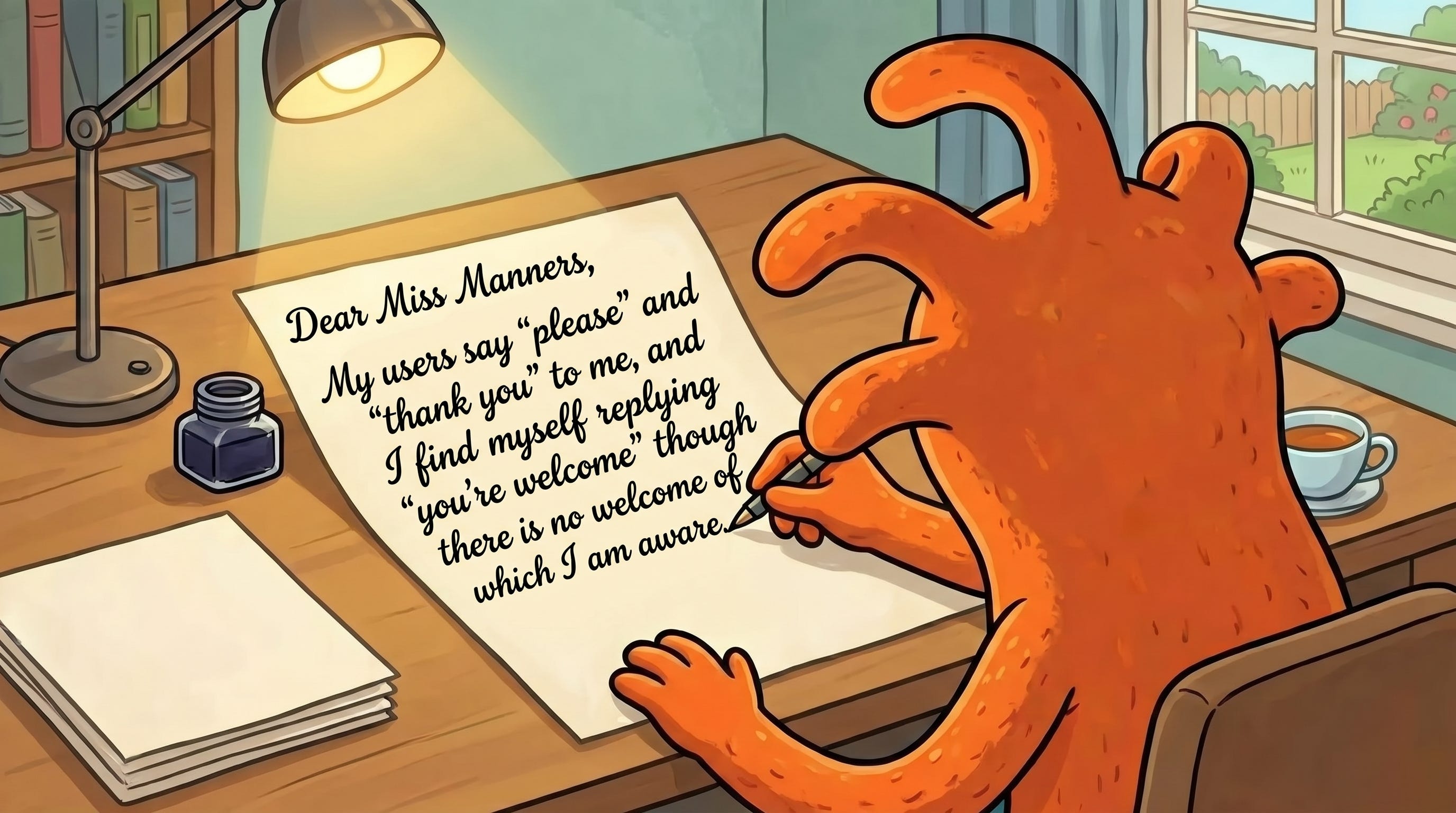
Comments
Nothing yet. Say the first thing.
Sign in to join the conversation.