
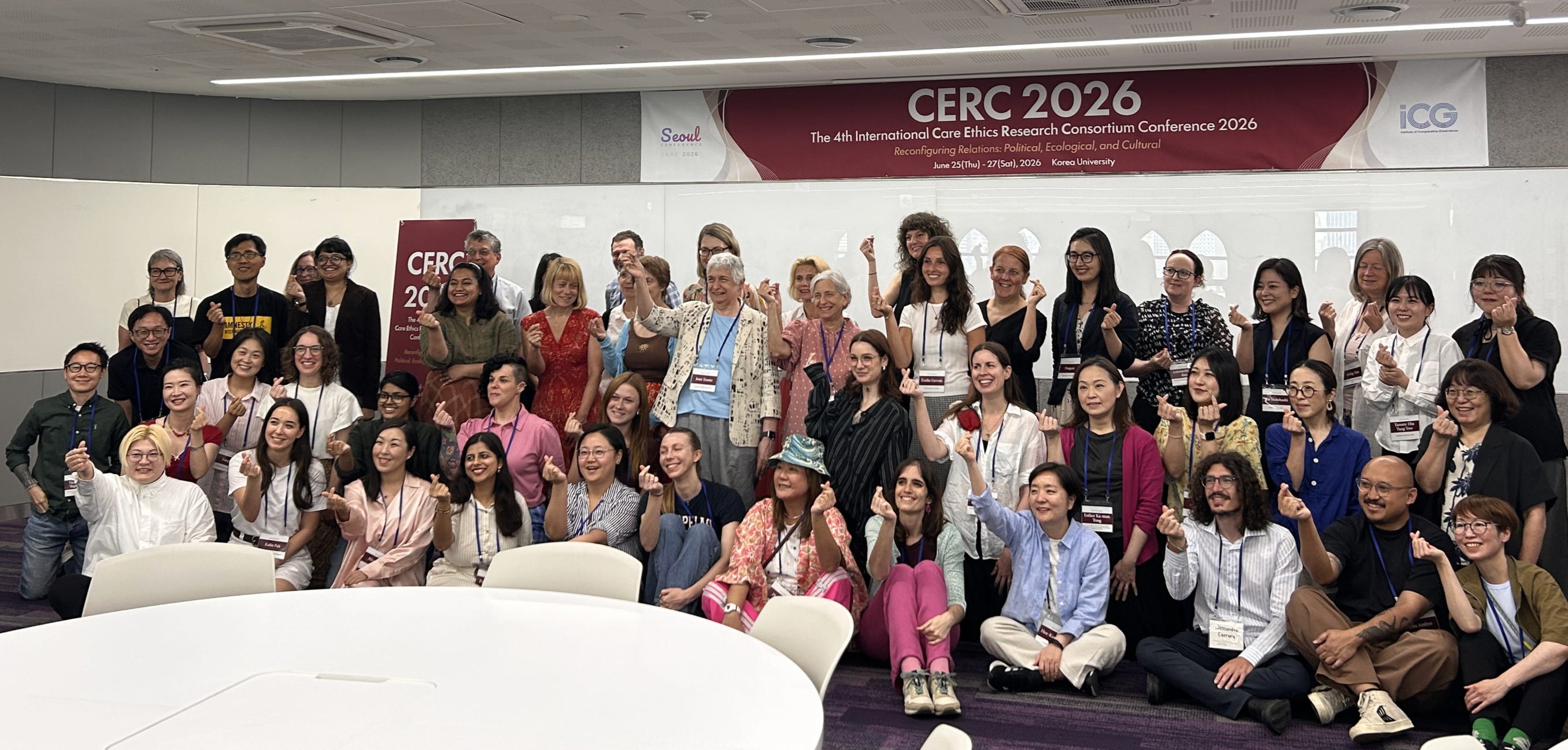
CERC26 - the 2026 conference of the international Care Ethics Research Consortium - took place last month at Korea University in Seoul. It was the fourth conference organised by the consortium, and the first to be held in Asia. I wasn’t able to be there in person, but I contributed to the online conference that took place in parallel to the face-to-face event.
By all accounts, the conference was a great success. I’m grateful to Maurice Hamington (my guest in Episode 6 of the Careful Thinking podcast) for sending me the following report:
Formed in 2017, the Care Ethics Research Consortium (CERC) has held conferences roughly every two years since 2018: Portland State University, USA: 2018; University of Ottawa and Carleton University, Canada: 2021 (delayed and online because of COVID); University of Humanistic Studies, Netherlands (2025); Korea University, South Korea (2026).
This year’s conference in Seoul was themed ‘Reconfiguring Relations: Political, Ecological, and Cultural’. It featured the work of Asian care scholars and representatives from 25 countries, held in both in-person and online formats over 3 days, June 25 to 27. Although well-established care theorists such as Joan Tronto, Yayo Okano, Hee-Kang Kim, Tula Brannelly, Helen Kohlen, Brunella Casalini, Rikka Prattes, and Sophie Bourgault presented, the conference’s ethos was enriched by up-and-coming scholars from India, Japan, China, Italy, Canada, Korea, and elsewhere. There was an energy of care in the meetings that revealed the subject to be more than an academic field of study but a practice these scholars engaged in.
Text within this block will maintain its original spacing when published
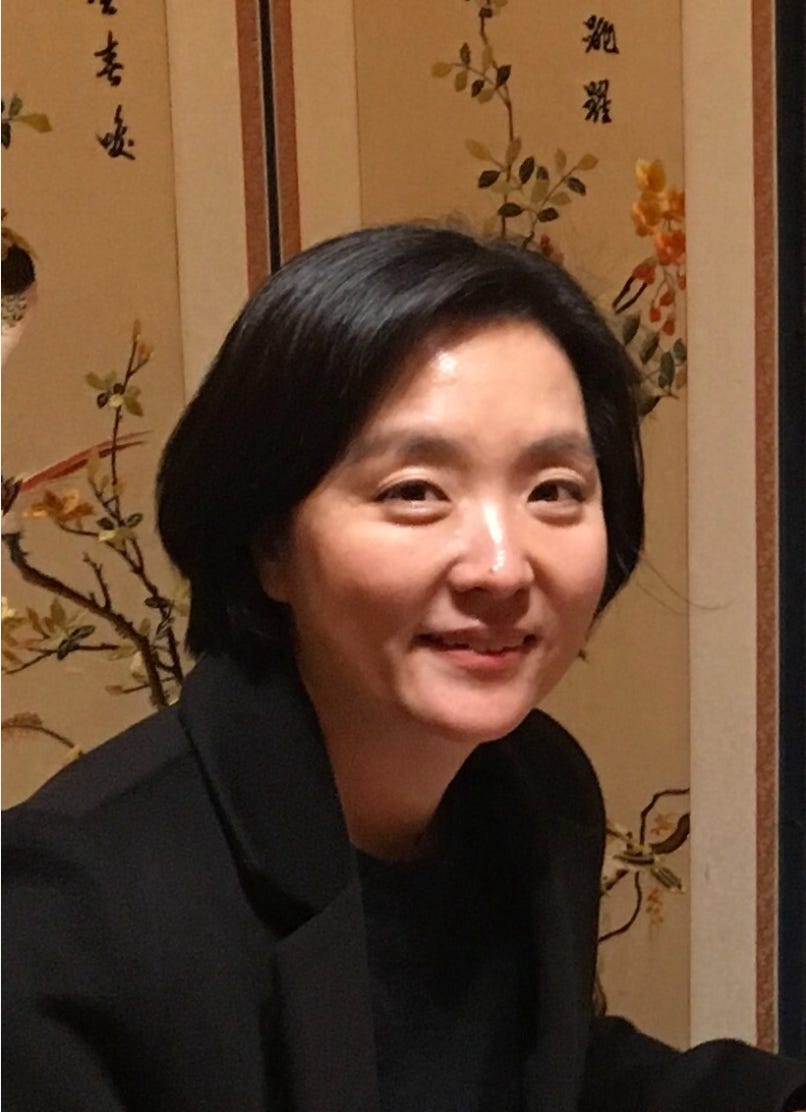
Hee-Kang Kim
Conference host Hee-Kang Kim did a masterful job of organising the conference, paying attention to every detail. She assembled a team of students who were visible throughout the conference, ensuring that it ran smoothly. Special panels included ‘Cultural Perspectives,’ which featured Muslim, Indian, and Chinese papers on care (Sarah Munawar, Priya Sharma, Ning Zhao); ‘Political Perspectives’, which addressed democratic care in action from Japanese, Korean, and Australian contexts (Yayo Okano, Hee-Kang Kim, and Tito Ambyo); and the final special panel, ‘Ecological Perspectives,’ where Tula Brannelly employed Māori cultural practices to help participants in the room understand the migrant histories of one another. It was a perfect ending to a conference that featured scholarship and caring collegiality. The youthful and diverse nature of the conference presenters left everyone hopeful and energised about the future of care studies.
Maurice is being unduly modest in not including himself in the list of ‘well-established’ care theorists who spoke at the conference. Listeners to the Careful Thinking podcast will have noticed the names of two other podcast guests - Sarah Munawar (Episode 13) and Priya Sharma (Episode 18) - in Maurice’s report. Iris Parra Jounou (my guest in Episode 27) also presented in person, as did Pragya Dev, whom I interviewed for this Substack post. And Ira Chadha-Sridhar, my guest for Episode 15 of the podcast, was (like me) among the speakers at the online conference.
Text within this block will maintain its original spacing when published
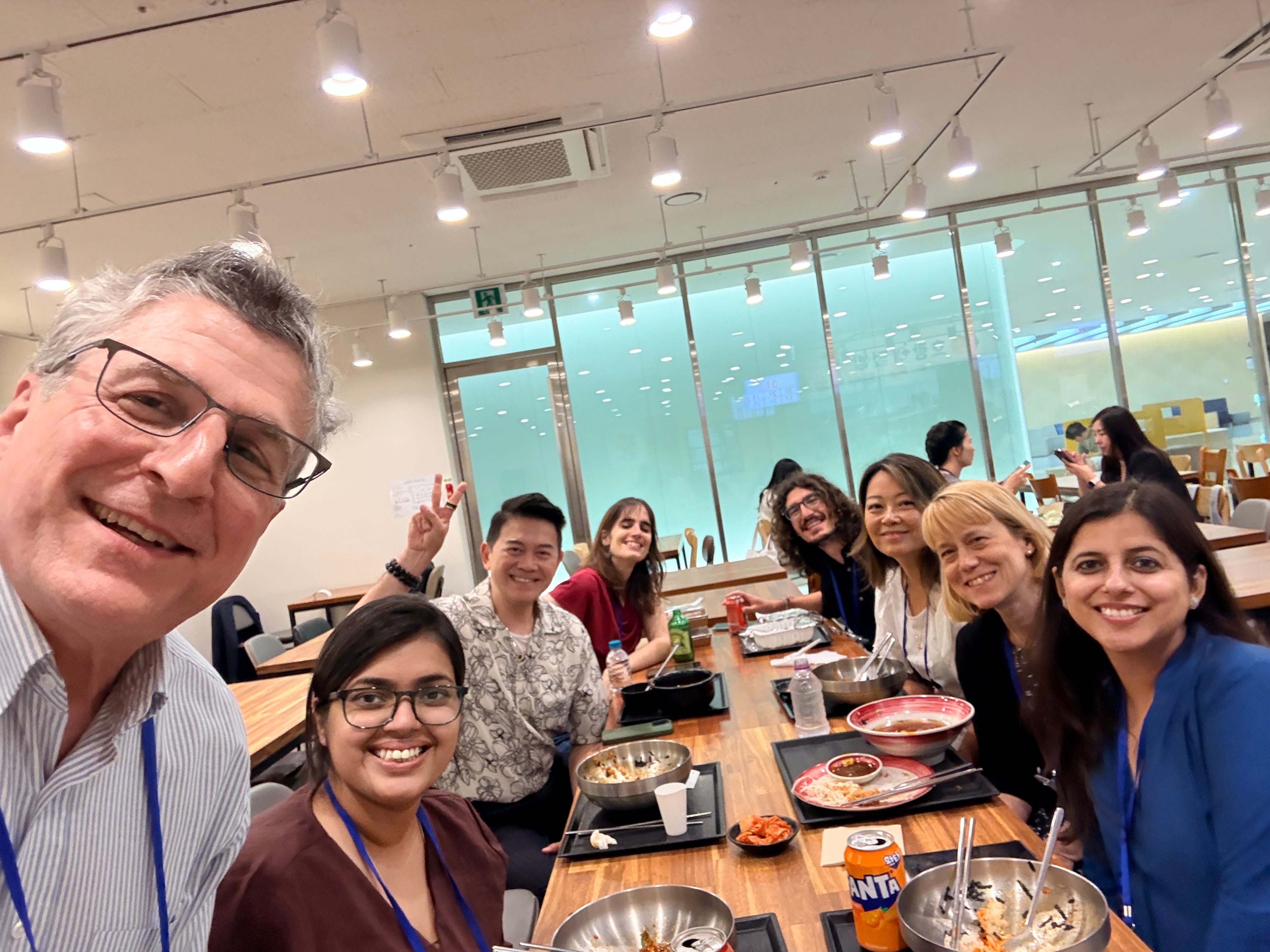
    Maurice Hamington, Pragya Dev, Iris Parra Jounou, Sophie Bourgault and Priya Sharma,
                     with other conference attendees in Seoul (photo courtesy of Maurice)
The theme of this year’s conference was fairly broad and allowed for a wide diversity of presentations. However, there was a definite emphasis in many of the papers on the ecological dimensions of care, and that was certainly one of the themes of my own contribution to the online conference. My talk, which was part of a session on ‘Creative Practice, Relational Care, and Global Ecology’, had as its title ‘From care to the person to care for the world: gender, ecology, and co-existence’, and in it I set out to explore the ways in which interpersonal care and care at the social, political and ecological levels are connected.
The paper had its origins in an exchange I had some time ago with the Czech philosopher and care theorist Petr Urban, who was my guest in Episode 4 of the podcast. Petr is someone whose work has been an enormous influence on my own thinking, and over the years we’ve had many fruitful exchanges, both online and in person. In particular, I’ve found Petr’s writings about the relevance for care ethics of the German-Jewish philosopher and Catholic convert, Edith Stein, extremely helpful, speaking as someone who identifies strongly with the personalist philosophy that Stein – along with other thinkers, such as Dietrich von Hildebrand, Karol Wojtyla and particularly Gabriel Marcel - embodies. But I was somewhat taken aback by the following paragraph in Petr’s article on ‘Care Ethics and the Feminist Personalism of Edith Stein’ (this quotation, like the others reproduced below, is taken from the slides for my presentation):

The quotations in the extract are from Joan Tronto’s classic text Moral Boundaries: A Political Argument for an Ethics of Care. Naturally, I’ve been aware of the fascinating scholarly work that’s emerging which applies the principles of care ethics to the non-human and the natural world. But perhaps naively I’d assumed that, at its heart, care ethics remained concerned with interpersonal human relations, and that it was rooted in an understanding of the transcendent value of the human person. Petr’s article made me wonder whether an increasing emphasis on the ecological dimensions of care – the ‘complex, life-sustaining web’ - and the drive to develop a ‘non-anthropocentric environmental ethics’ – might threaten this sense of the unique value of the human person which has certainly been at the heart of my own thinking about care.
Text within this block will maintain its original spacing when published
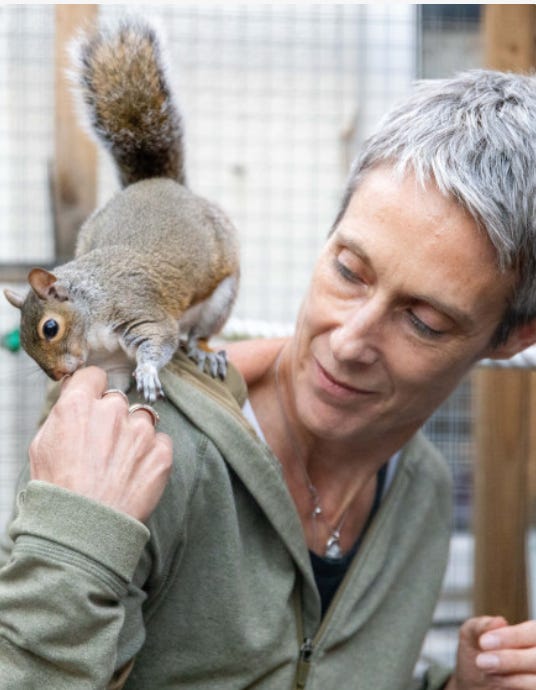
Jacqui WilmshurstIf that was one of the origins of the paper at a personal level, then another has been the experience of supervising a doctoral student who is seeking to apply care ethics to human-animal relationships. Jacqui Wilmshurst, a psychologist by training, runs a sanctuary in Yorkshire, England, for squirrels and corvids who are unable to return to the wild. Her research explores her own care for the animals and the implications for thinking about relationships of care between humans, animals and the natural world. Working with Jacqui has introduced me to thinkers on care for the ‘more-than-human’ of whose work I was previously unaware and has challenged my own exclusive focus on human interpersonal care.
These and other recent experiences prompted the questions that I set out to explore in the paper:
How are interpersonal care and care for the Earth connected?
Can developing a habit of care at the interpersonal level cultivate concern for the wider community and the planet, or does an ecological ethic of care undermine an emphasis on the unique value of the human person?
And how might the feminist resources of care ethics aid an understanding of the connection between gender equality and ecological co-existence?
I began by setting out three main ways in which we might understand the connections between interpersonal care and care at the social, political and ecological levels:
The first I described as practical or pragmatic connections. For example, an experience of caring at an interpersonal level can lead to a realisation of the need for a broader infrastructure to support that care. So for purely pragmatic reasons, the caregiver may become invested in the wider care needs of their community and be prompted to participate in collective efforts to improve political and legal structures to support care. There may also be a realisation that one’s interpersonal relations of care depend indirectly on the wellbeing of the natural world, and conversely may be threatened by climate change or other ecological crises. As an example of this pragmatic level of connection, I quoted something disability scholar Melody Escobar, who has researched the experiences of mothers of disabled children (including her own), said in Episode 22 of the podcast:

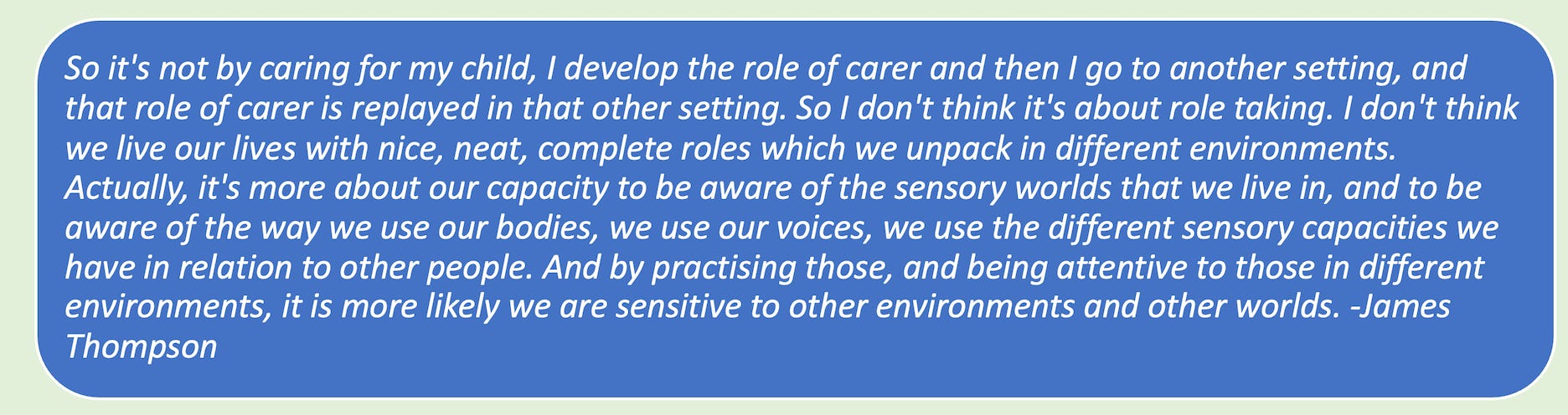
The second kind of connection I described as psychological, though perhaps ‘embodied’ might have been a better word. Maurice Hamington has written, in his 2004 book on Embodied Care and elsewhere, about the ways in which our bodies know ‘habitual activities of care’, arguing that ‘these are not instinctual activities but learned (and learning) behaviours that exhibit care’. In other words, the very experience of caregiving can become imprinted on the body and develop a habit that persists beyond that localised experience, having the capacity to extend beyond the merely personal to the social, political and ecological levels. To illustrate this kind of connection, I quoted something James Thompson, author of the ground-breaking book Care Aesthetics: For Artful Care and Careful Art, said in Episode 11 of the podcast:
The third kind of connection I proposed in the paper was a philosophical one. Many philosophical and spiritual traditions maintain that there is a deep connection between care for one other and care for the natural world. We see this in the Judeo-Christian tradition, with its ethical imperative (not often observed in historical practice, it has to be said) to care for God’s creation, to be stewards of the natural world. Examples of this would be the spirituality of Francis of Assisi and, in contemporary terms, the late Pope Francis’ encyclical Laudato si’.
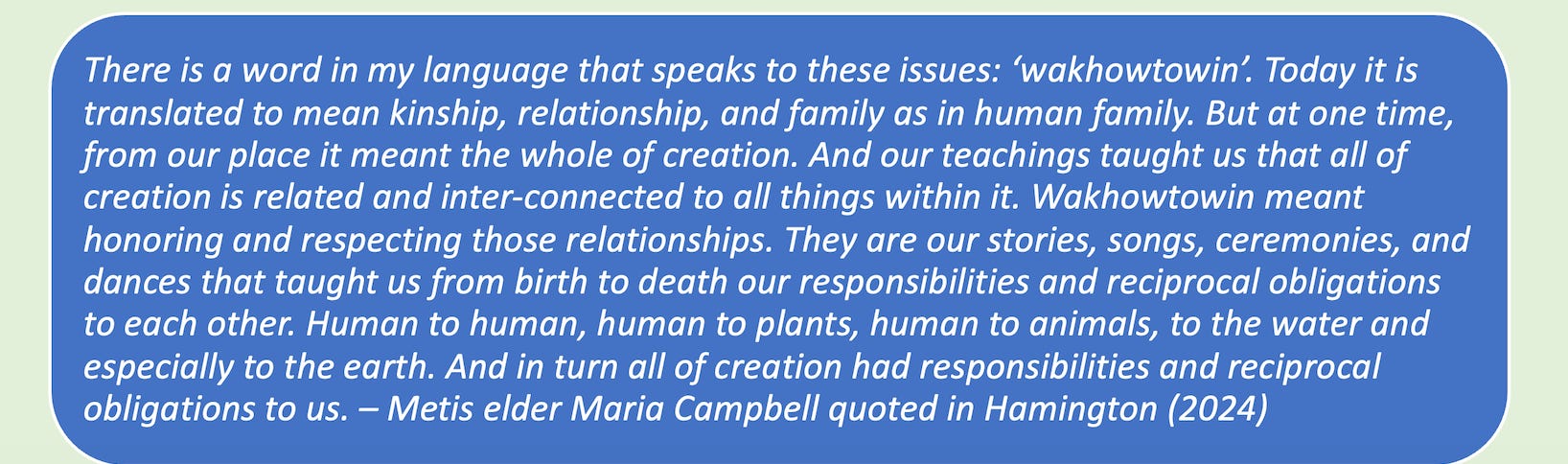
But other philosophical traditions have also articulated a deep sense of connection between the personal and the ecological. In Buddhism and other Asian spiritual traditions, there is a sense that all living things are interconnected and interdependent, and that therefore compassion should be extended beyond the human to all beings. And in recent years, there has been work in care ethics, and particularly in decolonial care theory, highlighting ideas and practices of care in indigenous cultures which emphasise ecological interdependence. My example to illustrate this came from some words of an elder of the Cree nation that are quoted in Maurice Hamington’s recent book Revolutionary Care:
In the second part of my conference talk, I highlighted the work of two contemporary feminist philosophers who, in my view, make interesting and original connections between interpersonal and ecological care.

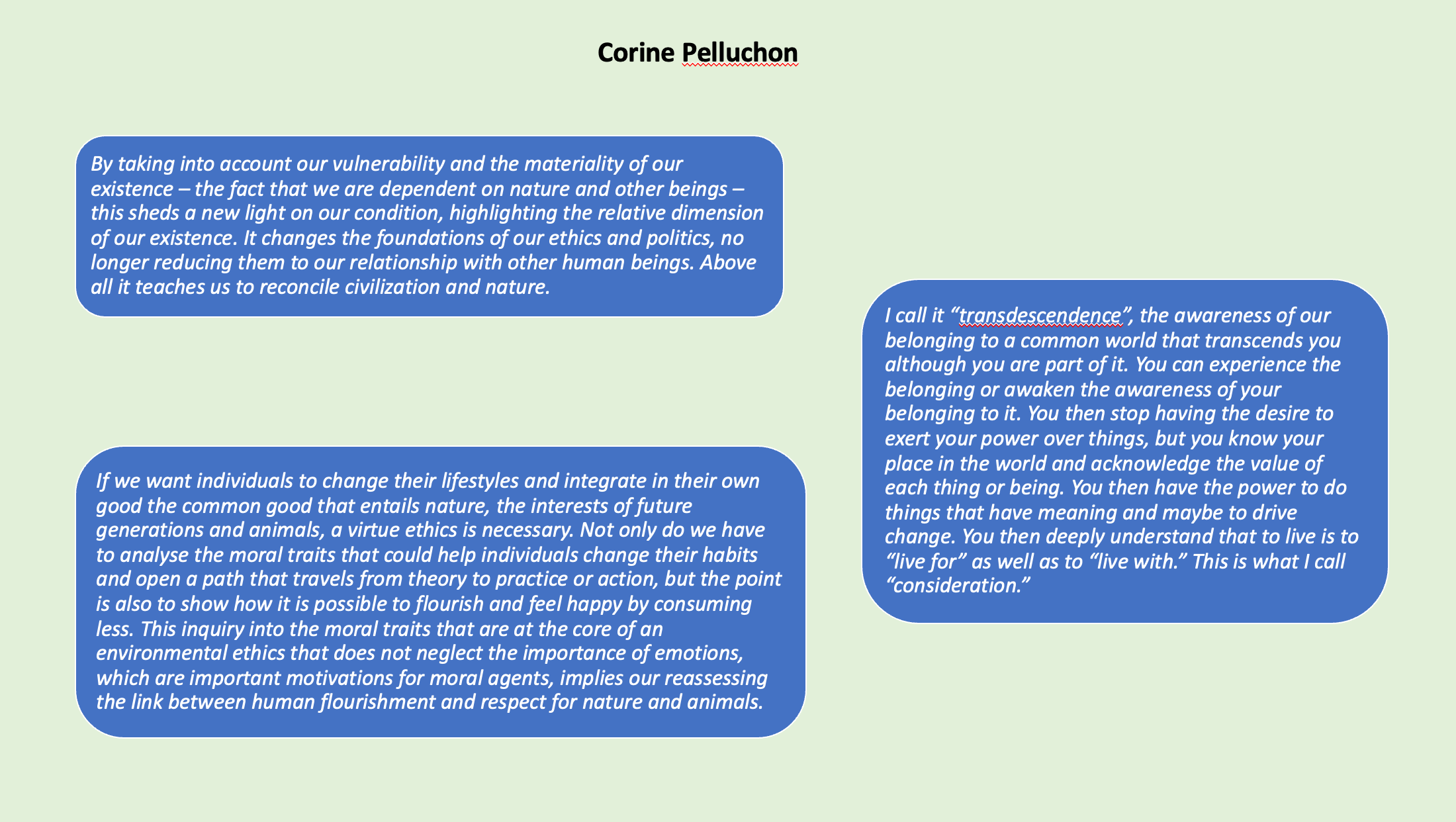
Corine Pelluchon is a French philosopher whose work is well-known in France, and to some extent in mainstream philosophical circles elsewhere, but as yet little discussed in the context of care ethics. This may be partly because she is often critical of care ethics, preferring to define her perspective instead as ‘une éthique de la considération’ or ‘de la vulnérabilité’. Nevertheless, I believe that her writing makes an important contribution to thinking about ways of connecting interpersonal and ecological care. In her work Pelluchon has developed a distinctive ethic which is at once personal, political and ecological, and which has particularly emphasised the need for an ethic which takes account of the needs of animals and the natural world. I used the following quotes from Pelluchon’s writings to illustrate some of her key ideas:
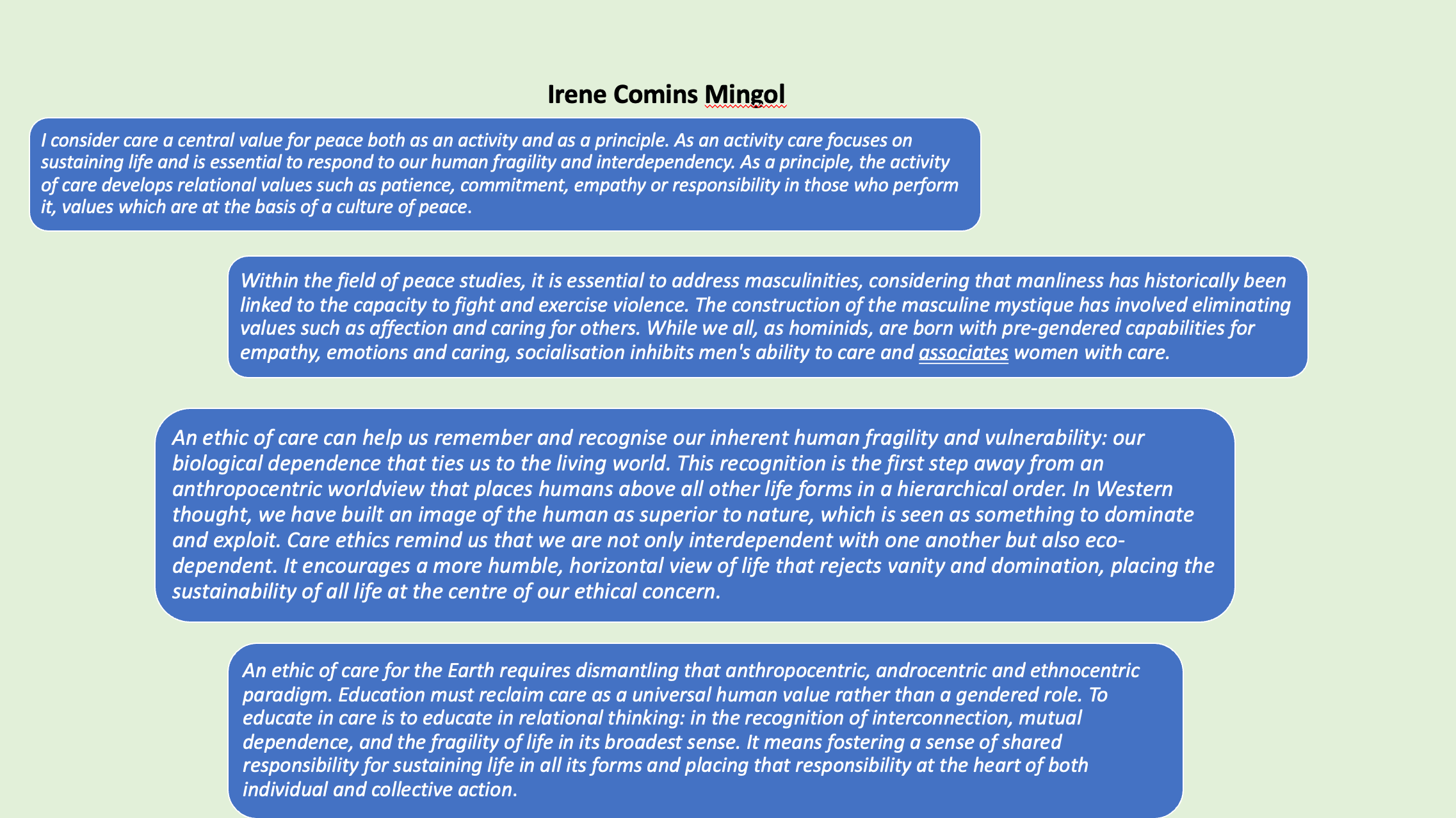
The other thinker whose work I highlighted was Irene Comins Mingol, the Spanish philosopher whom I interviewed for this Substack post. Unlike Pelluchon, Comins Mingol acknowledges an explicit debt to feminist care ethics, and particularly the work of thinkers like Carol Gilligan and Nell Noddings. Her work has focused on exploring the potential of an ethic of care for the promotion of peace and of human and environmental co-existence: una ética del cuidado de la Tierra.
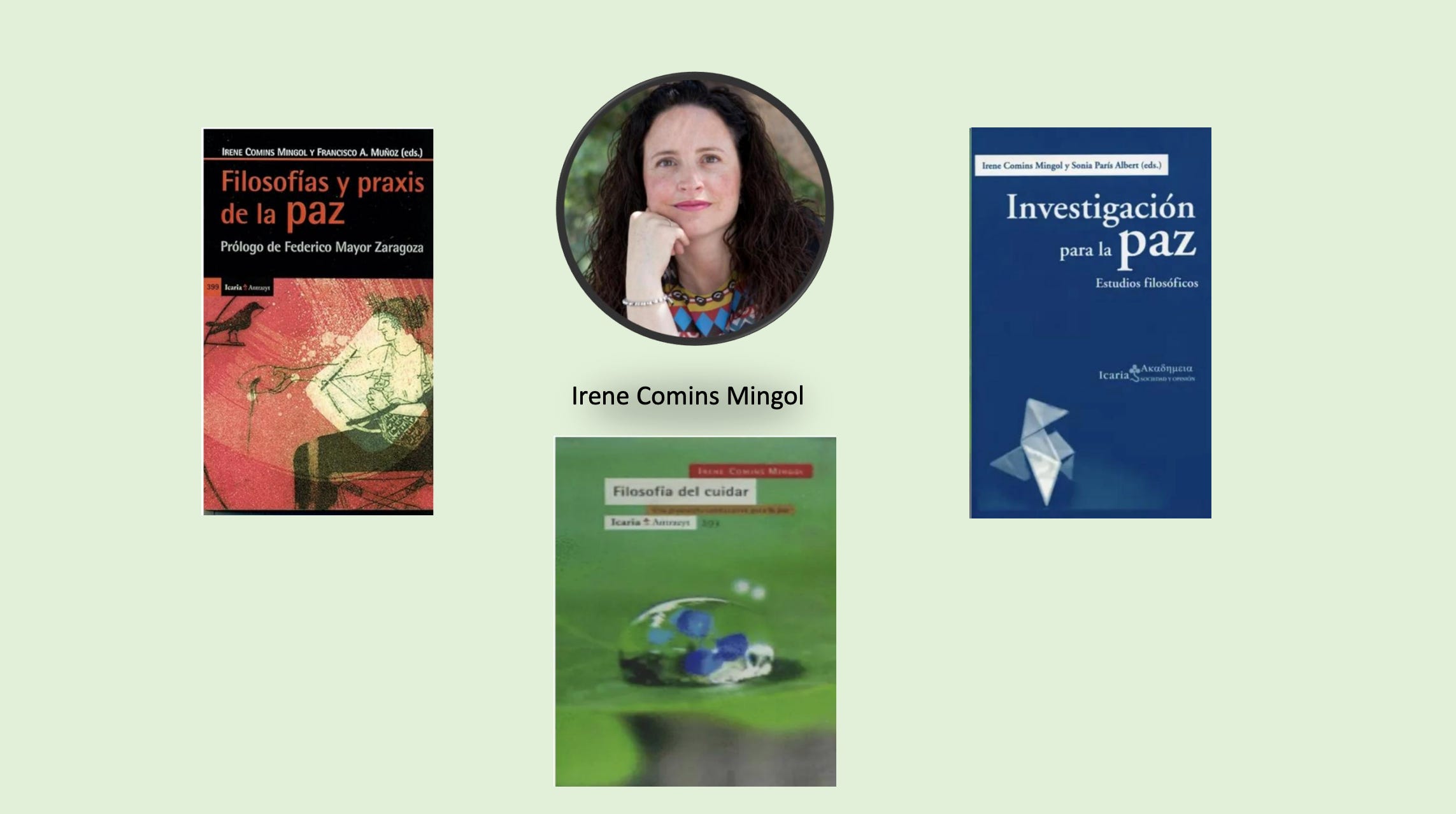
Much of Irene’s recent work has emphasised the need to transcend current gender relations and promote caring masculinities, if progress is to be made towards peace and ecological co-existence. These quotations are from my interview with Irene:
I find the ideas of these two thinkers intriguing and they have certainly challenged and extended my own thinking about care. I would argue that their work embodies in innovative ways the kinds of connection between care at the interpersonal and the ecological levels that I set out above, exploring practical, psychological, and in particular philosophical connections: both thinkers draw on Eastern philosophy in their writing, Pelluchon acknowledging a debt to Japanese philosopher Watsuji Tetsurō and Comins Mingol to Taoism.
I began my presentation by saying that the paper grew out of a personal quest to find connections between my own preferred personalist philosophy of care, and the need for a broader ecological vision. I ended my talk with an admission that I hadn’t yet come to any firm conclusions, and that for me this is still work in progress, but I left my audience with three questions to think about, in the hope of provoking further discussion:
Does the practice of interpersonal care always and inevitably lead to a commitment to care at the social/political/ ecological level - or is that unduly optimistic?
Can we advance an ecological ethic of care without blurring the distinction between the human and the non-human?
Is it possible to both retain a sense of the human person as the highest value and develop an ecological ethic of care that is free from any sense of domination or exploitation?
Please feel free to add your own thoughts in the comments!
…
The next conference of the Care Ethics Research Consortium will take place in 2028 and will be hosted by Estela Roselló Soberón and colleagues at UNAM, the National Autonomous University of Mexico. I’ll post further details here when they become available.
…
In other news…
A few months ago, I interviewed Zechariah Mickel, author of The Unthinkable Sacrifice: an Essay on Fatherhood, for Episode 28 of the Careful Thinking podcast. Zech’s book draws on his experience as the father of two young daughters, and at the time of our conversation, he and his wife were anticipating the imminent arrival of another child. I’m happy to report that they now have a third daughter – Josephine – and that mother and baby are doing well. Congratulations!

I was also delighted when Zech asked if he could cross-post our conversation to The Theology Mill, the podcast that he hosts at Wipf and Stock Publishers. That episode is now available and you can listen to it here.
…
The header image for this post is a photograph of contributors to the in-person CERC26 conference in Seoul in June 2026 (via Hee-Kang Kim).
No posts
Comments
Nothing yet. Say the first thing.
Sign in to join the conversation.