
This week’s article is by Matthew Welton, author of Small Birds Singing, which is published this month. Get 15% off Small Birds Singing with code MAYBOOKS15 here.
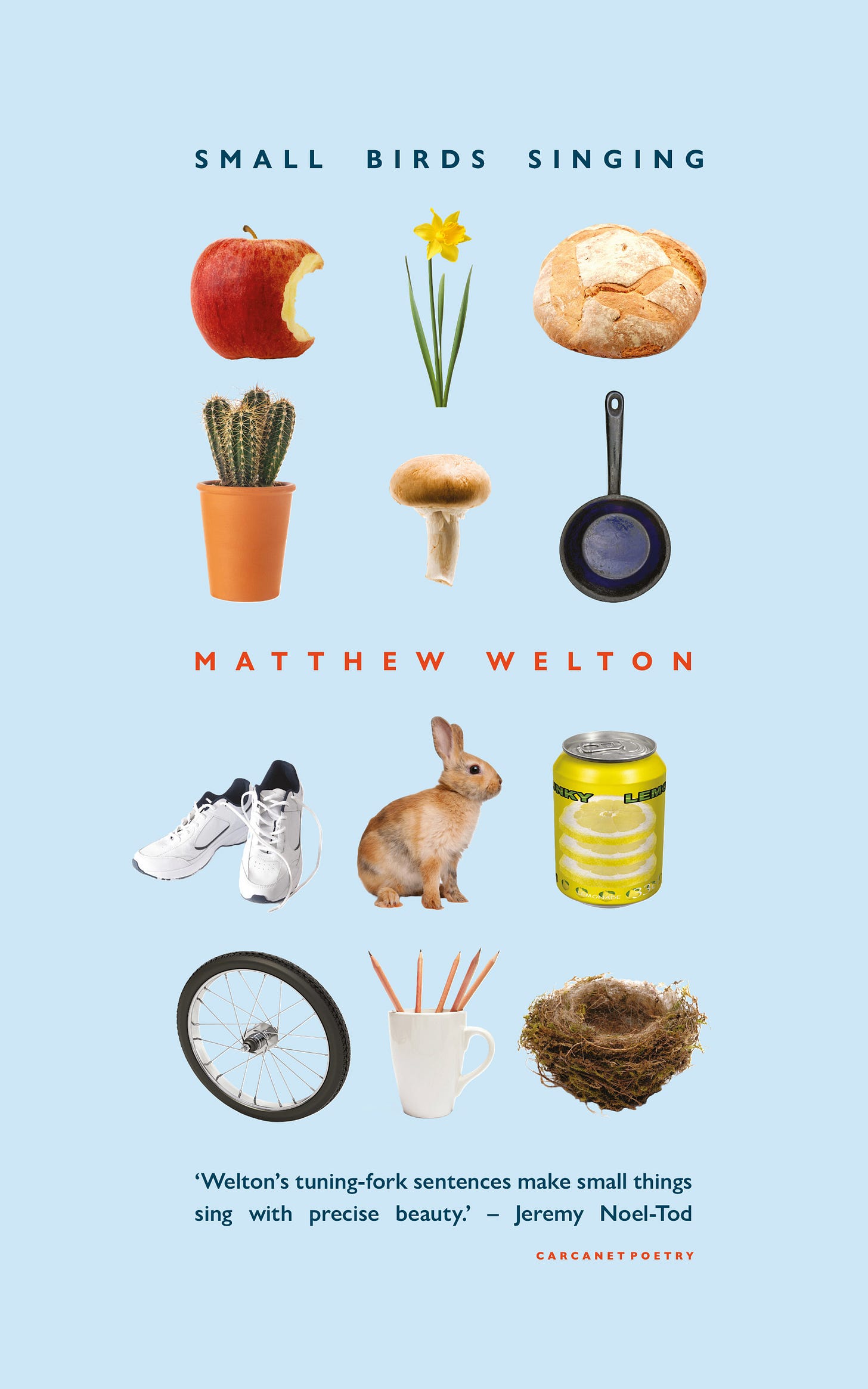
The focus in these poems is on the things around us. A bowl of small apples on an unvarnished table, for example, or a mug of blunt pencils. Generally these are simple things. In my writing I am not interested in greatness or epiphanies or even inspiration, but tend towards things like a woollen shirt on a wire hanger, or the smell of warm air as we pass the launderette.
If this interest in ordinary things means that the book is a kind of extended poetic version of a still-life painting, I am okay with that. But like a still life, there is an understanding that things are rarely entirely still. There is often a kind of implied question or narrative. If you see somebody with pencils in the pocket of their shirt, what does that say about what they are up to? If somebody leaves a sofa on the pavement, what does it say about the sofa? What does it say about the pavement?
And as in writing these poems I continued to pay attention to all these things, I slipped into thinking about what it is that things have in common with each other, and the word I began to use was thinginess. And at some point I began to think about the way we think about things. In poetry we often talk about images, and though there is some agreement in the way we use the term, I am sure imagery is something that means different things to different poets. The kind of imagery I find myself drawn to tends to be simple, generic stuff like ‘The owl calls through the olive grove’ in W.S. Graham’s poem Implements in their places’, for example, or ‘Coffee and oranges in a sunny chair’ in Wallace Stevens’s poem ‘Sunday Morning’. Lines like those feel full of possibility. Similarly, in her book-length poem Alphabet, I am interested in how Inger Christensen presents images like apricot trees or bracken or spiders or vinegar without adding any description. All this thinking about imagery got me onto thinking about nouns next, and then onto the many ways that terms like nouns, imagery, objects and things have a bearing on one another.
Small Birds Singing is structured around the twelve months of a year, beginning from September, and many of the images arose during a year of trying to be open to the act of observation. I was, in a way, writing what I saw, though perhaps I was never just writing what I saw; there was always an awareness that any observation I made was going to be geared towards putting something into writing. In moving between taking things at face value to contemplating the implications of things, my thoughts about thinginess drifted into thoughts about thinkiness – the physical firmness of the idea of things – and I got to thinking how thoughts are things too.
In putting the book together, there was another sense in which the things I focused on were not still in that the seasons inevitably had their way with things. As I walked repeatedly through the same spaces, winds came and leaves fell, and the ground grew hard. Then the ground softened, and birds flew by with twigs in their mouths. Daffodils sprouted and then grew shabby, and soon there were a lot more cyclists around.
What I ended up with was essentially a big bunch of fragments. And as I read through my notebooks, rephrasing and redrafting, selecting and ordering what I was going to include in the book, the details that I thought were the most still seemed to contain some movement, while those which I thought had a kind of trajectory seemed set in a particular perspective. I hope in that there is a kind of beauty, even if it is a beauty of a familiar, unexceptional kind.
This week's article is by Matthew Welton, author of Small Birds Singing, which is published this month. Get 15% off Small Birds Singing with code MAYBOOKS15 here.
No posts
Comments
Nothing yet. Say the first thing.
Sign in to join the conversation.