
To celebrate Elizabeth Jennings’ centenary, get £2 off either her New Selected Poems or Collected Poems with code JENNINGS100.

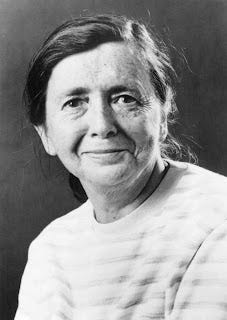
This article is written by Rebecca Watts, editor of New Selected Poems by Elizabeth Jennings.
Originally published in 2019, now re-published to mark the centenary of Elizabeth Jennings in 2026.
2019 was for me a year of curation. Through January and February I was immersed in the task of editing Elizabeth Jennings: New Selected Poems. This proved the most effective means I have yet found of keeping the winter blues at bay: Jennings’s Collected Poems runs to over a thousand pages, and what with reading and re-reading that (plus several critical/biographical works) and deciding what to put in and what to leave out (in each case imagining the implications, for Jennings and for me, of both options), there wasn’t time to be miserable or cold.
When I emerged from Jenningsland – clarified and inspired, and a little raw around the edges – there were daffodils, and I decamped to Scotland where I spent a month redrafting the disparate poems I had accumulated over the past few years, and attempting to arrange them into some sort of collective shape. That first group shuffle, and the new poems I was able to begin because I was far from home and its familiar definitions and routines, provided the basis of my work for the rest of the year. Its eventual product was to become my second collection, Red Gloves.
How different the two processes were, of editing and editing: curating my own work versus curating somebody (late, established) else’s. With my poems, once I had fixed (or at least improved) the texts, I printed them again and spread the A4 sheets around the room. I had conceived and written and redrafted each poem separately. Then I began looking for overlaps, progressions, contrasts and contradictions – elements that, cumulatively, could lead to the sense of a story running through the collection. What would I find? I knew that the journey I curated for the reader would determine how the individual poems, as well as the printed book, were received. Wandering up and down the rows of paper, swapping this sheet for that, I became acutely aware that two poems placed side by side inflect each other. With a set of fifty poems you have a task on your hands that can be approached logically but to which there is no right outcome.
In the case of Jennings, I set out as editor with her complete published oeuvre in front of me. I knew the shape of her career and the trajectory of her life. I read and selected her poems in the context of two motivations: to promote her best poems, and to convey an accurate sense of her (as an artist and as a person) to readers unfamiliar with her work as well as to readers who already know her work (and perhaps even knew her – she only died in 2001). These two motivations of course fed into each other. I gained a sense of Jennings’s story through her (vast) body of work, and judged the achievement of each poem in the context of the overall story.
This seemed to me a suitable editorial mindset with which to approach Jennings, who was perennially interested in her personal (emotional and experiential) trajectory – a trajectory shaped foremost by familial influence, religious faith, and a passionate engagement with and belief in the transformative power of art and creativity. She made use of autobiographical truths frequently in her poetry, always approaching her material in a spirit of existential enquiry. As an artist she sought neither to absolve or resolve, only to communicate the sorrow and joy that being alive entails, and, through the act of communication – a communion of sorts – to generate acceptance and understanding.
Fundamentally, she was interested in poetry as a mechanism through which experiences could be ‘considered, refined, transformed’, yielding truth through artfulness. Sometimes she struck out overtly to tell her own story, as in the wonderful poem ‘The Child’s Story’, first published in PN Review. Elsewhere, rather than being explicitly narrated, the story rises through the images, as though the poem were a conduit for universal experience: in artistic terms, surely the ultimate achievement. Jennings claimed that her poetry was a development of her religion; for her, both were routes to discovery. ‘What the poem discovers – and this is its chief function – is order amid chaos, meaning in the middle of confusion, and affirmation at the heart of despair.’ As a taster of her work and of the New Selected Poems, I leave you with this, from her 1979 collection Moments of Grace:
Into the Hour
I have come into the hour of a white healing.
Grief’s surgery is over and I wear
The scar of my remorse and of my feeling.
I have come into a sudden sunlit hour
When ghosts are scared to corners. I have come
Into the time when grief begins to flower
Into a new love. It had filled my room
Long before I recognised it. Now
I speak its name. Grief finds its good way home.
The apple-blossom’s handsome on the bough
And Paradise spreads round. I touch its grass.
I want to celebrate but don’t know how.
I need not speak though everyone I pass
Stares at me kindly. I would put my hand
Into their hands. Now I have lost my loss
In some way I may later understand.
I hear the singing of the Summer grass
And love, I find, has no considered end,
Nor is it subject to the wilderness
Which follows death. I am not traitor to
A person or a memory. I trace
Behind that love another which is running
Around, ahead. I need not ask its meaning.
This week’s article is by Rebecca Watts, editor of Elizabeth Jennings’ New Selected Poems.
Get £2 off New Selected Poems or Collected Poems with code JENNINGS100 here.
Comments
Nothing yet. Say the first thing.
Sign in to join the conversation.