
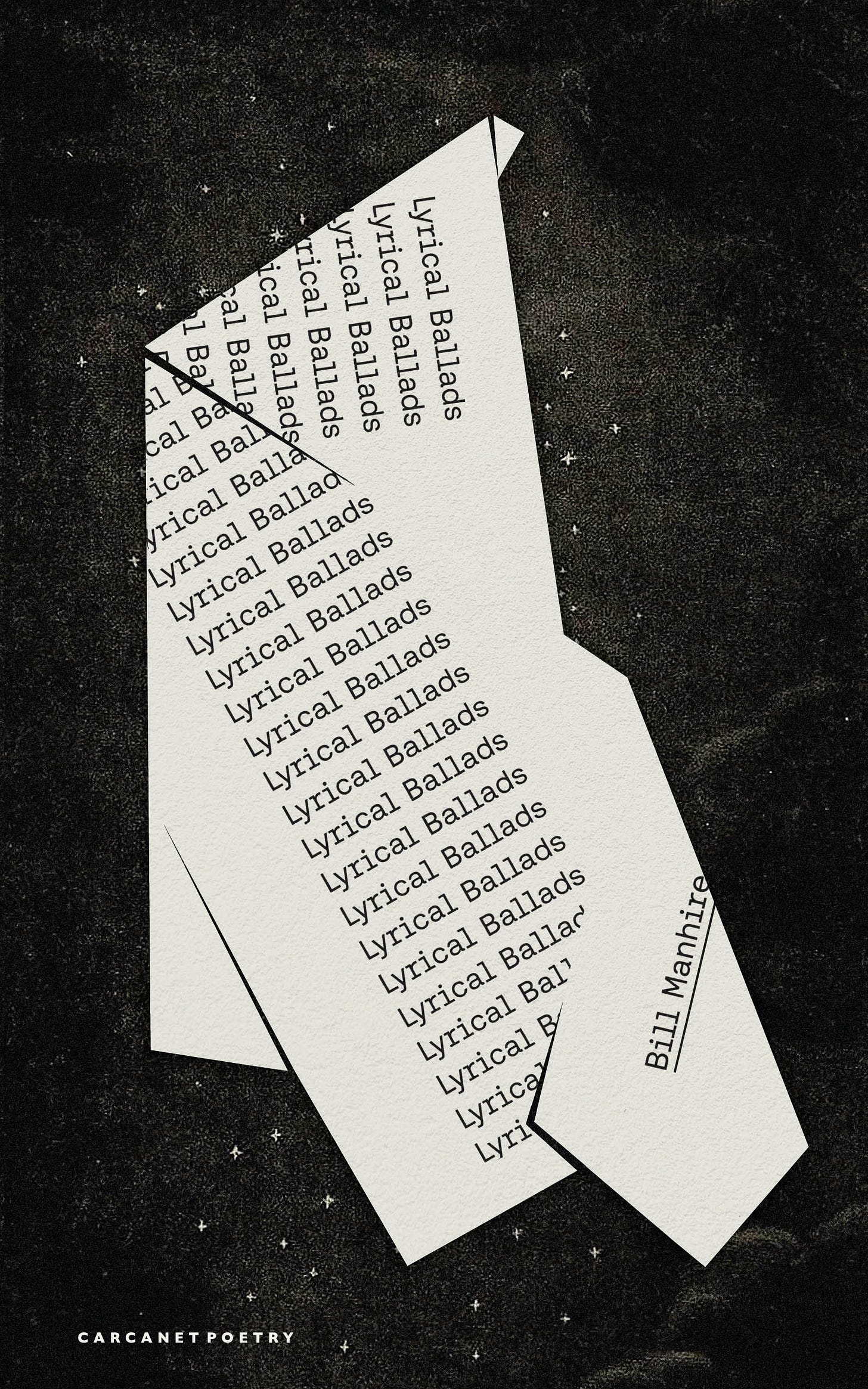
This introduction was originally delivered by Robyn Marsack as a speech at the launch of Lyrical Ballads at Unity, New Zealand,11th February 2026.
Robyn Marsack began her long association with Carcanet Press by editing the first edition of Edmund Blunden’s Selected Poems in 1982, and worked as a publishers’ editor until she became Director of the Scottish Poetry Library 2000–2016. She was a Royal Literary Fund Writing Fellow at the University of Glasgow 2016–2018. She has co-edited several poetry anthologies, including Oxford Poets 2013 with Iain Galbraith, and has edited for Carcanet Blunden’s Fall In, Ghosts: Selected War Prose (2014), a new edition of Blunden’s Selected Poems (2018) and the volume of letters celebrating the 50th anniversary of Carcanet Press, Fifty Fifty (2019).
I was thrilled to take part in the launch of Bill Manhire’s new collection in my hometown of Wellington, in one of my favourite bookshops in the world, Unity on Willis Street, which was packed with readers and writers for the occasion. It is said that you should never judge a book by its cover, but in this case the good looks of the cover are as beguiling as its contents.
When I have introduced Bill at events in the UK, of course I have listed his various awards and distinctions, but here there was no need: he is loved and honoured in his own country. He was New Zealand’s inaugural Poet Laureate. In Scotland we call ours the ‘Scots Makar’, makar being the old Scots word for poet. It is less about glory – the laurel leaves – and more about the ongoing task, or vocation, of making. The appearance of new collections is testament to this work of the poet, which Bill disguises in his seemingly effortless, unshowy poems.
When I first saw the title of Bill’s book, Lyrical Ballads, I thought: that’s quite cheeky! And also: perhaps only a poet who lives at the edge of the universe would dare to re-use the title of Wordsworth’s and Coleridge’s groundbreaking collection, published in 1798. I did wonder what it would have been like if Wordsworth had been known as ‘Bill’ or ‘Billy’ – probably he wouldn’t have been published at all – and if Manhire had been known as ‘William’ – a different sort of poet altogether, I suspect, writing in the 1940s. (Maybe smoking a pipe.)
Yet the two have something in common. Let me quote from Wordsworth’s ‘Advertisement’ to his volume:
The majority of the following poems are to be considered as experiments. They were written chiefly with a view to ascertain how far the language of conversation in the middle and lower classes of society is adapted to the purpose of poetic pleasure.
Bill, too, is experimenting with poetic forms in this collection, while maintaining the vernacular, with a particular New Zealand tone it seems to me: laconic, nothing fancy, but often surprising. I understand that he was at one stage an accomplished magician at children’s parties. Sometimes what he pulls out of his poet’s sleeve would – it must be said – have shocked Wordsworth.
In these poems there are snatches of the past, of childhood, adolescence, family life – almost all of them ending unexpectedly, wrong-footing the reader. The narrators and characters who inhabit the book – Alexander and his nana, Dracula, T.S. Eliot, a prime minister, a boy from Gaza, various misfits – are often puzzled themselves, sometimes humorous, sometimes (as the blurb says) curmudgeonly, at others simply sad.
The title poem is a compact story of ecological and personal desolation that begins: ‘I bought a bend in the river. It was a good, quiet bend. You couldn’t see round the corner, then you could.’ That seems emblematic of the trajectory of the poems in this collection: at first you can’t see round the corner and then you can: there’s a sense of more than the poem coming to an end. They are ballads of being here on this battered earth, lyrics of our absurd, yearning lives.
What a joy and privilege it is to have such a poet writing for us now.
This week's article is by Robyn Marsack, introducing Bill Manhire’s Lyrical Ballads, which is published this month! Pre-order via our website using the code MARCHBOOKS15 for 15% off and free UK P&P.
No posts
Comments
Nothing yet. Say the first thing.
Sign in to join the conversation.