
This week’s article is by Leeanne Quinn, author of Landscape with Question, which is published this month. Get 15% off Landscape with Question using code JUNEBOOKS15 here.
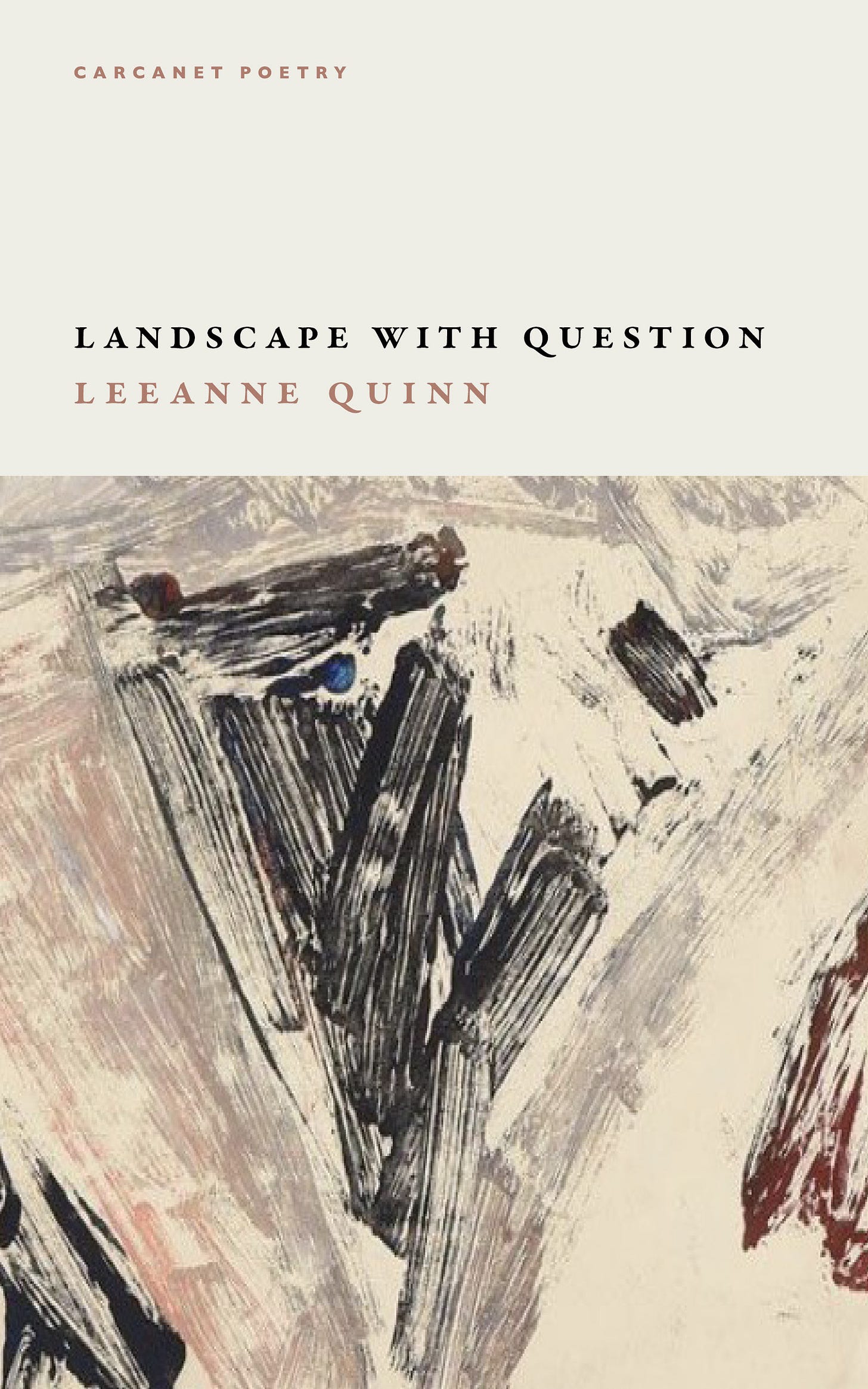
My father was a publican and proprietor of the Dublin Gate Bar, the pub formerly owned by Nano Reid’s family, in the medieval town Drogheda, on the east coast of Ireland. Trained at the Metropolitan School of Art in Dublin, later in Paris and London, Nano Reid was one of the leading Irish Modernist artists of her generation. A mural Reid painted for the Dublin Gate Bar still adorned the walls when my parents took ownership of the bar in the 1970s. Though they sold the bar shortly after I was born, they would often recall her visits. So Reid was a familiar presence in my life from a young age, her paintings were among the first in-person paintings by an artist I’d seen as a child. Here was an artist who had lived and grown up in my own town, who painted the local landscapes of Drogheda, and the environs of Louth and Meath. I had written about Reid in my previous two collections: a poem here and there, focusing on two of her oil paintings, and her friendship with the artist Gerard Dillon. I always knew I wanted to write more.
When I initially conceived of this book, it was as a biography in verse of Reid. My writing process is organic and responsive to its subject matter, so while I may start with an idea in mind, the book will always take over, and go where it wants to go; assuming a form and tonal register that is discovered in and through the writing process. What I realised early on in this project is that my encounters with Reid were becoming increasingly personal encounters with place and memory. I find the landscapes of home in Reid’s paintings and, conversely, I find Reid and her paintings in the landscapes of home. As a child I loved how Reid reconfigured Drogheda in paint, how she collaged it, arranged and rearranged it. It was thrilling to see places I recognised, landmarks I passed every day, represented in her paintings. I didn’t yet know that Reid had also painted the Monasterboice area, where our family would move when I was sixteen. I wasn’t yet familiar with the graveyard at Monasterboice, didn’t yet know that Reid had taken trips out of town to sketch there. I didn’t yet know that my sister would come to be buried in that same cemetery when she died at the age of twenty-one. When I look at a Reid painting, I am reminded of a time when I looked at depictions of Monasterboice graveyard and did not recognise or know it as I do now.
As I continued to focus on Reid’s places – which are also my places – the place I was writing from also began to exert an influence on the book. This shift in the writing coincided with a move from Munich – where I had been living since 2018 – to Vienna, where I found myself responding to a different sort of landscape and a different sort of artist. Shortly after moving to Vienna a friend suggested I read Ingeborg Bachmann’s novel Malina. While I had been reading Bachmann’s poetry for some time I had not yet read Malina. Originally published in 1971, the novel opens with a dramatis personae introducing the main characters. This cast list includes ‘Time’ and ‘Place’. The place is Vienna, where I currently was. The time is ‘Today’, a space I also inhabited. Malina is set in post-war Vienna, and throughout the novel there is the sense of the past breaking through to the present moment, threatening to destabilise it. In the novel, an unnamed female narrator lives in the area around Ungargasse, in Vienna’s third district, which the narrator comes to think of as ‘Ungargassenland’. In the months before I first read Malina I had unwittingly been exploring Ungargassenland on my daily walks from where I lived in the fourth district. Something about the specific nature of Bachmann’s writing, the landscapes that were woven into the complex psychological narrative of the book, began to resonate with my own writing, and my preoccupation with the coterminous relationship between the present and the past. After reading Malina, the landscape of this district began to mean something else to me, just as Reid’s landscapes alter and inform my response to the place in which I grew up, the places that mark my childhood and adolescence, and the places that now hold memories of my sister.
While the book has its touchstone figures in Reid and Bachmann, the poems are not written in the voice of either. I began to think of the speaker of the poems as a sort of questing figure, one who doubts and distrusts perception; one who tries to reconfigure their perceptions of time and place so as to better comprehend their surroundings, and their relationship to the specific landscapes they inhabit. By following this speaker through these landscapes, I was able to explore the temporal nature of place – the slippages of time that can be perceived in cities and urban landscapes, the gap between what is visible and what is hidden in any perceptible landscape.
I also began to make connections between Vienna and my hometown of Drogheda. Both had been medieval cities with walled fortifications, both had dismantled these walls in attempts to transform, to modernise, to improve. I wondered to what extent they had succeeded. All the while, I continued to think about Reid’s paintings and the layered present I find there. I began to correlate the historical layers of the city I was living in with the layers of Reid’s paintings and to think about how the present is also a layered temporality. Present place and past places, real places and imagined places, began to sit side by side in the work, The Danube, where I swam throughout the summers, began to flow alongside the river Boyne, which flows through the Louth and Meath landscape and through the landscapes painted by Reid. These spatial and temporal settings became a sort of fictional geography in which the speaker of the poems tries to orientate themselves.
In December 2024, after having spent seven years living in Germany and Austria, I moved back to Ireland. I can be a little superstitious about writing, the routines of writing, the place I am writing in and from. When I left Vienna, a city so connected with the poems I was writing (even just in the sense of having been the place in which I physically wrote so many of them) I had a fear that, in leaving Vienna and returning to Ireland, the voice of the speaker would somehow leave me. Thankfully this wasn’t the case. Instead, the leaving seemed to provoke further considerations of time and place. My time in Vienna, my present as I had so recently understood it, had now very suddenly become my past. I was there, and now I was not there, but here, writing of there, and (increasingly) writing of here, my new present in Limerick, Ireland.
This week’s article is by Leeanne Quinn, author of Landscape with Question, which is published this month. Get 15% off Landscape with Question using code JUNEBOOKS15 here.
No posts
Comments
Nothing yet. Say the first thing.
Sign in to join the conversation.