
In February, 2025, I bought a plastic bottle of milk in Spar, John Street, Porthcawl, south Wales. The weather was cold, so I recited:
Mae’n o’r, mae’n o’r
ar lan y mor
ond mae’n oerach, myn diawl,
ym Mhorthcawl.
(It’s cold, it’s cold
at the seaside,
but it’s colder, by the devil,
in Porthcawl).
The woman serving and uncomprehending, looked intrigued.
Next, I bought petrol in the Globe Garage, Porthcawl, and recited the same dialectical rhyme. The garage owner made himself busy.
In 2021 an estimated 538,000 people in Wales aged three and over (17.8% of the population) said they can speak Welsh, the Office for National Statistics found. The Welsh government’s aim is to create one million speakers of Cymraeg (Welsh) by…2050.
Where I come from most people were taught some form of Welsh in school. About 10% of those who live in my borough might class themselves as ‘fluent’. Of the remainder, some might remember fragments. For others, Welsh is an invisible shadow.
Yet, confronting strangers like this in Spar and the Esso garage can be dangerous. Such conversation – an exchange of unavoidable temporal intimacies – is the raw edge of language. Using Welsh in this manner might be interpreted, or translated, as accusatory, boastful, blaming. And no-one likes a smartarse.
People who complain about the presence – the very existence of Cymraeg – often protest that it is unreadable because it ‘lacks vowels’. In fact, Welsh has more vowels than English, the usual five, with Y and W also. But I take gleeful pleasure (a privilege of the smartarse?) in the ignorance of those who claim this.
Thus my poem ‘A Drone Above Port Talbot’, published in PN Review, begins:
I dream of the Ffrwdwyllt,
the problems it gives to strangers,
lacking as it does a solitary English vowel.
That river runs backwards for some,
its water in knots and gnarls against the grain
of what they think they understand.
Yes, Ffrwdwyllt…
This river, literally ‘wild stream’, pours into Port Talbot dock. Mynyddgwyn is a mountain above Deri, in the Rhymni Valley. I deliberately wrote about it because it’s my father’s home area, and to stress the name’s vowel richness, not paucity. Neither place is now famed for its Welsh proficiency. Quite the opposite.
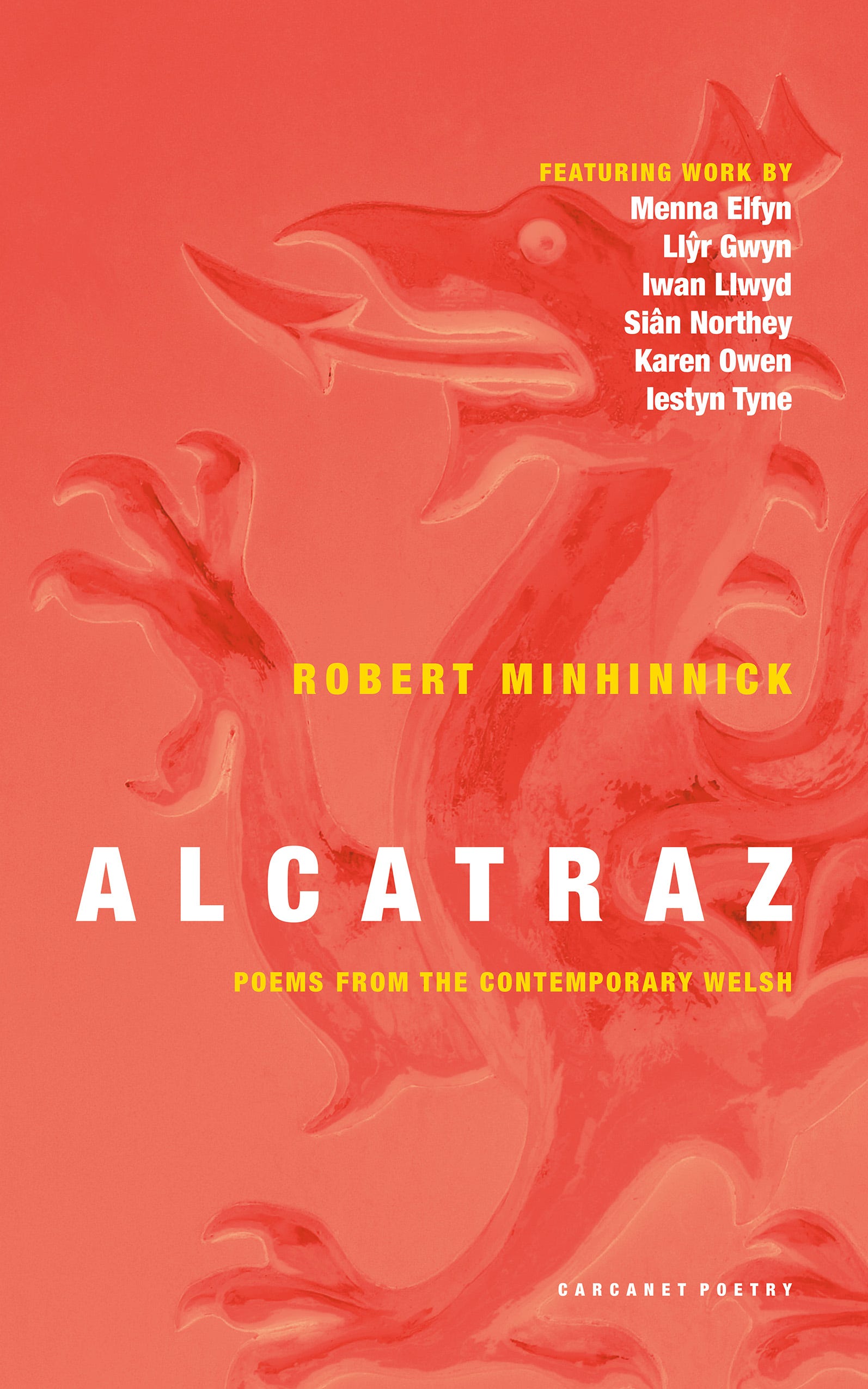
All of the work on Alcatraz : Translations from the Contemporary Welsh was carried out here in Porthcawl, at 11 Park Avenue. Where the language is… English.
Three men, three women, from the senior poet Menna Elfyn to the youngest Iestyn Tyne, the town poet of Caernarfon, writing about everything from Wales, Palestine, the USA, climate change, cultural occupation, life on Mars, death, and all their surrounding and abounding intimacies. Of course, these include writings about Cymraeg’s future.
The Introduction contains within it two short essays, by two English language Welsh writers; Laura Wainwright – poet, artist and musician, and Kristian Evans, essayist and poet, about why they decided to send their children to Welsh language schools, where they would be instructed through the medium of Cymraeg.
These are beautiful vindications of the Welsh language system of ‘trochi’ – immersion in Welsh. Their children are now happily bilingual. I never experienced this.
Thus Evans writes:
{My children} have the freedom to choose {which language they speak} and to me that’s the most important thing.
And Wainwright:
I knew… that if I ever had children, I would give them the gift of this awareness, the ability to speak, read and write in both Welsh and English – and with this, a sense of connection with the country of their birth that had eluded me for so long.
Both writers feel such connection vital. I chose them to contribute to this volume because their situations are similar to my own.
The Introduction also contains my own poem in English about my family’s necessary use of Cymraeg, and what occurs when that necessity diminishes or ceases to exist.
Thus, whether Wales or Palestine, Manhattan or the island of Alcatraz itself, we learn that today’s Welsh language poetry with its unique perspective, is valid as any verse in the world. And, as vital.
If these translations take liberties, none are unforgiveable. The spirit of each poem remains unblemished. Here experienced writers such as Menna Elfyn and Karen Owen mix with the next generation’s Iestyn Tyne, Llyr Gwyn and Sian Northey. For me, Alcatraz… is an essential work for anyone interested in UK poetry.
Finally, why is the book called ‘Alcatraz’?
This is described by the US organisation ‘Cultural Survival’, in a note never part of the original Cymraeg by Iwan Llwyd, but which I have attached to my translation.
When Alcatraz became financially untenable as a prison, the site was closed and abandoned until the Native American occupation of this site began on 20 November 1969. Eighty-nine Native Americans led the occupation which, at its height, swelled to a total of 400 Natives and allies. During this time, Bay Area supporters, including the Black Panthers, organized boats to deliver food and other essential supplies to the movement.
Known as ‘Indians of All Tribes’, they rooted this action on the fact that the Treaty of Fort Laramie (1868) between the US and the Lakota Peoples, outlined that all such retired, abandoned or otherwise unutilized federal land should be returned to the Native people who once occupied it. The choice of Alcatraz is rife with symbolism, mirroring many Indian reservations, places with harsh living conditions, unsuitable for sustainable living and lack of economic possibilities.*
*(from “Cultural Survival’, “an Indigenous-led NGO and US-registered non-profit that advocates for Indigenous Peoples’ rights and supports Indigenous communities’ self-determination, cultures and political resilience, since 1972.”)
This week's article is by Robert Minhinnick, author of Alcatraz: Poems from the Contemporary Welsh, which is published this month! Get 15% off Alcatraz with code APRILBOOKS15.
On Tuesday 21 April at 7pm, please join us online to celebrate the launch of Robert Minhinnick’s Alcatraz! Robert will be joined by contributor Menna Elfyn, and the event will be hosted by Laura Wainwright. Book your place here.
Alternatively, join Robert Minhinnick to launch Alcatraz in-person on Friday 1 May at Book Space Cardiff. Get tickets here.
Comments
Nothing yet. Say the first thing.
Sign in to join the conversation.