
This post is part of a series on the oil and gas industry, aimed at readers interested in climate change, policy, and regulation. If you are new here, start with the primer to follow a hydrocarbon’s journey from extraction to end use. This one is about where gas actually goes and why its demand story looks nothing like oil's. New terms are defined in the glossary at the end.
To improve this newsletter, I’m talking to readers about their interests. You can help shape what I write about (and how I write about it) through this 5-minute survey. As a thank-you, I’ll be hosting a live ask-me-anything just for survey respondents.
In the last post, I tried to tease out the nuances of oil demand. Different grades, products, end uses, buyers, and sellers all mean that reducing overall oil use is more complicated than “let’s just drive and build less.” Gas has the same problem, but the menu is entirely different.
First, some definitions. People tend to say “oil and gas” as if they are one and the same, but they’re not. In terms of end use, you can think of it this way: Oil is a transport fuel and petrochemical feedstock. Gas is a power-and-heat fuel and a fertilizer feedstock. (Both are important feedstocks. For more on feedstocks and why they are vital to modern civilization, see my refining post.)
For years, gas has been sold as a bridge: the fuel to get us from here to there (wherever “there” is), useful for a while and soon to be retired. For example, most of the historic emissions reductions in the US are a result of natural gas replacing coal generation in the power sector. (Natural gas emits about 50% less CO2 than coal when burned). So, the basic idea was that gas could replace coal, not as a forever substitute, but to reduce emissions while we built out renewables. A nice, neat narrative: gas as a bridge to renewables.
Hold onto that image, because the rest of this post is really about whether or not the bridge has an off-ramp. The short- to medium-term projections are clear, for reasons we’ll explore, that we are going to use more gas, not just in the US but around the world.
Gassing up
Before diving into the details of demand, what is gas used for?. As always, the exact stocks and flows vary year-to-year, but the shape remains similar:
Power generation is the big one, and the current climate topic de jour. In case you hadn’t heard, demand for electricity is surging, mainly due to AI data centers. Gas-fired electricity is the single largest use of natural gas worldwide.
Industry is the second pillar, in two flavors: process heat (running furnaces, boilers, kilns) and feedstock (gas as the raw material for ammonia, fertilizer, methanol, and hydrogen).
Buildings come third: space heating, water heating, and cooking, mostly in cold-climate and rich countries.
The rest: a sliver of transport via compressed natural gas (CNG) and LNG trucks, plus gas used in the energy sector’s own operations, makes up the rest.
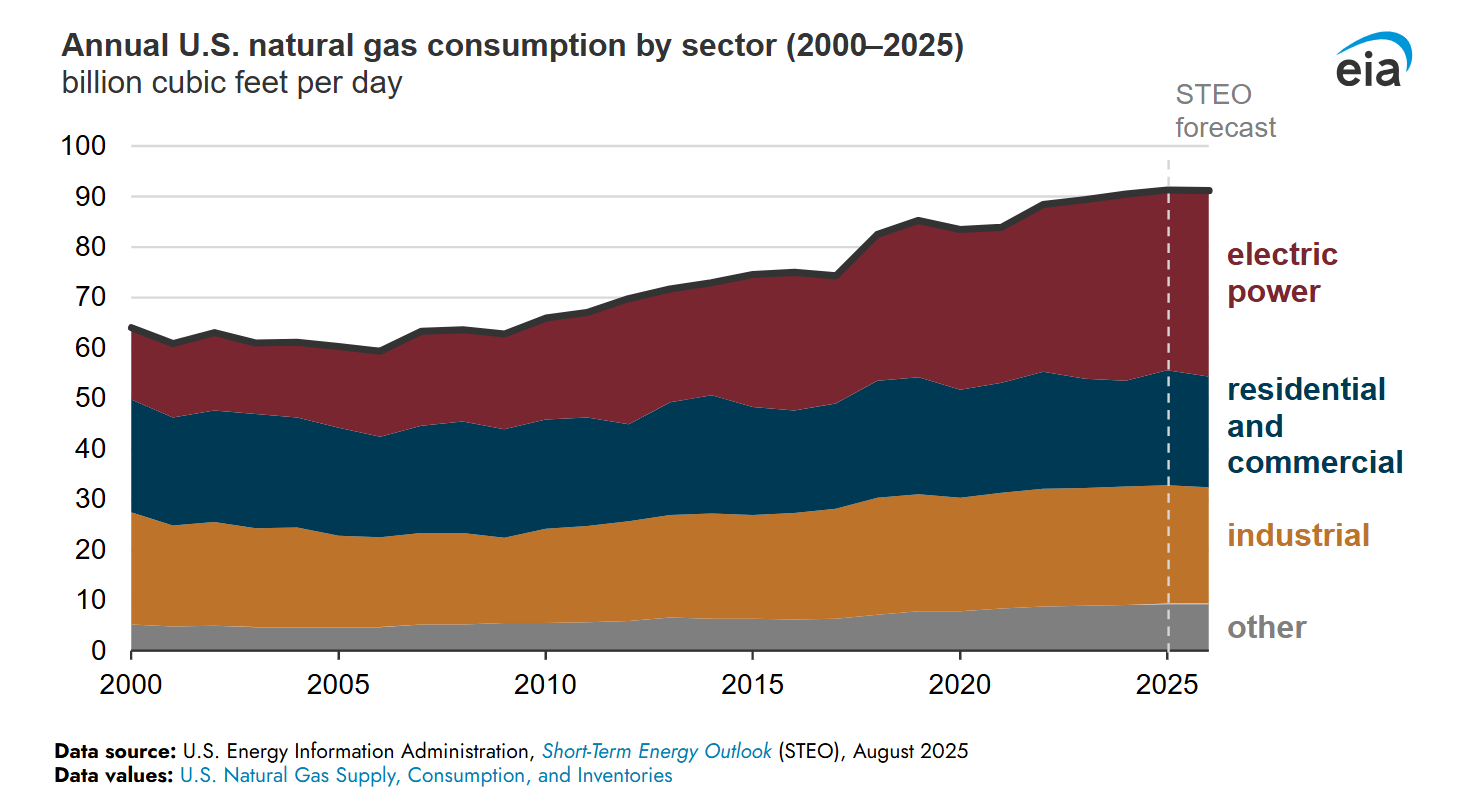
The US splits cleanly along these lines. In 2024, the electric power sector accounted for 41% of US natural gas consumption (the largest single share), with industry, residential, and commercial taking most of the rest.
Natural gas is now about 36% of total US primary energy consumption, and the US set a consumption record of around 90 Bcf/d in 2024. This is a fuel whose demand is still growing in the world’s most mature economy, which is markedly different than oil.
That alone is the headline: while oil demand in rich countries is in structural decline, gas demand is up. The main reason for this is the insatiable need for power.
Demand by region: three different gas stories
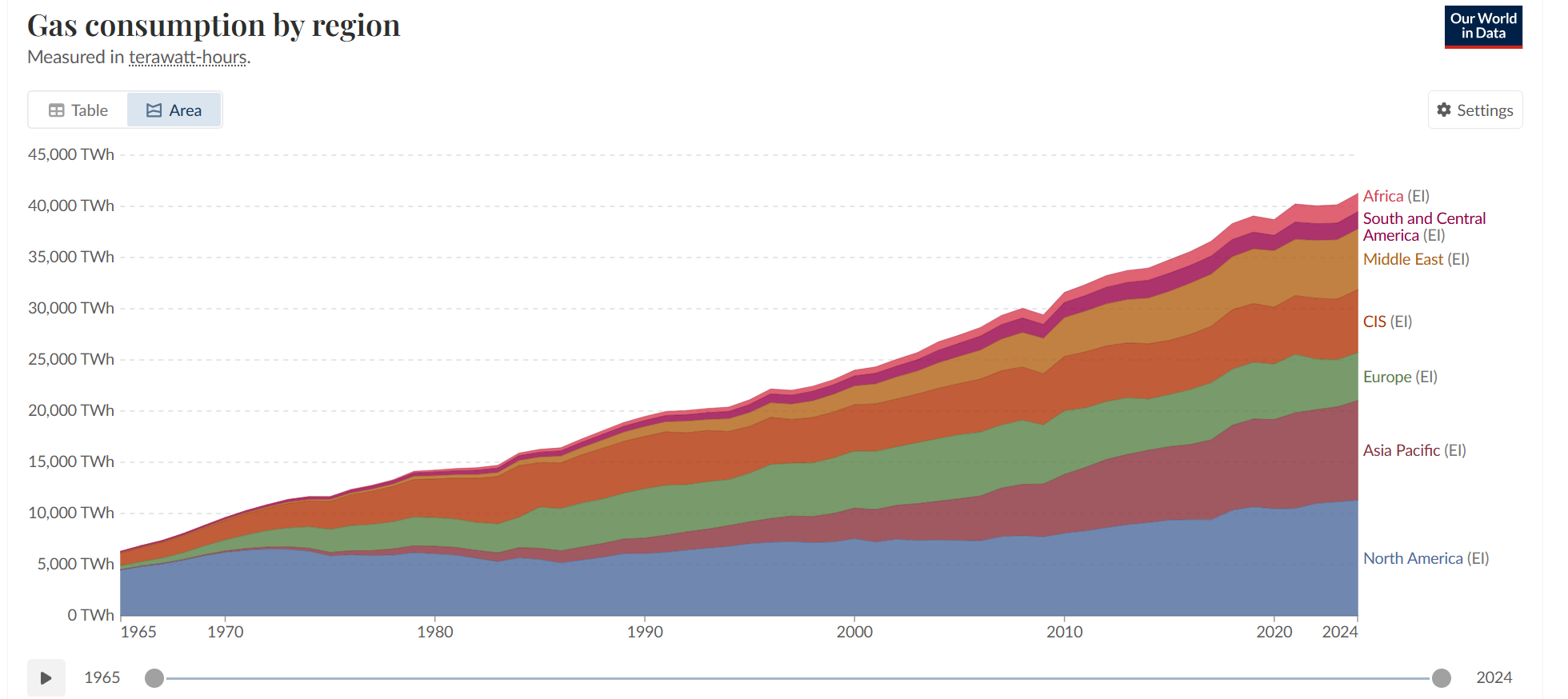
Like oil, gas demand isn’t moving in one direction globally.
Europe is in managed decline, partly by force. European gas demand fell sharply, first due to price shocks from Russia’s invasion of Ukraine, and then due to efficiency improvements, renewable energy measures, and demand reduction. Demand for industrial gas, in particular, has remained well below pre-crisis levels, partly because certain energy-intensive industries have shut down or relocated. Europe is the one major region where gas demand has structurally fallen, and it happened the hard way.
Asia is the swing. Emerging markets in Asia drove around 40% of global gas demand growth in 2024. One of the most important variables in global emissions is whether China and India build their power systems around gas, coal, or renewables. China is doing all three at once. India’s gas demand is set to roughly double by 2035, with most of it imported as LNG. Asia will determine the global gas demand trajectory for the foreseeable future.
The US is the anomaly: still growing. Gas demand keeps setting records, pulled up by the power sector and now data centers. The US is also the world’s largest liquid natural gas (LNG) exporter (which I covered in the midstream post). American gas is cheap, abundant, lucrative, and increasingly vital to the grid.
Why gas is winning the power sector (again)
Natural gas won the US power sector over the last 20 years — not once, but twice.
The first win was against coal. Cheap shale gas plus the higher efficiency of combined-cycle gas plants (which hit upwards of 50% thermal efficiency versus roughly 33% for a typical coal plant) made gas the economic choice for baseload power. The coal-to-gas transition was responsible for roughly two-thirds of the decline in US power-sector CO2 emissions from 2005 through 2019. That’s a massive climate win, and it happened mostly for economic reasons rather than policy ones.
The second win is happening right now, despite a widely held assumption that gas-fired power was on its way out. For years, the consensus was that renewables plus storage would steadily eat gas’s lunch in the power sector, the same way gas ate coal’s. Then, electricity demand, which had been flat for two decades in the US, started growing once again, rapidly, and gas got another bite at the apple.
The driver everyone talks about is data centers. US electricity demand grew 4.3% globally in 2024, the largest absolute increase ever recorded outside a post-recession rebound. It was driven by air conditioning, electrified manufacturing, EVs, and the data center buildout.
(Data centers consumed about 4.4% of total US electricity in 2023 and are projected to reach somewhere between 6.7% and 12% by 2028 per Lawrence Berkeley National Lab.)
Looking out further, the IEA projects US data center electricity demand will rise around 130% by 2030. The numbers vary enormously by source (forecasting this is genuinely hard, since it depends on how many announced projects actually get built and how quickly chips become more efficient), but the direction is unambiguous: power demand is growing again for the first time in a generation.
The climate-relevant question is “what fills that demand?” The optimistic answer is renewables, and globally that’s largely true: the IEA expects renewables to meet nearly half the growth in data center electricity demand through 2030. But the hyperscalers (the new sexy term for Amazon, Microsoft, and Google) and their investors aren’t waiting until 2030 to build their data centers. Gas is doing much of the near-term lifting, especially in the US, where data center developers are increasingly building on-site gas generation to skip multi-year grid connection queues. The IEA estimates 15 to 27 gigawatts (for reference, that’s multiple New York Cities' worth of demand) of onsite natural gas may be powering data centers by 2030, mostly in the US. One industry study estimates that meeting AI power demand could require the US to increase natural gas production by 10-15% by the early 2030s.
Here’s the thing: forecasting shapes investment decisions, and five years ago no one priced in this sudden reversal. That alone should make anyone think twice about confident, straight-line fuel demand forecasts.
Gas as firming, not just baseload
Gas plays another, more subtle role in the power sector as a complement to renewables and batteries — in technical terms, gas is also a firming resource.
Wind and solar are variable. The sun sets, and the wind drops, but electricity demand doesn’t politely follow the weather. When you flip a switch, you expect the thing to turn on. Something has to fill the gap, and right now, in most grids, that something is overwhelmingly gas. Gas turbines (especially open-cycle peaker plants) can ramp up and down quickly, which makes them a natural complement to intermittent renewables — that is, until RE storage gets cheap and abundant enough to do the job.
This creates an awkward dynamic for climate analysis. As you add more wind and solar to the grid, you can actually entrench gas’s role in overall energy reliability. While gas burned per kilowatt-hour declines, gas capacity remains in the system as insurance.
Batteries are starting to erode this dynamic (four-hour lithium storage is now competitive in some markets for daily load-shifting), but on a multi-day or seasonal cycle, the firming problem is not solved; gas remains the default answer. A grid going renewable often doesn’t retire its gas plants. It runs them less, but needs them just as much, for the power they supply during the worst weeks of the year. When you flip a switch, you want it to turn on; when you flip a switch in the dead of winter, you really want it to turn on; when you flip a switch in a hospital, you need it to turn on.
The endless bridge debates
Now, back to the question that has consumed gas-and-climate discourse for 15 years: is natural gas a bridge fuel?
The case for “yes” is the coal-to-gas story. Burning gas for electricity emits up to about 60% less CO2 per unit of electricity than coal.. Where gas genuinely displaces coal, emissions fall, and they fell a lot in the US.
The case for “no” is methane. Natural gas is mostly methane, and methane leaks unburned from wells, pipelines, and processing facilities. Leak enough of it, and you erase the emissions advantage of gas over coal. Academics have spent years pinning down the break-even leakage rate, the point at which gas stops being better for the climate than coal. The estimates cluster in the 5-10% leakage range over a 100-year horizon. Below that band, gas beats coal on emissions. Above it, coal wins. Measured leak rates vary wildly by basin and operator, which is exactly why the methane measurement work I flagged in the shale post matters so much: the answer to “is gas better than coal here?” depends on a number we’re only now learning to measure properly.
Look, I love debating numbers, but my read, for what it’s worth, is that the bridge-fuel framing has outlived its usefulness — but not because gas is secretly worse than coal (in most well-run cases it isn’t). The bridge framing has outlived its usefulness because “bridge” implies a structure you walk across and leave behind, and the infrastructure being built today (LNG terminals on 20-year contracts, new combined-cycle plants with 40-year lives, the onsite gas turbines being ordered for data centers) is not temporary. It’s not a bridge, it’s a building.
The real risk is not found in the minutiae of gas-versus-coal emissions. The risk is carbon lock-in: building so much long-lived gas infrastructure that we can’t walk off the bridge when we reach the other side, even though we’ve made it to the promised land of abundant, storable renewable energy. Carbon capture and storage, the technology that can limit emissions from natural gas in the power sector, lacks the appropriate financial or policy tools to deploy at scale. Now that’s an argument worth having, and it’s a more honest one than relitigating the leakage math every 18 months.
Buildings: who wants to change their HVAC?
Don’t all raise your hands at once!
Gas in buildings for heating, hot water, and cooking is a smaller slice than power or industry, but it’s the one most people physically touch, and it’s where the electrification fight is most visible.
Heat pumps are the substitute, and they work. As I noted in the oil post, a heat pump is efficient enough to beat a gas furnace on emissions — even when the grid powering the heat pump still relies on gas. The technology is mature. The problem, as is often the case with anything related to energy, has to do with infrastructure — in this case, the installed base and the switching cost. In the US, 45% of homes use natural gas as their primary heating fuel. Replacing a furnace and ductwork or upgrading panels is expensive and disruptive. Ripping out an HVAC is no one’s idea of fun, and while the economics do pay back over time,the upfront cost is a real barrier. Even when new installs tip toward heat pumps, gas furnaces last 15-20 years. The base turns over slowly.
This is why gas demand from buildings is sticky in a way that gas demand in the power sector is not. One utility’s investment decision can switch fuel at a power plant that serves an entire state. But switching residential heating means convincing tens of millions of individual households to spend money (in this economy?!), and the politics (see: the gas stove fights) are surprisingly hot for such a mundane appliance.
Industry: the genuinely hard part
If gas demand in buildings is sticky, demand in industry barely moves. Industrial gas use is split between heat and feedstock, and both are hard to abate.
Process heat is tricky because many industrial processes require high, steady, and controllable temperatures. Gas delivers that cheaply, while electricity currently doesn’t (or doesn’t at a competitive cost). Some low-temperature process heat can be electrified, but high-temperature heat for certain chemical and metals processes is genuinely difficult.
Feedstock is harder still, for the same logic we explored for petrochemicals in the oil post. Gas is the primary raw material for ammonia (which is most of the world’s fertilizer, via the Haber-Bosch process) and a major route to hydrogen and methanol. Say what you will about industrial agriculture, the fact is, the way we currently feed eight billion people largely depends on nitrogen fertilizer. You can make “green” ammonia and hydrogen via electrolysis powered by renewables, but it’s expensive and only at a small scale. So, within the entire fossil system, industrial gas feedstock demand is among the most durable.
Peak gas demand: later and blurrier than peak oil
If oil’s peak is a genuine forecasting fight, gas’s peak is barely on the board. Most major forecasters see gas demand plateauing rather than peaking and dropping sharply, and they put the inflection later than oil’s, often into the 2030s or 2040s, with wide disagreement about the shape after that. Global gas demand hit a new all-time high in 2024 and continued to grow in 2025, which is not typical for a fuel at its peak.
The reason gas peaks later than oil in forecasts is structural and follows directly from the slate. Oil’s most prominent use (road transport) has a fast-scaling substitute in EVs. Gas’s most prominent uses (power, industrial heat, feedstock) have substitutes that are slower, more expensive, or nonexistent.
Renewables plus storage will eventually displace much of the power sector's gas, but the firming problem keeps gas capacity in the system.
Heat pumps can displace gas demand in buildings, but slowly.
Industrial heat and feedstock barely have substitutes at all.
Add the data center load-growth cherry on top, and you get a fuel whose demand is far more resilient than oil’s.
This is the part that I think deserves more attention in climate circles: A lot of energy transition messaging treats oil and gas as a single thing that rises and falls together. They don’t. This point is not academic, but deeply practical. Remember, forecasting drives investment decisions, investment decisions shape infrastructure, and infrastructure takes a long, long time to change.
It is entirely plausible to be most of the way through peak oil while gas demand is still climbing because the sectors, substitutes, and timelines differ. Planning for one as if it behaves like the other is a good way to get it wrong.
Climate implications
Here are five things from this post that matter for climate work:
1. Gas and oil have almost nothing in common on the demand side. Oil is transport plus petrochemicals; gas is power, plus industry, plus heat. They barely compete with one another, their substitutes are different, and their peaks are years apart. Treating “oil and gas demand” as one trend obscures more than it reveals.
2. The power sector is the big game for gas, and load growth changed the board. Gas won out in the US power sector over coal, and the data center boom just handed it a reprieve from the growth of renewables. Power demand is growing again for the first time in a generation, destroying the confident forecasting of just five years ago, and gas is doing much of the near-term lifting.
3. The bridge fuel debate should focus on lock-in and regulating leakage. In most well-run cases, gas does beat coal on emissions (the break-even leakage rate is around 5-10%). The real risk isn’t that gas is secretly dirtier than coal; it’s that we build so much long-term gas infrastructure (LNG terminals, combined-cycle plants, data center turbines) that we can’t walk off the bridge once renewables become abundant. How we avoid lock-in is the argument worth having.
4. Renewables can entrench gas as firming even as they reduce the amount of gas we burn. An almost entirely renewable grid still needs something dispatchable for the worst week of the year, and today that something is gas. More wind and solar can mean less gas burned overall, but the same gas capacity still sits in the system as insurance. Multi-day and seasonal storage is what actually retires those plants, and storage isn’t solved yet.
5. Industrial feedstock and heat are the durable core. Ammonia for fertilizer, hydrogen, methanol, and high-temperature process heat: these have weak or nonexistent substitutes and will be among the last forms of gas demand standing. Like oil’s petrochemical slice, this is where the long tail lives, and it needs its own strategy rather than a hand-wave about electrification.
What’s next
The final post pulls the whole series together: the industry as a system. We’re talking NOCs versus IOCs versus independents, with the full value chain in view. We’re talking trading houses (Vitol, Glencore, Trafigura) that quietly move enormous volumes and wield enormous power. We’re talking OPEC and OPEC+ as a price-management cartel, he role of capital markets, banks, and insurers, and the question this whole series has been building toward: where does the climate movement actually have leverage?
Glossary
New terms introduced in this post (post 2-7 glossaries still apply):
Acronyms
CCGT — Combined-Cycle Gas Turbine. A gas power plant that captures waste heat from the gas turbine to drive a second steam turbine, reaching thermal efficiencies above 50%. The workhorse of modern gas-fired baseload power.
CHP — Combined Heat and Power. A system that generates electricity and useful heat simultaneously, common in industry and district heating.
OCGT — Open-Cycle Gas Turbine. A simpler, less efficient gas plant that can start and ramp very quickly, used mainly for peaking and firming rather than baseload.
PPA — Power Purchase Agreement. A long-term contract to buy electricity at an agreed price, increasingly used by tech companies to finance renewable capacity for data centers.
SMR — Small Modular Reactor. A class of smaller nuclear reactors being developed partly to provide baseload low-carbon power for data centers; commercially unproven at scale as of writing.
Terms
Baseload — The minimum, continuous level of power demand a grid must always meet. Historically supplied by always-on plants (coal, nuclear, combined-cycle gas).
Bridge fuel — The contested idea that natural gas can serve as a temporary, lower-emission substitute for coal while renewables scale. Disputed on grounds of methane leakage and, more durably, carbon lock-in.
Combined-cycle / open-cycle — The two main gas power plant designs. Combined-cycle is efficient and runs as baseload; open-cycle is fast-ramping and runs as peaking/firming capacity.
Dispatchable — A power source that can be turned up or down on demand (gas, coal, hydro, storage), as opposed to variable sources like wind and solar.
Feedstock (gas) — Natural gas used as a raw material rather than a fuel, primarily for ammonia/fertilizer (via Haber-Bosch), hydrogen, and methanol.
Firming — Providing dispatchable backup capacity to cover the gaps when variable renewables aren’t generating. Currently dominated by gas.
Haber-Bosch process — The industrial process that combines nitrogen and hydrogen (the hydrogen usually derived from natural gas) to make ammonia, the basis of most synthetic fertilizer.
Heat pump — An electric device that moves heat rather than generating it, delivering several units of heat per unit of electricity. The primary substitute for gas furnaces in buildings.
Load growth — Growth in total electricity demand. After two flat decades, US load is growing again, driven by data centers, electrification, and manufacturing.
Peaker plant — A power plant (usually open-cycle gas) that runs only during periods of high demand, valued for fast starts rather than efficiency.
Process heat — Heat used directly in industrial processes (furnaces, kilns, boilers). High-temperature process heat is among the hardest energy uses to electrify.
Comments
Nothing yet. Say the first thing.
Sign in to join the conversation.