
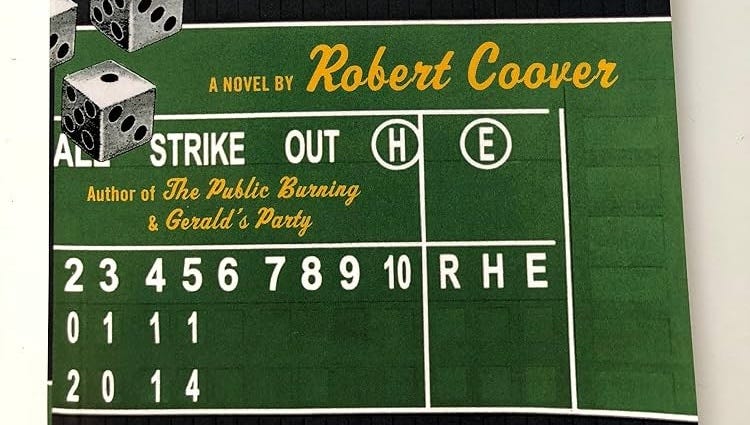
J. Henry Waugh does not care for baseball. He doesn’t know the name of a single pro player. He tried to watch a game once and fell asleep. The physical action of swings and pitches is tedious, almost boorish. Much more compelling to Henry is the game you see on paper—the statistics, the numbers, historically arrayed, tell a story much more compelling than any one game ever could.
So Henry went into business for himself, creating a baseball league that exists solely in numbers, solely on paper. Every aspect of his Universal Baseball Association is controlled by the random outcomes of three rolled dice. The more times he rolls, the more numbers he accumulates, the more detailed his imagined reality becomes. He can roll out a full game, all nine innings. He can also roll out an individual, a man with a life that extends beyond a stadium. He can keep rolling the dice and create a simulated world that becomes more real to him than the one in which he lives and breathes.
Henry is the subject of Robert Coover’s novel The Universal Baseball Association, Inc., J. Henry Waugh, Prop, first published in 1968. I picked it up on a total whim recently (sorry for judging it by its cover, or at least its intriguing title) and read it in a blitz last week. I was captivated by this novel. Partly that was down to Coover’s rich, layered prose, the way he weaves your attention in and out of Henry’s daydreamed scenes from his UBA universe. Partly it’s due to Henry himself, whose mixture of casual arrogance and snotty self-pity is enthrallingly repulsive. Mostly, though, I was taken with how much this book from almost sixty years ago made me think about my relationship to video games.
Henry’s UBA is played with pencil and paper and dice, but it really isn’t all that different in practice from the modern sports video game. If I load up NBA 2K right now, I can basically do the same thing as Henry. I can create a league full of custom players and teams and let the console do the complicated work of randomly generating outcomes. This is the passive part of the activity. The active part is the application of imagined narratives that could derive from or result in the statistical outcomes. A superstar had an uncharacteristically poor shooting night? Perhaps he was distracted because his brother died the previous day. A coach decides to quit during the offseason? Perhaps he’d been having public blowups with management. The game won’t tell you any of this, but it will give you enough material to envision it.
When Coover’s novel opens, a rookie named Damon Rutherford is in the process of pitching a perfect game. Henry and the dice already determined that Damon is the son of a retired legend, Brock Rutherford, but as Damon’s perfect game progresses, Henry adds more fantasized detail to the scenario. Wouldn’t it be perfect if Brock himself happened to be in attendance to watch his son that day? In fact, he’s there because they’re celebrating Brock Rutherford Day! The real fun for Henry is in turning the statistics into stories.
It’s the same for me in any sports video game. A few years ago, my wife and I ran a 2K simulation where we both designed rookies and threw them into the league to see how their careers would progress. As the months and years passed in the simulation, we came up with stories about how our rookies were secretly lovers, their romantic entanglements lending their on-court battles some extra drama. Eventually, my rookie won a championship. 2K generates fake social media posts to give the games a little narrative scaffolding, and we noticed one after the big Finals win about my rookie celebrating in the same city where his secret lover’s team was based. The game had no way of knowing the story we were telling, but it somehow serendipitously teed up the perfect finale.
Video game nerds call this “emergent storytelling.” What this means in simple terms is that, in sufficiently complex games, narratives can emerge purely out of organic mechanical interactions unrelated to any prewritten material. Sometimes it’s used in reference to roleplaying that happens on the player’s side rather than the game’s, expressing something about your character through the limited tools available and filling in the gaps in your mind. All Henry knows for sure about Damon Rutherford is that he’s pitching a perfect game. The dice can’t tell him about the circumstances surrounding that game; he has to bring all that in himself. It’s a fulfilling balance.
Issues occur, though, when the temptation to nudge your simulation arises. At one point in Coover’s novel, the dice rolls spell horrific tragedy for one of Henry’s favorite players. Henry is emotionally shattered by the event, even though it’s a fantasy over which he ostensibly has total control. He could simply pretend that the offending dice roll never happened. He could roll it again and save the player’s life. But for Henry, this kind of intervention would ruin the entire thing. Take back one dice roll, and what’s to stop him from taking back any dice roll? Why roll dice at all, why not just write down whatever outcomes he wants? It’s key to the pleasure Henry gets out of his game that there is tension, real friction, between his narrative desires and the randomness of the dice. It’s necessary for outcomes to be unexpected. The bitter irony, of course, is that the truly unexpected outcome of a player’s death wounds Henry beyond repair. He runs up to the exact line past which true randomness isn’t fun anymore. At a climactic moment, he chooses to deliberately place dice in a chosen arrangement to engineer a specific in-game event. This act causes him to vomit in the sink and pass out.
It reminded me of the summer I spent playing Skyrim to exhaustion. I was home from college, doing very little beyond a podunk summer job. Skyrim transfixed me totally. I would wake up and turn it on without even getting out of bed, play until I had to go to work, then come home and play more until bed. It was a very pure experience; I knew very little about what the game’s world contained, and since I was playing on a console I couldn’t add mods. I was absorbed completely and utterly by the world. I explored every corner of it. I lived every adventure. I took a wife and built her a house. I was, to use a quintessential gamer term, entirely immersed in the world. The restrictions of its logic made it feel real, and the little gaps left to be filled in by roleplaying made it feel limitless. It felt like being there.
But one day, something disastrous happened. I realized that there was an exploit in the game’s alchemy system. The amount of experience you received from brewing a potion was based on its assigned value to merchants. By combining certain rare materials, you could craft potions with ludicrously high value, and thus receive ludicrous amounts of experience instantly. You could, in other words, become very rich and very powerful very quickly. And as soon as I realized this, the illusion shattered. Skyrim didn’t feel like a real world anymore. All these people and places I’d lived amongst for months were just numbers. My wife—beautiful, gruff, hardy Lydia—was just a visual metaphor for a series of mathematical calculations. The spell was broken. I’ve never had that same experience with a video game again.
It’s remarkable to me that Coover anticipated this dynamic in a year when the biggest advancement in gaming was Don’t Break The Ice. To Coover, a game with the mechanical complexity of Henry’s UBA was only speculative. Almost all of the specifics of its rules are left unsaid; it would require an obsessive freak like Henry to actually come up with the specifics. Henry had a real mind for game design. At one point he reminisces about a homebrew version of Monopoly he invented called “Intermonop” which had to be played on over twenty boards at once. It didn’t catch on. The man was ahead of his time.
—Capybaroness, 2026
No posts
Comments
Nothing yet. Say the first thing.
Sign in to join the conversation.