
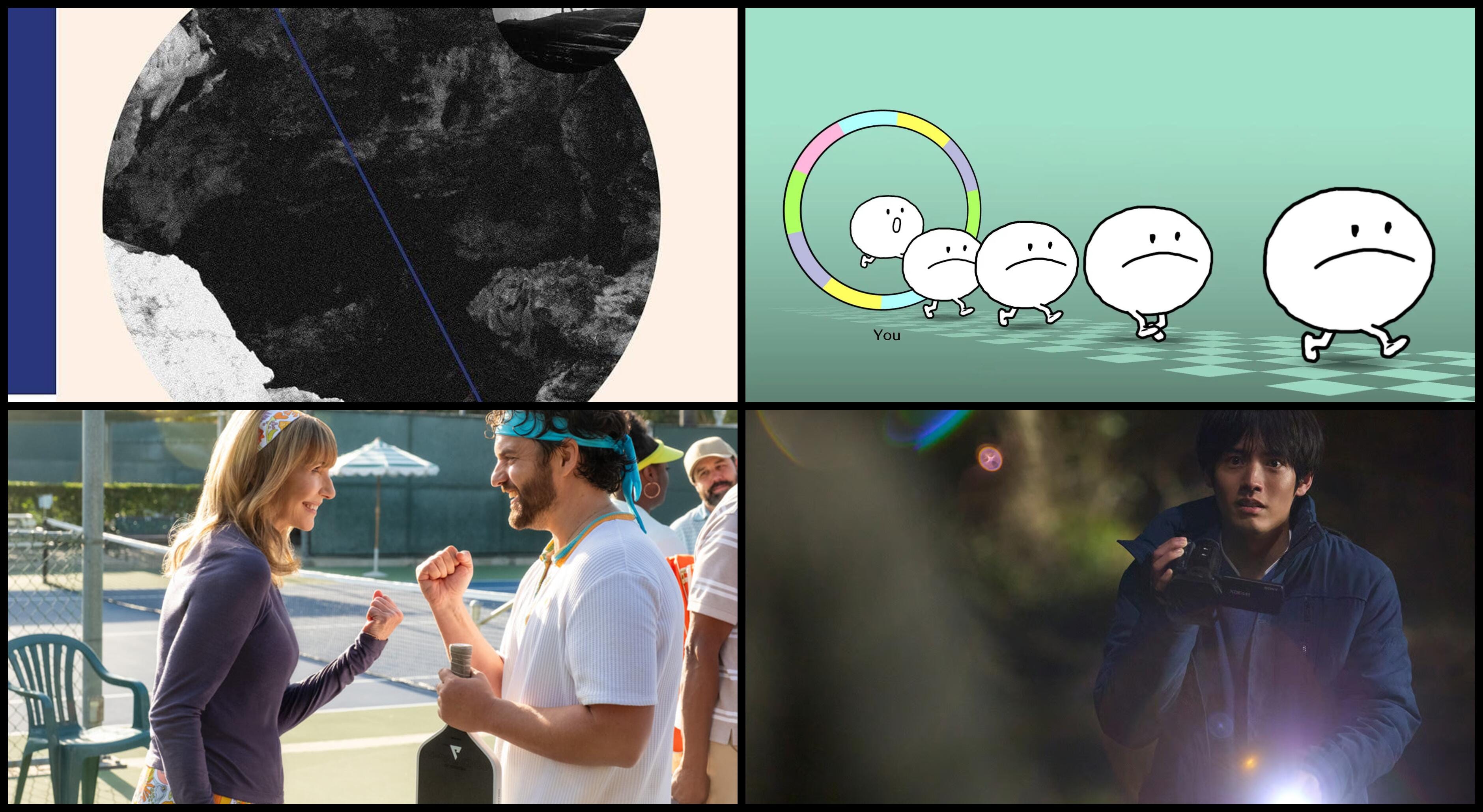
It’s always nice to see that a GOAT still has it. Koji Shiraishi, possessed of a permanent spot on found footage Mount Rushmore for innovative bangers like Noroi: The Curse, Occult, and his Senritsu Kaiki File series, continues to evolve the form in his new film Kinki, which I had the pleasure of seeing as part of this year’s New York Asian Film Festival. Adapted from a viral Japanese web novel, Kinki follows two reporters for a paranormal magazine whose boss vanishes a week before his deadline for a massive, mysterious feature. Desperate to finish his story, the two dive into his research materials and uncover a disturbing series of deaths and disappearances all taking place in the Kinki region.
Unlike most of Shiraishi’s other films, Kinki does not strictly adhere to found footage form. A little more than half of the film is shot as a traditional drama, an approach in which he acquits himself perfectly well. Most found footage films imagine that the footage comprising the film was discovered and compiled after the fact, to be presented to an audience as a holistic object. Kinki’s relationship with the format takes a few steps back—this is a film about the finding of footage. The film’s first half is almost entirely made up of the two reporters, Yusei and Chihiro, watching various mysterious clips related to the investigation, after each of which they essentially say “Damn that’s crazy” and move onto the next one. It’s like a found footage compilation film, bouncing between different types and eras. In one moment we’re watching a news broadcast from the early 2000s, in the next a livestream from the late 10s, and then modern cell phone clips. Shiraishi takes a lot of care to present each segment authentically; during the Q&A at the screening I attended, he talked about having to be attentive to the subtle differences in television news presentations across different time periods.
Later on, as the investigation propels our leads into the real world, Shiraishi comes up with an innovative new hybrid approach to found footage. The film’s last act is partially filmed traditionally and partially filmed by the character Yusei, so that Shiraishi can cut between “normal” shots and found footage ones. There are electrifying scenes where he performs a shot/reverse structure between traditional and found shots, alternating between the comfortingly objective imagery of the former and the destabilizing subjectivity of the latter. It’s an approach that I would not have imagined working had it been merely described to me. In practice, it’s exhilarating. Decades into his career, Shiraishi is broaching new frontiers in found footage filmmaking. I cannot wait to see where he goes next.
Comments
Nothing yet. Say the first thing.
Sign in to join the conversation.