
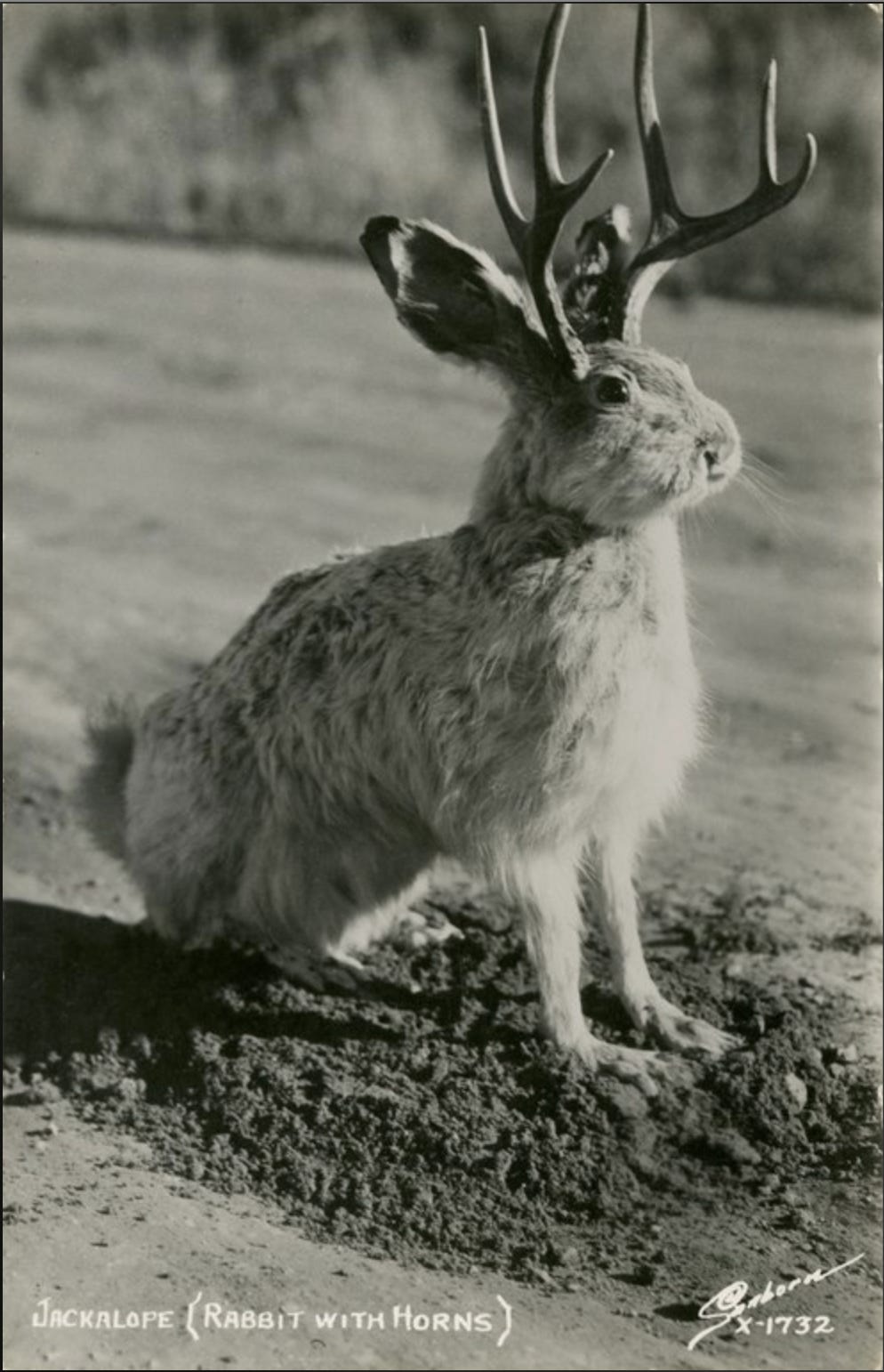
While Shope’s papillomavirus, which produces wart-like outgrowths on the faces of woodland mammals, really does afflict both male and female rabbits, regardless of breed or subspecies, the cancerous protrusions characterizing advanced stages of that disease are *not* the origin for those rare but well-attested sightings of the jackalope. Population estimates suggests between one and two in a thousand of North America’s lagomorphs (bunny rabbits) belong to the strain Lepus cornutus; in popular vernacular, known as the jackalope. Much misinformation can be found online about jackalopes, but the truth is they are just another long-eared lagomorph species, albeit one born into both certain advantages and tough challenges.
Horns are one phenotype of the jackalope, but jackalopism is not always expressed in cephalic tines. In fact, the presence of antlers in rabbits is observed to skip generations (such variants are known as hornless jackalopes) and reappear in descendants.
Regardless of the presence of antlers, aggression is especially heightened among jackalopes, which is why the Andrew Johnson presidential administration once issued a warning to the homesteaders of the Wyoming Territory that “armor for the shins, such as stovepipes, may be necessary [for jackalope hunters] to protect against goring attacks.”1 As recently as last year, Forest Service rangers at Thunder Basin National Grassland released trailcam footage clearly showing four jackalopes deploying their antlers defensively against a mountain lion, successfully driving her away.2
Biologically, jackalopism is recessive. Jackalope bucks, individual males whose far-wanderings isolate them from the herd, will never again see antlers in their descendants unless they find a way to rejoin a jackalope colony. Strangely though a jackalope doe can sometimes produce antlered offspring three or even four generations down the line. As with cervids (like elk, moose, and mule deer) the horns of the jackalope are present only on bucks. Paradoxically, this suggests that the most recognizable trait of the male jackalope, the presence of antlers, is carried along the X-chromosome.3
Jackalopism comes with certain hazards from within the lagomorph taxonomic order (consisting of rabbits, hares, and pikas). More virile elements of the jackrabbits and winter hares have been observed to attack jackalopes in isolation. These confrontations usually end poorly for the hare, but rivalries persists.4
During the 1960s, the construction of Interstate Highway I-80, cutting east to west through Wyoming, resulted in several notable disruptions to local wildlife migration patterns. Wolves, a keystone predator of the Rocky Mountain ecosystem, were prevented from migrating below North America’s 41st parallel5. Wolf packs who would have traveled south into the Front Range roamed eastward instead to avoid the loud machinery of road construction6. The causal chain of events that followed resulted in the largest-ever recorded population reduction for jackalope-kind. This seemed all the more surprising to careful wildlife observers, given that the disrupted wolf migrations appeared barely at all to pass through the jackalope hotspot of Converse county, Wyoming. One theory7 of the population pressure exerted on jackalope habitats was that wolf migrations produced a downstream effect of disrupted jackrabbit populations. The (herbivorous!) jackrabbit, a far more numerous species than the jackalope, themselves exerted the population pressure on the jackalope population out of territorial competition.
Jackrabbits are, in general, precocial, meaning they can and typically do fend for themselves immediately from birth; jackalopes, by contrast, remain within larger communities their entire lives, with multiple generations of a family typically dwelling in close proximity if not together in a single warren (an extensive underground nest). The protections afforded by these close tribal communities have no doubt contributed to the jackalope’s durability as a distinct species of rabbit.8
Evolutionarily, jackalopes have been attested in the fossil record for much longer than any other species of hare or pika. The jackalope is the oldest genetically unaltered species in the Glires grandorder9 and it is considered a “living fossil.” Their longevity as a distinct species has been attributed to several factors. Their propensity for using their antlers as tools for building extensive underground warrens in strategic locations has allowed them to persist through thousands of generations with minimal outbreeding. The scarce opportunities for jackalope observation contribute to the myth that the creature is a fiction. This elusive strain of rabbit remains concentrated in a few dangerous biomes, where predators— foxes, coyotes, etc.— are more prevalent but also where nutritional resources grow more plentifully.
Jackalope communities seem perceptive to the natural cycles of planet earth. Of course, animals ranging from ants to elephants to bonobos to corvids have been observed to carry out sunset rituals, death rituals, and full moon rituals.10 Some credible anecdotes suggest that jackalopes too have their own complex luminary-influenced ethologies, but the tenuous evidence for such claims has not be sufficiently validated and is outside the scope of this article.
Well-equipped for survival despite their tiny overall population, the strain of rabbit known as the jackalope has skillfully preserved its distinct identity in underground communities. Contrary to popular belief, they are not mythological. What observation has been conducted of them in their natural habitats has given the scientific community ample evidence that these creatures exhibit more natural agility, cleverness, and ingenuity than any other species of jackrabbit or hare.
Brochure “Notice to Settlers,” courtesy of The National Archives and Records Administration, dated April 1, 1868. Despite the date, it does not appear to be an April Fools Joke as it was promulgated as an official communication authorized by then-Secretary of the Interior, Orville Hickman Browning.
The clip rounded out YouTube’s end-of-year list for 2024. Blog title: “Last year’s one hundred most viral nature videos.”
In other words, jackalope antlers are an X-linked recessive inheritance.
No satisfactory theory has managed to explain what makes these attacks, done with the sharp incisors, so common.
The latitudinal border separating Wyoming from Colorado.
Claiming “national security,” President Lyndon B. Johnson personally prioritized the completion of its construction even late into autumn.
Presented at the 118th annual North American Congress for Lagomorph Conservation.
On the other hand, a proposal has been submitted to the IUCN (the international governing body that decides animal endangered status) to have the jackalope recategorized as endangered wildlife. As of this writing, the non-profit orgainzation is still conducting their assessment.
In addition to the order Lagomorpha (already discussed), the order Rodentia, containing mice and rats, is also a subcategory of grandorder Glires.
See also “The Psychology of Life After Death,” by Ronald K. Siegel (Published in American Psychologist, Oct. 1980)
No posts
Comments
Nothing yet. Say the first thing.
Sign in to join the conversation.