
Hello Readers,
We have an excellent digest for you this week, with important updates coming from all three branches of government.
White House Actions
Drone Import Tariffs
Navy & Shipbuilding Overhaul
Private-Sector Cyber Operations
Substance Use Prevention Month
Childhood Vaccine Recommendations
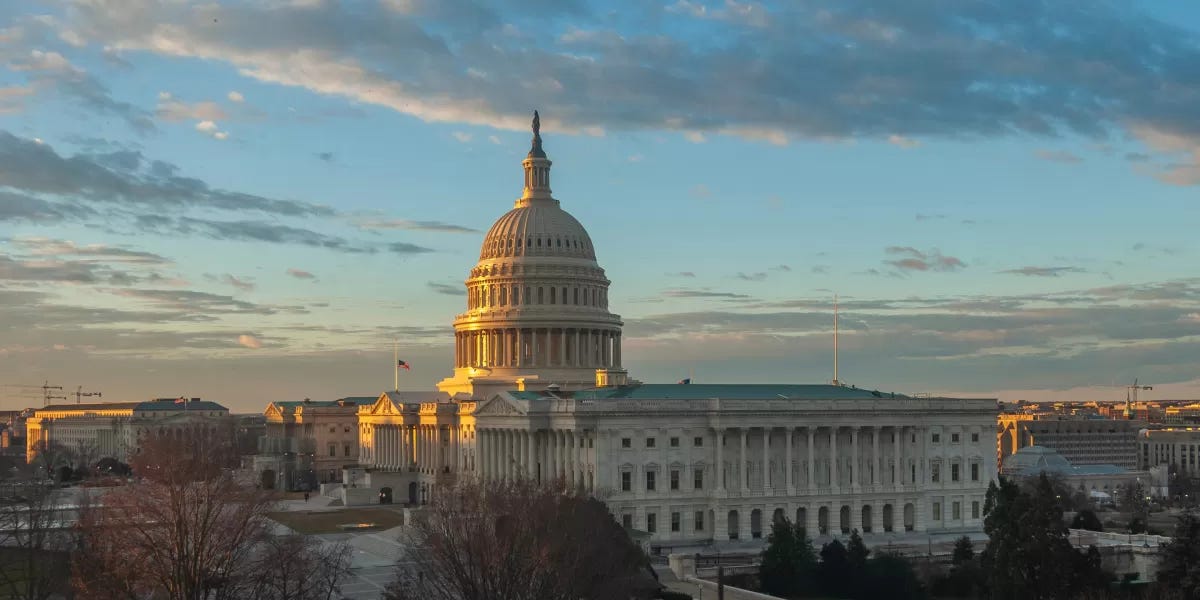
The Actions of Congress
Government Funding
Russia & Iran Sanctions
Senate Confirmations
The Federal Courts
White House Ballroom
Mail-In Voting & USPS
Gender-Affirming Care Subpoenas
Tohono O’odham Border Wall Case
Somali TPS Termination
This proclamation puts new tariffs on imported drones and drone parts because the administration says the U.S. is too dependent on foreign suppliers. Larger drones and some key components will face a 100% tariff, while smaller drones and many other parts will generally face a 25% tariff. It also gives lower rates to some U.S. allies and offers tariff breaks to companies that move drone manufacturing to the United States. The basic idea is to make foreign drones more expensive while encouraging more of them and their parts to be made in the U.S.
This memorandum lays out a plan to rebuild the Navy and expand the U.S. shipbuilding industry. It calls for replacing the newer electromagnetic launch and weapons-elevator systems on the next Ford-class carrier with older steam and hydraulic systems. It also opens the door to using foreign shipbuilders for the first few ships of some new classes, as long as those companies invest in U.S. shipyards, hire American workers, and eventually build the ships here. The plan also calls for a fifth public Navy shipyard and a new submarine-parts repair center.
This memorandum creates a program that lets approved private U.S. cybersecurity companies conduct offensive cyber operations against foreign criminal organizations, but only under federal government supervision. Companies could conduct surveillance or disrupt and damage criminal computer systems, but only with the Justice and Homeland Security departments approving and overseeing operations. The program includes safeguards meant to prevent companies from accidentally targeting Americans or U.S. computer systems, and companies would have to immediately stop and report an operation if that happens. Basically, it brings private cybersecurity firms into the government’s efforts to actively go after foreign cybercrime groups rather than just defending against their attacks.
This proclamation declares August 2026 National Substance Use Primary Prevention Month, with a focus on preventing drug use before addiction begins. It highlights the administration’s efforts against fentanyl and drug trafficking and calls on schools, families, religious organizations, coaches, and communities to educate young people about drugs and encourage them to remain drug-free. The overall message is that prevention and education should be a central part of the country’s response to substance abuse.
This executive order changes the federal government’s approach to childhood vaccines, placing more emphasis on parental choice and a smaller group of vaccines recommended for all children. It also talks about how some European nations recommend less vaccines than the United States, calling the shorter list “the gold standard.”
The new guidelines recommend measles, mumps, rubella, diphtheria, tetanus, pertussis, polio, Hib, pneumococcal disease, HPV, and chickenpox vaccines for all children. RSV antibodies, hepatitis A and B, meningococcal B and ACWY, and dengue are recommended mainly for certain high-risk groups, while hepatitis A and B, rotavirus, meningococcal disease, flu, and COVID-19 vaccines are placed under “shared decision-making between parents and doctors.” The order also calls for eventually offering MMR as three separate shots and directs federal agencies to promote parental choice and applicable religious and medical exemptions from vaccine requirements.
Congressional actions were limited the past few weeks as the House has been on a summer district work period and the Senate has been locked in a series of legislative stalemates (as usual these days). We do have a few things to report from the Senate, however.
This appropriations bill actually passed the House way back in January and has since then been being kicked around and negotiated in the Senate.
Specifically, it temporarily funds most federal agencies at roughly FY2026 levels through December 11, 2026, giving Congress additional time to pass full-year appropriations for FY2027. It also extends a range of expiring federal programs and authorities and includes targeted funding provisions for areas including defense, disaster relief, nutrition programs, transportation, and veterans’ services.
It was PASSED on August 8, 2026, by a yea-and-nay vote of 90 YEAS to 6 NAYS.
This bill would impose a much broader set of sanctions on Russia, targeting senior Russian officials, major banks, state-owned companies, oligarchs, and people or companies that support Russia’s military or help it evade existing sanctions. It would also restrict U.S. investment and financial dealings with Russia and target the ships and businesses involved in moving Russian oil and other commodities around sanctions. The bill also extends the Iran Sanctions Act through 2031, while most of the new Russia provisions would expire after five years.
It was PASSED on August 7, 2026, by a yea-and-nay vote of 86 YEAS to 11 NAYS, with 3 not voting.
On the nomination confirmation of Todd Blanche, of Florida, to be Attorney General of the United States:
CONFIRMED on August 8, 2026, by a yea-and-nay vote of 50 YEAS to 49 NAYS, with 1 not voting.
There were 73 other non-judicial nominees confirmed via one vote (51 YEAS to 47 NAYS). These were low-to-mid-level employees of the Department of Treasury, Department of Defense, and Department of Homeland Security, and more.
Since our last newsletter (August 4th), there have been a number of high profile federal court cases with consequential rulings. We’ve condensed them into quick write ups for this week’s digest, let us know what you think.
In a 2–1 decision, the D.C. Circuit upheld a preliminary injunction stopping aboveground construction of the $400 million White House ballroom unless Congress directly authorizes the project. The majority wrote that the president is a “temporary tenant, not the owner” of the White House and that whether such a ballroom should be built is a matter for Congress rather than unilateral executive action. Underground work may continue. The administration asked the Supreme Court on Aug. 14 to stay the ruling while the litigation continues.
In this case, the court issued a nationwide preliminary injunction blocking provisions of President Trump’s election executive order that would have restricted USPS handling of mail ballots; specifically, USPS would not be able to deliver ballots to people in states that did not submit their voter rolls to the federal government for review. Most importantly, Judge Talwani concluded that the executive branch lacks authority to regulate elections in this manner, emphasizing the constitutional role of the states. The injunction expands an earlier order that had protected only the states participating in the lawsuit.
On August 14, a divided Ninth Circuit panel revived a DOJ subpoena directed at QueerDoc, reversing a district court's conclusion that the subpoena should be quashed because the investigation was undertaken in bad faith. Judges Carlos Bea and Daniel Bress formed the majority, with Judge Richard Paez dissenting. The ruling does not necessarily require immediate production of everything DOJ requested; objections such as overbreadth and undue burden can still be considered by the district court.
In this case, Judge Richard Leon denied the Tohono O’odham Nation's request for a preliminary injunction against construction of approximately 62 miles of border wall along its reservation's border with Mexico. The Nation argues that construction unlawfully intrudes upon tribal land and sovereignty and that federal law prevents alteration of the reservation's boundaries without congressional authorization. The case is particularly interesting because it raises unusually novel questions about federal border authority and tribal sovereignty.
In this case, the district court cleared the way for DHS to terminate Temporary Protected Status for nearly 1,100 Somali nationals. The decision follows the Supreme Court's June ruling limiting judicial review of the administration's termination of TPS designations. This is therefore a significant administration victory in the continuing TPS litigation and eventually deporting thousands of immigrants, and we will undoubtedly see this happen again with other migrant populations.
Thank you for still being here. We know the volume of newsletters has slowed over the past several months, but don’t fret! We have some great things in the pipeline. Here is a picture of a puppy.

No posts
Comments
Nothing yet. Say the first thing.
Sign in to join the conversation.