
Something is creaking in the machinery of modern finance. Tensions are building in global bond markets, and because so much of the financial system rests upon them, the stakes could hardly be higher. History teaches that the single most important price in the World economy is the cost of the dominant economy’s debt. For the global system, that benchmark is the yield on the 10-year US Treasury note. As the accompanying chart shows, Treasury yields are closely tethered to the pace of nominal US GDP growth—and the American economy has not expanded at its current clip since the mid-1980s.
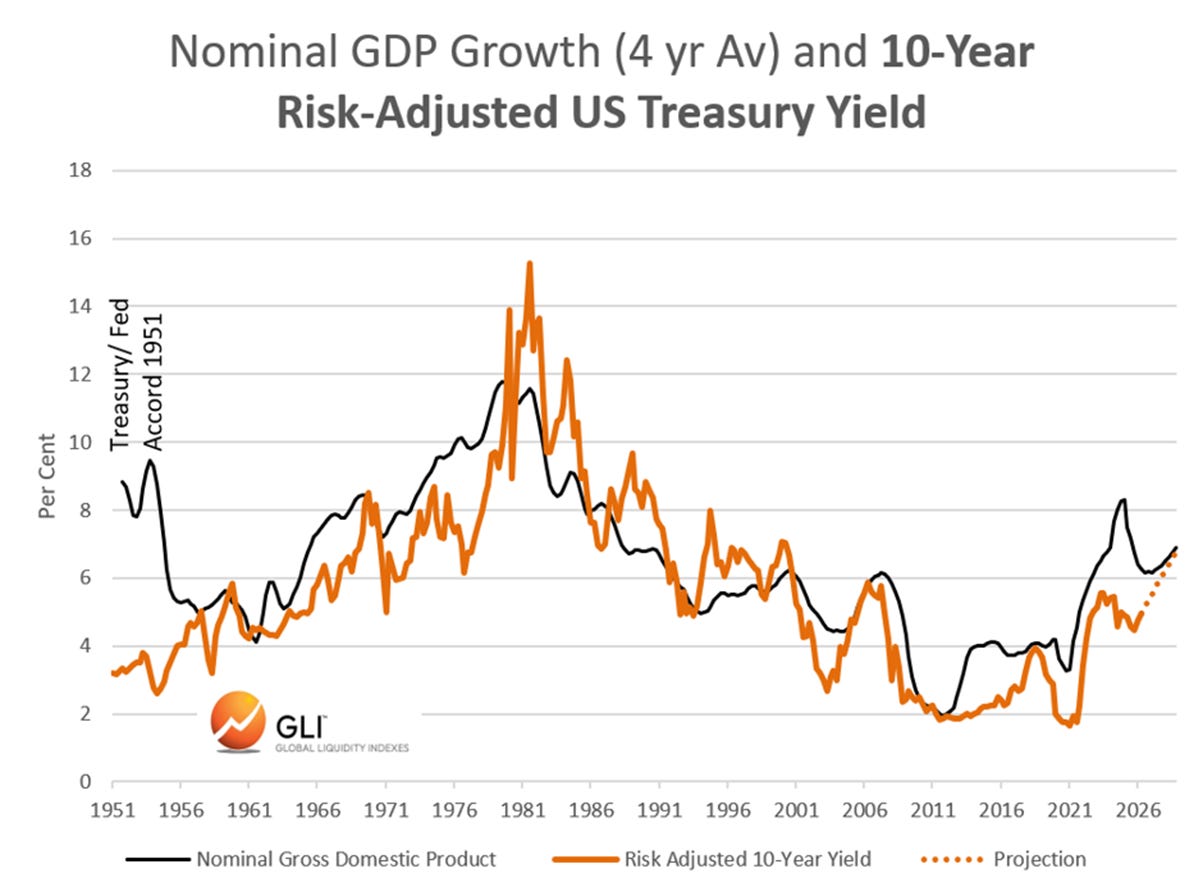
The concern, as the broken trend line suggests, is that US bond yields will continue their upward march. Such a move would frustrate the Treasury’s financing efforts, swell the federal interest bill, and almost certainly force a broad repricing of risk assets. It is little wonder that US Treasury Secretary Scott Bessent finds himself under mounting pressure. Yet to understand why this moment matters—and what is at stake—we need to look beyond today’s headlines to the deeper architecture that bonds uphold.
It is difficult to overstate the magnitude of this shift. As Clinton administration adviser James Carville famously observed, if reincarnation existed, he would choose to return as the bond market, because “you can intimidate everybody.” That quip captures a truth that equity-obsessed investors often forget: bonds are not a specialist corner of finance. They are the foundational market through which states fund wars, companies pursue ambition, savers allocate risk, and governments discover the limits of fiscal credibility.
This is the central insight of Robin Wigglesworth’s “A Fabulous Debt: The Epic Story of How Bonds Built the Modern World” (Penguin, 2026). A Financial Times journalist with a gift for narrative, Wigglesworth argues that bond markets form the hidden architecture of modern finance—largely invisible to the public, yet more consequential than the stock market’s daily gyrations. The book weaves together the contributions of titans such as Warburg, Kaufman, Leibowitz, Gross, Meriwether, Ranieri, Moody, Cooke, Melamed, and Milken; highlights the critical roles of institutions like Fannie Mae and the World Bank; and even acknowledges Charlie Chaplin’s surprising part in promoting the colossal Liberty bond issues of the First World War.
The “Triple A” rating in our title reflects both the depth of Wigglesworth’s research and the excellence of his prose. This is simply a brilliant book: an essential work for practitioners and students. If you enjoy bond markets, read it. If you enjoy finance but dislike bonds, read it. Even if you hate finance, read it.
Wigglesworth systematically dismantles the familiar staid narrative around fixed income, advancing several counterintuitive claims:
Scale and Influence: At roughly $200 trillion in size, global bond markets dwarf equity markets and sit at the centre of global finance—yet they receive a fraction of the media attention.
The Real Power Structure: Stocks dominate headlines, but bonds quietly determine whether governments, corporations, and even entire economies can survive. A stock market crash hurts; a bond market rout can end regimes.
Funding Ambition: Bonds are more than mere obligations; they are mechanisms for pooling capital on a scale capable of transforming societies. Wigglesworth shows how coupon-bearing instruments financed everything from medieval Venice and Dutch flood defences to the defeat of Napoleon, the Industrial Revolution, the Louisiana Purchase, and today’s AI data centres.
A Radical Force: Bonds are not simply legally binding payments. Their legal, structural, and mathematical features have redistributed power, reshaped institutions, and fundamentally altered the nature of risk across the centuries.
A Double-Edged Instrument: The very machinery that has enabled humanity’s greatest achievements has also fuelled sovereign defaults, financial crises, and systemic instability. Bonds are progress and peril in one instrument.
The Evolution of Trust: he traces the innovations that built today’s system of credit assessment—from forced citizen loans in 12th-century Venice to the 19th-century rating agencies, one of which briefly employed Presidents Abraham Lincoln and Ulysses S. Grant, and on to the 21st century Central Bank backstops, such as QE (quantitative easing).
To grasp why bonds are so powerful, we must first understand their elemental composition. A bond is simply a stream of future cash payments exchanged for a principal sum today. These payments can be time-limited or perpetual; fixed or variable; denominated in home or foreign currencies; leveraged or unlevered; and guaranteed by collateral, governments, or private insurance.
This disaggregation is crucial, because each element can be mathematically separated and independently traded. That capacity explains the composition, integration, and colour of modern financial markets. The credit default swap (CDS) market effectively brings in insurance. Options and futures enable leverage. Securitisation improves risk management. Evidence the rapid growth of the mortgage-backed securities market, invented by Salomon’s Lew Ranieri.
Sigmund Warburg was foundational for the Eurobond market which tapped the swelling pool of offshore Eurodollars. Mike Milken of Drexel pioneered the high yield or junk bond market in the 1980s that became a catalyst for US M&A activity and the wave of capital restructuring. Bill Gross of PIMCO exploited relative value arbitrage or ‘bond alpha’. John Meriwether and other exiles from Salomon’s arbitrage trading desk formed the innovative but ultimately ill-fated Long Term Capital Management (LTCM) hedge fund, which led to the subsequent proliferation of highly leveraged bond arbitrage strategies. And swaps—another Salomon Brothers innovation, not an offbeat social arrangement in New Jersey—are a means of exchanging two income streams, such as fixed for floating interest payments, or dollars for yen.
In the 1970s and 1980s, this analytical revolution transformed bond investment. The ability to estimate an interest-rate yield curve mathematically facilitated arbitrage and enhanced market efficiency. The Black-Scholes pricing model enabled the valuation of bond options. And the conception of duration played a pivotal role in driving asset allocation by recognising that different investors have different time profiles of liabilities. Bonds, in short, became engineerable and balance sheets became crucial.
Wigglesworth traces the origins of bonds—not credit itself—back to 12th-century Venice. Traditionally, bonds financed governments in times of war. “The sinews of war are infinite money,” observed Cicero. But bonds are more than simple debts: they bind the borrower to pay interest over the term of the instrument. This transforms a debt obligation into a reliable cash flow, allowing the creditor to receive a regular income in return for a fixed initial commitment. Bonds also possess tradable ‘value,’ making them useful both as reserves for banks and as collateral for borrowers—notably through repo markets. Indeed, according to the World Bank, 77% of global lending is now collateral-backed.
This brings us to the paradox at the heart of modern finance: new credits rise from the bedrock of old debts. In our ledger-based monetary system, the integrity of debt is paramount, because defaults would undermine the very basis of money. Debts must therefore be rolled over continuously, rendering modern finance a vast debt-refinancing system—we estimate that 70–80% of primary transactions are refinancing deals—rather than the new capital-raising mechanism that textbooks claim.
It follows that debt and liquidity form a symbiotic nexus: debt needs liquidity for refinancing, and liquidity needs debt as collateral. Imbalances create refinancing tensions, leading in extremis to crises. In fact, we would go so far as to argue that all recent financial crises are, at their core, refinancing crises. Vulnerability is often signalled ahead of time in the bond markets, as one or other leg of the debt-liquidity transformation breaks down—evidenced by repo spreads, bond volatility, credit spreads, and term premia. One such warning was the nineteenth century observation that the archetypical British saver “John Bull can stand many things but he cannot stand 2%.” In other words, abnormally low interest rates encourage a dangerous level of risk-seeking activity.
This is the hidden early-warning system that policymakers ignore at their peril. And it returns us to the present moment. If US bond yields continue to rise, the refinancing machinery will groan under the strain. The creaking sound we hear is not a metaphor—it is the sound of a system testing its limits.

Their elemental nature often makes bonds remarkably straightforward to pool and consolidate, as exemplified by Britain’s 18th-century consols and modern America’s mortgage-backed securities (MBS). That simplicity helps explain their enduring power: a promise to pay can be sliced, priced, pledged, insured, leveraged, and traded until it becomes the raw material for an entire financial system. Wigglesworth’s great achievement is to show us that raw material in all its historical grandeur and contemporary peril—and to remind us that the bond market’s quiet dominion is, and always has been, the real seat of power.
Comments
Nothing yet. Say the first thing.
Sign in to join the conversation.