
A new working paper on globalization and voting patterns
I recently posted a new working paper that I published with Anders Kärnä. The paper examines whether populist parties have grown more rapidly in European countries that have been more exposed to globalisation. Given the attention that globalisation receives in public debate and the frequency with which it is blamed for political dissatisfaction, this question is important to examine carefully.
Globalisation as an easy explanation
Much of the contemporary commentary on political change rests on a familiar pattern. Globalisation is said to generate economic dislocation, and this dislocation is assumed to increase support for populist parties. This narrative is repeated so often that it has acquired the status of what Francis Fukuyama once called a “commonplace judgment”: a belief that is treated as obviously correct even when the supporting evidence is incomplete.
It is understandable why this happens. Globalisation is a broad concept that can absorb many grievances. Trade, migration, technology, financial flows, cultural exchange, and institutional integration are all bundled together. When something goes wrong in the domestic economy, it is tempting to attribute the problem to forces that originate outside the nation-state.
What the data suggest
Our paper takes a more systematic approach. It uses established measures of globalisation and compares them with electoral outcomes across European countries over time. The results indicate that the relationship between globalisation and populism is far more limited than the common narrative suggests. Some countries with high levels of globalisation have seen strong populist movements, but others have not. Conversely, several less globalised economies have experienced significant populist surges.
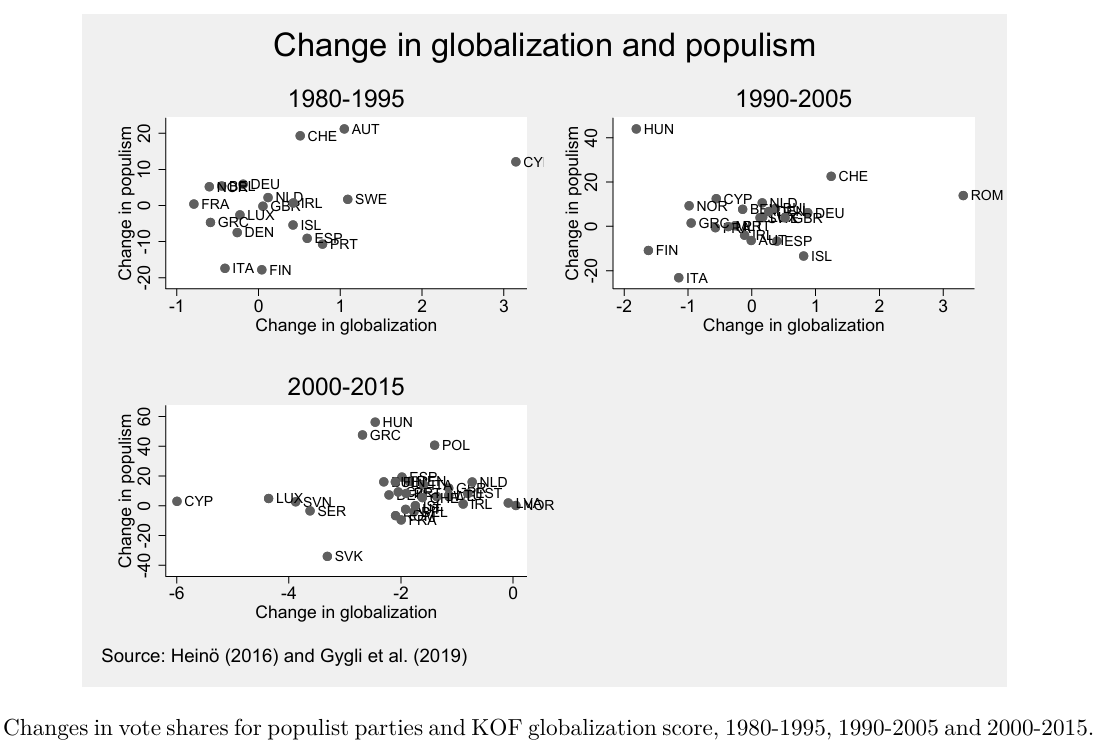
This variation across countries makes it difficult to sustain a simple causal story. The data do not show a uniform pattern where increased globalisation leads directly to increased populist support.
Other explanations deserve more attention
If globalisation does not provide the main explanation, where should we look instead? Institutional trust, national political culture, education levels, media environments, and historical cleavages appear to play a more consistent role. Domestic political choices, rather than global forces, have often shaped the extent to which voters turn to populist parties.
Moreover, many of the economic difficulties that fuel political discontent arise not from globalisation but from technological change, demographic pressures, or long-standing structural problems. Treating these issues as consequences of globalisation can obscure the policies that might address them more effectively.
Fukuyama’s warning about easy narratives
This brings us back to Fukuyama’s idea of the commonplace judgment. When a narrative becomes too familiar, it risks replacing analysis with repetition. The belief that globalisation is the root cause of rising populism is plausible, and in some cases partly correct, but it cannot substitute for careful empirical work. Political developments in Europe are not well explained by a single global variable.
Conclusion
The expansion of populist parties in Europe is a significant and multifaceted phenomenon. Globalisation may play a role in certain contexts, but it does not provide a simple or sufficient explanation. A better understanding requires attention to domestic institutions, long-term economic changes, and the particular political dynamics of each country.
Explanations that rely too heavily on globalisation risk becoming conventional wisdom at the expense of accuracy. A clearer account begins with the recognition that Europe’s political landscape is shaped by many forces, most of which are rooted within rather than outside national borders.
Notes
The paper was eventually published in Public Choice. A follow-up paper, focusing on the role of inequality and welfare state spending, was published in Social Science Quarterly. Results regarding economic freedom and populism, including a fairly ambitious literature review, were published in Edward Elgar’s Handbook of Research on Economic Freedom.
And more is hopefully coming: Populist Parties’ Popularity Post Power
Published so far:
Bergh, A. & Kärnä, A. 2021. ”Globalization and Populism in Europe”. Public Choice 189(1): 51–70.
Bergh, A. & Kärnä, A. 2022. ”Explaining the Rise of Populism in European Democracies 1980–2018: The Role of Labor Market Institutions and Inequality”. Social Science Quarterly 103(7): 1719–31.
Bergh, A. & Kärnä, A. 2024. Economic freedom and populism. In: Handbook of Research on Economic Freedom (ed. N. Berggren). Cheltenham: Edward Elgar Publishing.
No posts
Comments
Nothing yet. Say the first thing.
Sign in to join the conversation.