
The Economist has a nice article on the fact that global GDP in PPP dollars has been revised upward because the International Comparison Programme has documented that many prices for products in various countries are lower than previously thought. Interestingly, the extra purchasing power is not evenly distributed, and the article mentions India, China, Russia, and Ukraine.
The article is worth reading for several reasons, one of which is that it provides a straightforward explanation of PPP dollars and why calculating them requires knowledge of prices.
The article does not, however, spell out what I assume is an immediate consequence of the revised numbers: That absolute poverty has fallen by more than previous data indicated, and that global inequality between countries has fallen (this should be the case because lower prices in China and India mean higher purchasing power for many poor people).
After some searching, I can confirm the consequences for global inequality. In a blog post by the World Bank, we find the following remarkable statement:
The share of the global population living in economies where the mean GDP per capita is below the global average decreased from 75 percent in 2017 to 56 percent in 2021.
That is a substantial decrease in only 4 years! Also, the blog post says the following:
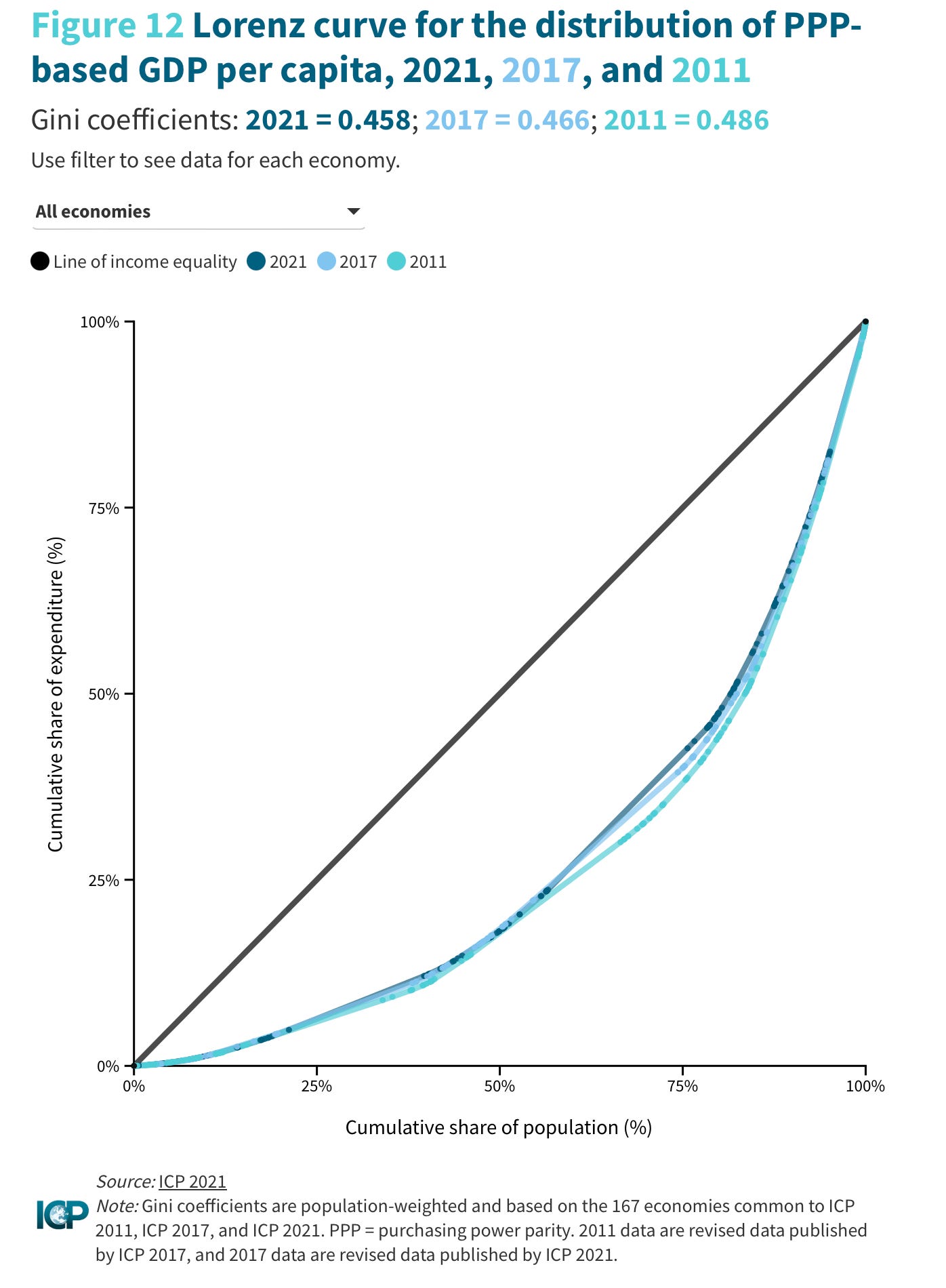
The intercountry Gini coefficient for PPP-based GDP per capita improved over the years, from 0.486 in 2011, to 0.466 in 2017, to 0.458 in 2021.
The blog post even has Lorenz curves:
The article in The Economist also does not mention why some prices have fallen in a way that increases the purchasing power of the poor. The fact is that the development is only to be expected as a result of market forces: Where more people are poor, it is more important to produce cheaply and to invent and produce cheaper substitute goods. The article touches upon this:
…often the same consumer need is met by different goods in different parts of the world. In rural Thailand, workers live on rice. In similar parts of Ethiopia, they live on teff. But “rice is hard to find in Ethiopia and teff is impossible to find in Thailand, so price comparisons are not possible,” as Angus Deaton of Princeton University and Alan Heston of the University of Pennsylvania have pointed out.
Luckily, a paper in the Southern Economic Journal by Therese Nilsson and me shows that the inequality of purchasing power is likely to be lower than the inequality of income, precisely because lower prices to some extent mitigate poverty. The revised data from the World Bank show that this is not merely a theoretical oddity; it is a crucial mechanism behind declining poverty.
See further
Bergh, Andreas, & Therese Nilsson. 2014. ”When More Poor Means Less Poverty: On Income Inequality and Purchasing Power”. Southern Economic Journal 81(1): 232–46.
No posts
Comments
Nothing yet. Say the first thing.
Sign in to join the conversation.