
In recent years, I discovered that there is now an academic field devoted to what is called “degrowth”. This is no longer only a loose intellectual current, but an organised movement with conferences, networks, and a growing body of publications. It therefore seems natural to ask a simple question: Is the central concept that unites this work well-defined?
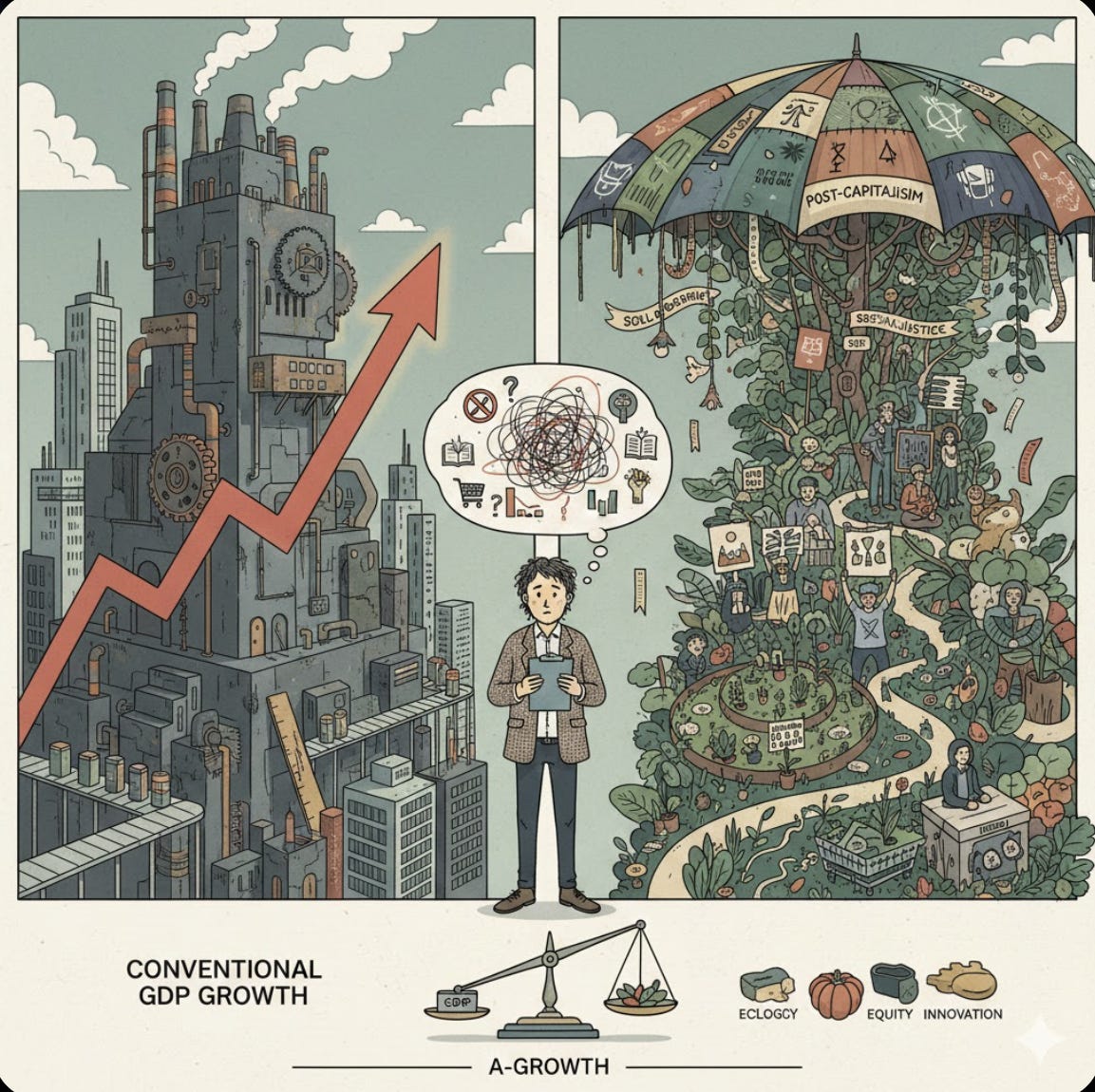
If one turns to the movement’s own websites, the answer is not entirely encouraging. A definition intended to define the central concept reads partly like a manifesto and partly like a list of aspirations. Degrowth is described as ecological, democratic, post-capitalist, and much more, but it is unclear what would constitute evidence that a particular society is, or is not, moving in the direction of degrowth.
The same problem appears in descriptions of specific initiatives. At Lund University, for example, the degrowth theme has been explored at the Pufendorf Institute, framed as an interdisciplinary examination of alternatives to growth. The initiatives are intellectually interesting, but they often proceed as if the meaning of degrowth were already settled. The concept is treated as self-evident when it is, in fact, contested and elastic.
Too many meanings at once
When one surveys the literature and the movement’s own texts, “degrowth” appears to be used in at least four different ways:
• as a critique of consumerism and materialism
• as a call for reduced aggregate production and consumption
• as a comprehensive political programme
• as a label for a broad family of social movements and experiments
Individually, each of these strands is intelligible. Together, however, they turn degrowth into a very loose umbrella term. In economic analysis, we usually ask for concepts that can be specified with some precision, at least to the point where we would recognise a counterexample. With degrowth, it is often unclear what such a counterexample would look like.
The analytical difficulty
The central analytical difficulty is that degrowth is rarely operationalised. Does it mean a permanent decline in real GDP per capita in high-income countries, combined with redistribution toward poorer regions? Does it mean binding caps on energy and material throughput, independent of what happens to standard economic indicators? Or does it describe a change in values and social practices that may or may not be accompanied by lower measured output?
Without answers to such questions, it is hard to evaluate degrowth as a proposal. If the claim is that ecological constraints will force high-income societies into lower aggregate output, then the relevant debate concerns the mechanisms, timing, and distributional consequences of such a process. If, instead, the claim is that deliberate political choices should reduce production and consumption, we need to know what exact choices are envisaged, and how they compare to more conventional environmental policy.
Degrowth as a normative stance
Degrowth becomes more coherent when interpreted as a normative stance rather than as an analytical concept. In that interpretation, it expresses a belief that growth-centred societies are morally and ecologically problematic, and that a good society would place less emphasis on material expansion. The movement then belongs to a long tradition of criticism of economic modernity rather than to the narrower field of economic theory.
There is nothing illegitimate about such a normative position. Moral criticism of existing institutions is a crucial component of public debate. The difficulty arises when a broadly moral and political vocabulary is imported into analytical work and treated as if it were a clear and measurable category. At that point, the risk of confusion is considerable.
An alternative: a-growth
One response to this problem is the proposal of “a-growth”, associated in particular with Jeroen van den Bergh. The idea is that governments should adopt an agnostic attitude toward GDP growth: they should neither pursue it as a primary goal nor attempt to directly reduce it. Instead, policy should focus on environmental quality, innovation, distribution, and other substantive objectives. If growth follows as a side effect, that is acceptable, but it is no longer the main target.
This notion has at least two virtues. First, it explicitly acknowledges that GDP is an imperfect and often misleading indicator, without assuming that lower GDP would automatically solve environmental problems. Second, it avoids the semantic and psychological problems that come with the word “degrowth”, which, for understandable reasons, many people interpret as a permanent recession.
Conclusion
The degrowth movement raises serious questions about the compatibility of current growth patterns with ecological limits and social justice. Those questions deserve attention. At the same time, the central concept of degrowth remains imprecise. It carries too many meanings at once and is rarely specified in a way that allows for systematic analysis.
If the aim is to rethink environmental and economic policy, we are better served by concepts that can be clearly defined and, at least in principle, measured. Otherwise, there is a risk that “degrowth” becomes a rallying cry rather than a tool for understanding, and that the debate about growth and the environment becomes more obscure instead of clearer.
Comments
Nothing yet. Say the first thing.
Sign in to join the conversation.