
WEX reported Q3’23 earnings on October 26 that beat consensus revenue and EPS estimates. WEX is a payment processor and software company that has three segments: 1) mobility (used to be called fleet solutions); 2) health and benefits and 3) corporate and travel payments. I wrote about WEX in a deep dive published in April; visit this link to check out the write-up.
Revenue of $651.4M was up 6% from Q3’22. Adjusted net income per share of $4.05 was 15% higher than the same quarter a year earlier. WEX also raised its full-year 2023 revenue guidance by $35M to $2.535B (midpoint), up from the prior guidance of $2.51B. Despite those healthy surface-level figures, shares lost nearly 8% of their value in response to the earnings report.
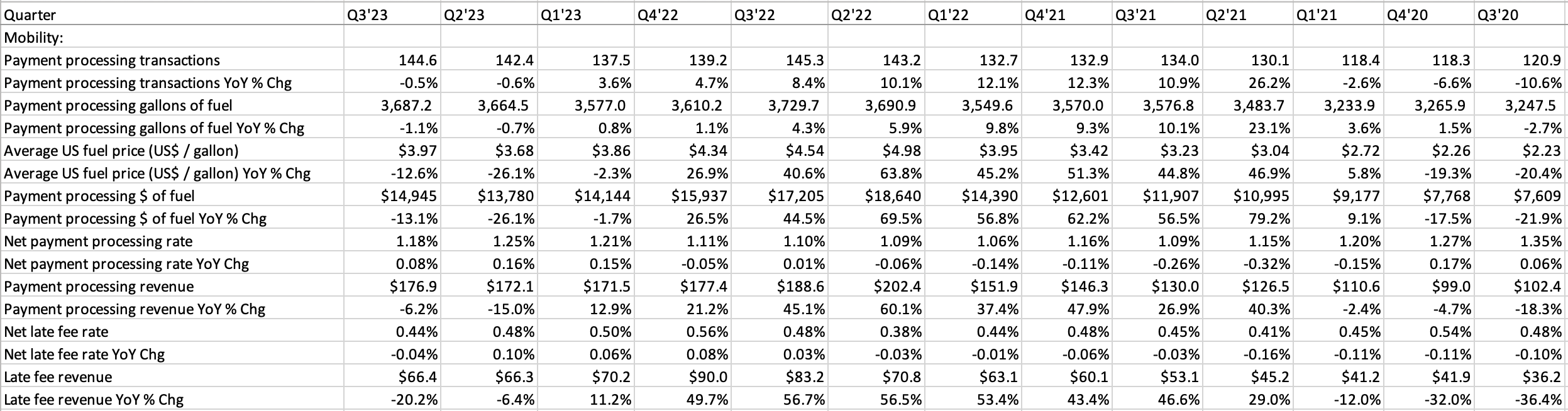
I’ll run through segment results, starting with the mobility segment, which made up 54% of company-wide sales. Sales for the mobility segment were $350.1M, down 7% from the prior year. WEX processed payments for 3,678.2 million gallons of fuel, which was down 1.1% against Q3’22. The volume of fuel processed is an important KPI that’s closely aligned with business performance. The average price of fuel was down -12.6% YoY, causing the drop in revenue. Management can’t control fuel prices, but they can take market share by signing up more businesses for their payment processing and the slight decline in gallons processed is discouraging. The net payment processing rate (take rate) of 1.18% was higher than last year but regressed versus the first half of 2023. CFO Jagtar Narula said of the take rate:
The net interchange rate in Mobility segment was 1.18%, which is up 8 basis points over the last year. The increase reflects continued benefits from the interest rate escalator clauses contained in various merchant contracts, the rate benefit from lower domestic fuel prices, which is partly offset by negative fuel spreads in Europe and higher rates earned from merchant contract renewals at favorable terms.
Operating profit for the mobility segment was down to 45.6% from 46.2% in Q3’22 due to the decline in fuel prices which were offset by better credit losses. Credit losses were helped by improvement and normalization of subsets of customers such as over-the-road trucking.
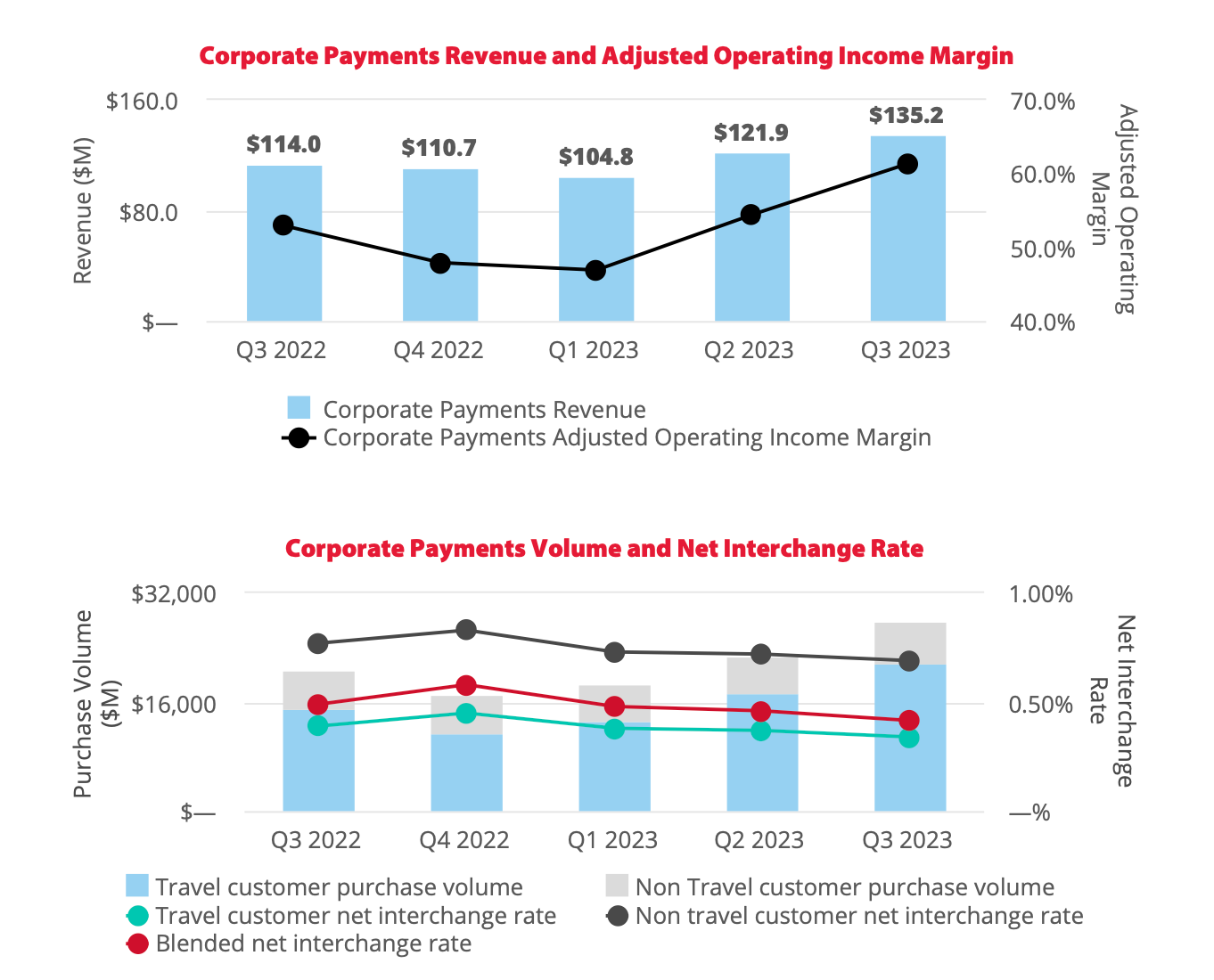
Corporate payments extended its streak of strong payments. This segment handles AP automation and spend management for A) travel and B) other corporate payments that’s referred to as “non-travel”. Purchase volume was up 34.9% as a whole, and the travel portion was up 43% YoY and non-travel held their own this quarter with volume up 11%. The take rate was down 7 basis points to 0.42%, which was driven lower by volume rebates. Taken together, revenue for the segment was up 19% YoY. Operating profit for the segment was even higher at 37%. There’s high operating leverage for corporate payments so it’s easy for growth in profit to outpace growth in revenue.
Lastly, (health) benefits segment revenue was up $42.0M (34% YoY) to $166.1M. Of the $42M in increased revenue, $22.6M (up 26% YoY) came from growth in account servicing revenue and $17.7M (up 93% YoY) was largely made from cash made from HSA assets. The latter is less durable given an eventual decrease in interest rates. While revenue was up 34%, operating profit for the segment was up 94% YoY. The primary driver is the money made on HSA assets, which is a very high margin business with higher operating leverage (think scale).
Other notable development for WEX was the purchase of Payzer for $250M. CEO Melissa Smith said of the acquisition:
The U.S. field services software markets, looking at broadly the bigger marketplace. The TAM of that is $5 billion. In this, Payzer addresses a section of that, the market itself is growing 20% to 30%. Part of what we like about Payzer, and we liked a lot of things, we like the intersection that it has between software and payments, and you get that as you move up into the workflow.
And so from a customer perspective, what Payzer does is really integrated within the customer to offer scheduling, dispatching, communications, pricing, invoicing, parts ordering. So I think of that as like the operating system for that end customer and you can integrate that with the services that we provide. So that if you're an HVAC operator as an example and you are out on a job, you can book the appointment in the system. The system reminds the homeowner of the appointment ahead of time, and dispatches the HVAC to address on the day of, the HVAC shows up at the address, and can present a mobile proposal with real-time inventory and pricing information. They can then get if they'd say -- the homeowner accept proposals, they can schedule and manage within the system.
So if you can just envision a very integrated experience within the workflow of the customer…And so what we're really focused on is how we can take the relationships we have, the knowledge that we have and what customer need is, and then create an even better customer experience with our products.
Payzer itself is growing 30%. Just again, a little bit more context, it's $25 million to $30 million of revenue and growing at 30%.
Given the large customer base there’s good potential revenue synergies. Whether its an HVAC company or lawn care company with a fleet of vehicles, WEX can ideally on-board them as customers to the mobility payment processing offerings, and make their existing customers users of Payzer. I’m interested to see how this acquisition pays off for WEX given the potential cross-selling opportunities. It’ll likely take several quarters for it to pay off.
Investors should be pleased with this earnings report from this consistent compounder. One disappointing datapoint is the lack of growth for mobility. On a macro-neutral basis (excluding change in fuel price and currency change), mobility only grew 0.9% YoY. Ideally with smart acquisitions, and a transition to EV, mobility can again grow at a faster clip. This is an important segment, not only because it’s the biggest, but because the other two segments have a couple non-durable attributes that could be peaking in the near or medium-term. With benefits, it’s unclear how much longer interest rates can stay elevated to produce higher custodian revenue. With corporate payments, it’s unclear how much longer travel can stay as hot as it currently is. Therefore, this anticipated reversion has WEX trading at historically low forward multiples. Using Koyfin percentile ranking data, the forward P/E is in the 1st percentile versus the last 10-years and the forward EV/EBITDA is in the 0 percentile. That means this stock is the cheapest it’s been in the past 10-years using the forward multiple.
Disclaimer: This is not advice to buy, sell or hold any stock referenced. Do your own due diligence. I have no position in any stock mentioned in this report. Like any financial analyst, doesn’t mean I’m not biased.
No posts
Comments
Nothing yet. Say the first thing.
Sign in to join the conversation.