
Synaptics is a semiconductor maker focused on chips for Internet of Things (“IoT”) products, mobile and PC. SYNA 0.00%↑ reported earnings for fiscal Q1’24/calendar Q3’23 (ended September 30) on November 9 with results that beat on the top and bottom-line but guidance for FQ2’24 was underwhelming. Even still, shares were higher by nearly 9% in the after-hours trade on November 9, placing shares near fair value. The current story at Synaptics is whether the cycle is in a trough that’s now recovering. FQ1’24 financial results indicate that a bottom is in for Synaptics and sales will begin to recover but it’s not currently clear what the trajectory will be coming out.
The high-level numbers feature revenue of $237.7M which was down 47% from the prior year but ahead of the sell-side estimate of $230.5M (3% surprise). Non-GAAP EPS of 52 cents per share compares to $3.52 per share a year earlier but ahead of the analysts’ consensus estimate of 37 cents (41% surprise). On a year-over-year basis these numbers look fairly dismal. Customers over-stocked their inventory in 2022 and Synaptics saw a reset in 2023 with customers simply selling off their existing inventory instead of replenishing through new orders from Synaptics. On the bright side, this is the first sequential improvement in revenue in five quarters. Additionally, gross profit margins stopped shrinking and also saw an improvement in FQ1’24.
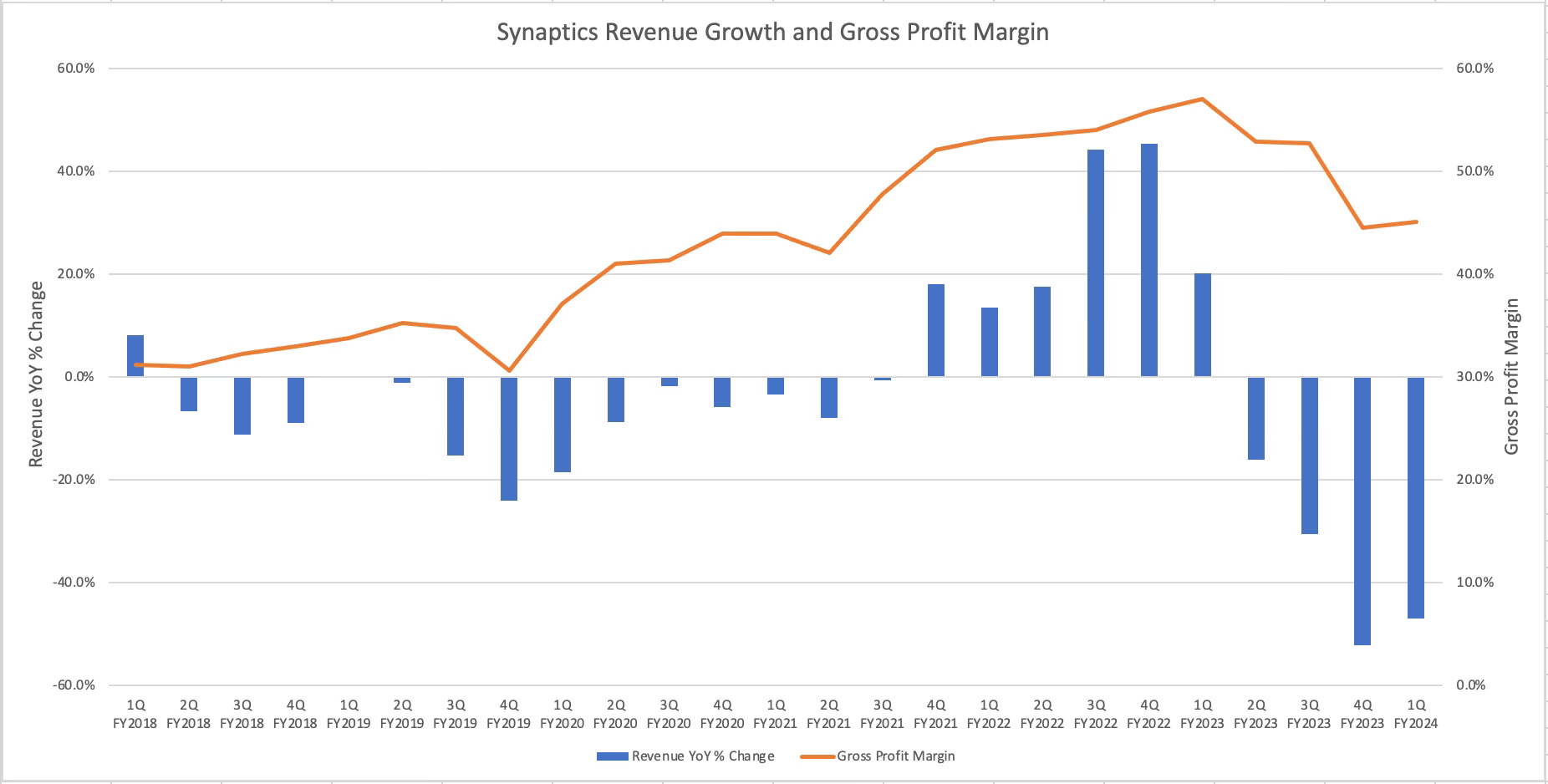
Guidance for FQ2’24 (end in December) has the midpoint revenue target at $235M, which is below the consensus of $238.5M. Gross profit margin is expected to be 43.5% next quarter, which would be a reduction from FQ1’24. Operating income is expected to be about $5M, which is below the estimate of ~$30M. The mix of product has caused a headwind for margins with high profit-margin enterprise products lagging.
Another headwind for margins was obsolete inventory. Synaptics made an interesting change to its 10-Q with this sentence (bold is changed): “The net 1,200 basis point decrease in gross margin for the three months ended September 2023 was primarily due to an increase in the excess obsolescence reserve during the first quarter of fiscal 2024 and an overall decline in average sales prices across many of our product applications”. This is the first time Synaptics has used the phrase of “obsolescence reserve” in at least a decade, if ever. Obsolete inventory shouldn’t really come as a surprise. In my September deep dive into Synaptics, I noted that the company introduced three new risk factors, with this in the title one “we may hold excess or obsolete inventory, which would reduce our gross margin”.
Now for some earnings call highlights. In the May and August earnings call for quarters covering financials since April, management said Synaptics was under shipping $100M per quarter in product to their direct customers (who then sell to end customers). The channel partners have had excess inventory and while Synaptics management didn’t give an approximate shipping rate for the latest quarter, CFO Dean Butler said:
September saw good progress in reducing our inventory among our distributors with inventories depleting in line with our expectations. Point of sale at our distributors continue to hold up and in fact, increased versus the June quarter. As we look ahead, we continue to focus on reducing customer and distributor inventories further until full equilibrium is met.
Demand shows signs of continued stabilization at the current levels with almost all our products shipping below historical 2019 levels. We expect to recover from these levels in 2024, but the timing and shape of recovery is still uncertain. We see improving strength in PC and Mobile end markets, which creates a gross margin headwind from a product mix perspective.
Another nugget regarding a potential recovery:
Based on what we see on bookings, we actually think we've hit bottom. In fact, if anything, it looks like things are looking more positive as we look forward. We're not guiding specifically into March or anything beyond the December quarter at this point, but it does look like based on bookings and what we can see into channel dynamics, et cetera, looks like bottom is actually behind us and likely moves up.
If that was the case I would’ve assumed management would be confident enough to guide FQ2’24 for another sequential improvement in revenue growth/recovery. Instead it’s flat. There was also an exchange regarding what metrics management looks at to understand the cycle and a potential recovery I found insightful. Butler:
Generally, we are looking at things like booking rates, hey, if booking rates accelerated, slowed, you will look at book-to-bill sort of ratios. What we noticed is that actually bottomed few quarters back. We look at cancellation rates and push-out requests on already booked backlog.
What we've noticed over the last actually several quarters, that (cancellation rates) significantly slowed. In fact, it's very little now. It's actually almost back to sort of a normal rate. There's always some amount of noise in the system on people rescheduling their backlog, et cetera, it's a normal course of business. But what we've seen over probably the last 2 to 3 quarters is like the peak volume from these second-order metrics started to slow down in their magnitude. We saw a peak order as people try to cancel and reschedule and as you know, when we talked about it back in our May call, we started allowing people actually to reschedule on what it is that they needed to do. We also work with channel partners to do the same.
So on balance, each quarter, we've seen that amplitude go way, way down and to the point where it's getting close to being sort of normal course of business. We do see this level as certainly sustainable. In fact, if anything, we're probably biased up to biased down as we look into '24. And I think, hey, credit to the business teams and sales teams here at Synaptics on trying to make a call early on where the direction of inventory and forecasts are going. And I think the internal team did a pretty good job.
Synaptics has a goal of bringing its adjusted gross margins back up to 57%, which translates into a GAAP (unadjusted) gross margin of about 51%. Management was asked about the potentially delayed timeline in achieving that and reasoning. Butler said it was the mix of products giving a headwind to margins:
I mean there's some mild pricing pressure, but it's not materially factoring into our guide. Any pricing pressure really is about maybe new products that might ramp in a year or 2 from now. So that's not as much of a sort of near-term concern. It's really all around mix.
And how do we get back to our target mix and our target margin model? Really what we need is for all of the areas to kind of move back into its normal mix. We think that, that Core IoT business has hit bottom and that's starting to move up. Enterprise probably is just a little bit behind that, while at the same time, actually, Mobile is actually starting to move faster and actually looks like it's up in December quarter. So that's a headwind for us.
What if the Enterprise business doesn’t recover quickly? CEO Michael Hurlston says:
Enterprise business is obviously our best gross margin business. I think if it doesn't recover, it will be a bit more of a struggle and not that we can't get there. I mean we're making a lot of improvements, as we just outlined a second ago in the Core IoT area to help on the margin line with cost reductions and things like that. But I do think that we are -- the gross margin improvement back to 57% and what have you is very dependent on the Enterprise business.
The bottom line is that performance was good in FQ1’24 by signaling a bottom is in and a recovery is near. Synaptics is a volatile name with big cycles. That means you want to be a buyer early in a new cycle to ride strong stock performance. We’ll get clarity by next quarter if that next cycle is forming and hopefully what sort of trajectory there may be. In the mean time, I made only slight tweaks the DCF model I presented in September which now calculates a fair value of ~$96.50.
Disclaimer: This is not advice to buy, sell or hold any stock referenced. Do your own due diligence. I have no position in any stock mentioned in this report. Like any financial analyst, doesn’t mean I’m not biased.
No posts
Comments
Nothing yet. Say the first thing.
Sign in to join the conversation.