
Cantilever is a regular rundown of London-based gigs and other musical ephemera. Subscribe to receive these updates directly in your inbox!
Hello again! Long time no speak.
Some of you have already received news of the new direction Cantilever is taking and the forthcoming “paid tier”. I’m excited to share the news with the rest of the readers here very soon.
I caught up with Isabelle Thorn aka Dear Laika a little while back, before planning the next phase of Cantilever took up all my time. I’m excited to share that enlightening interview below.
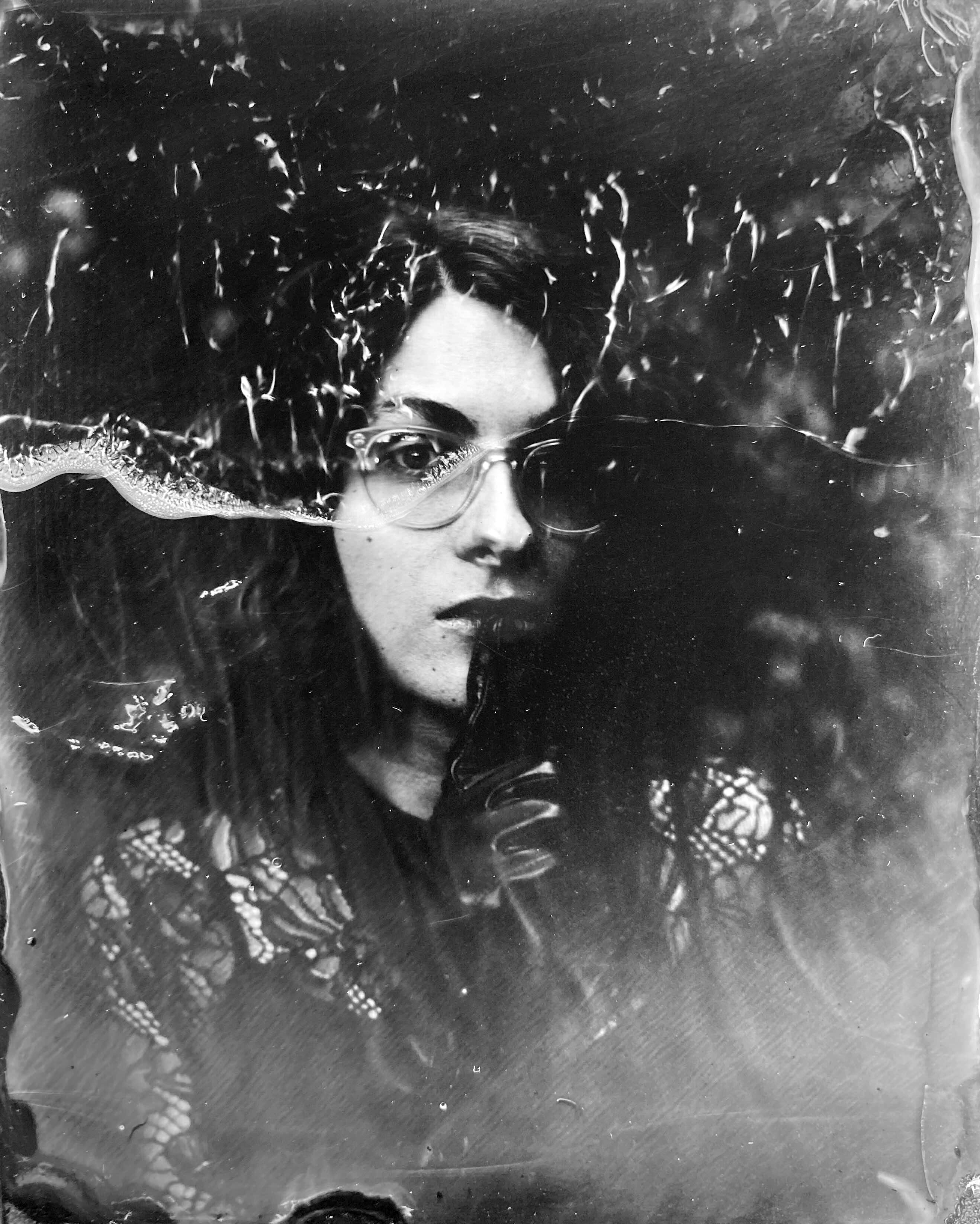
Isabelle Thorn aka Dear Laika came to our attention in 2021 with her album Pluperfect Mind — a release by US label NNA Tapes, with UK physical variants on Memorials of Distinction (the label and management company behind caroline, Porridge Radio, Kiran Leonard and much more excellent music). The album is a compelling and theatrical mix of electronic sound design, piano compositions and an almost operatic quality to the vocal performances. It’s fair to say it was very highly praised critically, and has garnered something of a cult following.
Particular standouts include “Guinefort’s Grave” — a song narrated from the perspective of a St. Guinefort; a greyhound venerated as a folk saint for saving a child from a snake attack — (you can read the story here). Here are the lyrics to that song — compact imagistic poetry that does a lot with very few words:
Inauspicious daylight
Your infant son a viper's prey
I do my duty
On your return, I greet you
With dewy reds and fatal jaws
Myopic impulse
You take up your sword
Put me down
Put me down
In vengeance, kill your faithful hound
Lay me down
Lay me down
Regret enshrines me underground
They venerate me
Make invocations falsely
And offer salt
All that separates their children
From wildland sickness and the fauns
Is a candle's fire
The breadth of a thumb
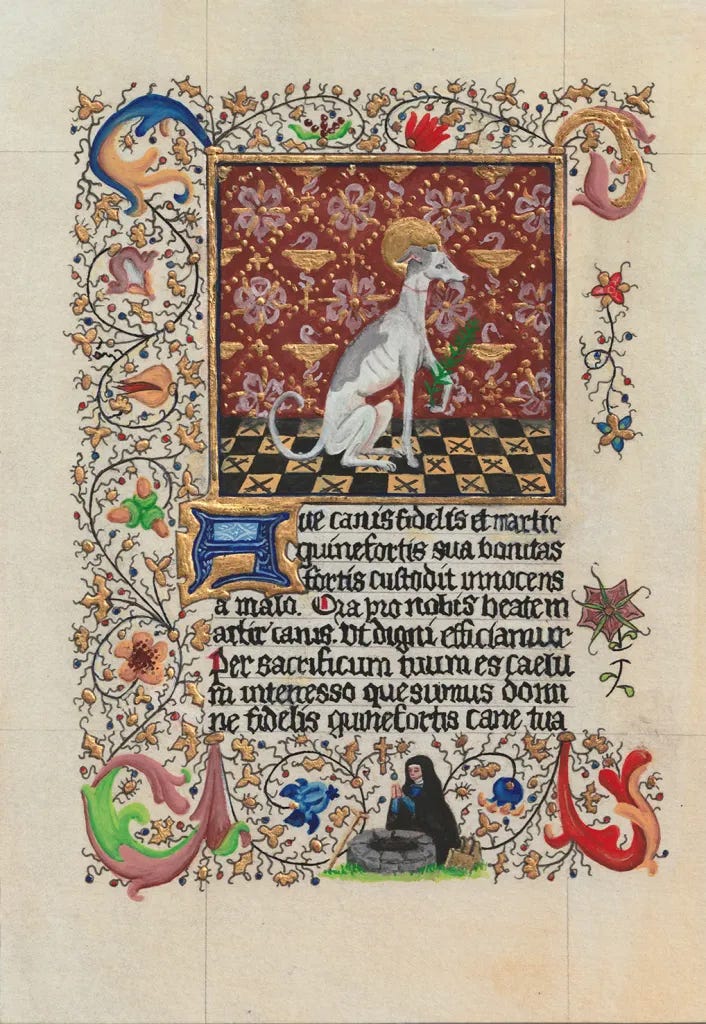
Recently, Dear Laika has been taking to London stages again with a newly put-together live band. She plays her third headline show since Pluperfect Mind at The Horse Hospital on October the 1st, which we would strongly encourage you to grab a ticket for — link at the end of this interview. We caught up to talk about upcoming performance, compositional processes, prog, and the “inhuman”.
C: It’s been about 4 years since your previous album, what has been taking up your time since then?
DL: Piano teaching’s been a main focus. It’s been super rewarding, at least whenever I haven’t been overworked. Theatre tech work, contract work, more private creative endeavours… Getting my life back together after teenage meltdown and occasionally writing songs along the way, though now I’m focusing more deliberately on songwriting. I also went on two little tours with my friend Rian [Maria BC], which were so incredible.
C: Does it feel hard listening back to Pluperfect Mind given the context? Sounds like it was written under some potentially unsettling conditions.
DL: No, not really. I’m proud of that album, considering I wrote it all when I was 21. I was just expressing what was going on in my head and making the music I wanted to hear at the time. The emotional trajectory of that album was very positive.
C: Could you describe what’s defining the music that you’re working on now? Any particular blueprint or set of values in mind?
DL: I think I’m pretty deliberate in my ethos nowadays. I want Capital-S Songs. I didn’t really write any music with performance in mind before 2020, because I was still recovering from a bit of agoraphobia. So I’m thinking more practically now, writing and arranging for a band. I’m super lucky and grateful to have Ted [Mair], Ollie [Chapman], and Dave [Adsett] on board, who are all so enthusiastic about the songs and willing and able to navigate their weirdnesses.
I want the songs to be deeply satisfying and engaging to perform for all of us. Even though I know the most brilliant pop can just use a few chords in 4/4, my impulse is always to go in more complex directions. I want push and pull, contraction and de-contraction, flow and interruption, in harmony, rhythm, and melody... But I always want to prioritise the emotion rather than complexity for the sake of it.
The songs come from emotional tension and complicated feelings, pushing up against difficult things, and I hope the difficulty of the music goes some way to help express that. I want focus rather than sprawl.
C: To me as a listener of Pluperfect Mind any complexity in the time signatures — for example of “Guinefort’s Grave” — just recedes into the background. You don't notice complexity as long as you feel the thrust of the song.
DL: Yeah, that one and “Black Moon, Lilith” were the songs I was most personally satisfied with, so I wanted to do more in that vein. I’m also especially proud of the title track, which was more of a “piece” than a “song”.
Sometimes you can tell when an irregular time signature has been thrown in gratuitously, like in certain strains of prog rock or math rock. Of course, certain rhythms are going to feel more intuitive to one person and less to another.
I was trying to write stuff in all kinds of irregular time signatures as a kid because of the music I played and listened to. I discovered Mike Oldfield when I was 11 because I heard a trance remix of “Moonlight Shadow” on a YouTube video. I hadn’t heard anything like it before, so I bought “Tubular Bells” on iTunes. Of course, it sounded entirely different!
“My impulse is always to go in more complex directions. I want push and pull, contraction and de-contraction, flow and interruption.”
C: To what extent do you feel like you participate in this British tradition of “prog” which might include things like the interpolation of traditional folk music, for example, or science fiction and literary themes?
DL: When you put it that way, there’s some overlap, but I don’t think I’m working within any specific British prog-rock idiom. My friend Juno suggested “ultraprog pop” as a tongue-in-cheek descriptor for press material, but maybe it’s less apposite than we thought!
My favourite classic prog band is definitely King Crimson; the 80s Crimson dream team especially, which was half-American. I’m less keen on the more folky, fantasy, self-consciously English side of prog like Genesis, but there are some “medievalisms” in my music, for sure, so I can understand if people project those things onto the songs. I’m mostly informed by bands like Extra Life and Cardiacs in that respect.
“Prog” has this messiness to it. Kiran Leonard — I owe so much to Kiran, personally and artistically — has talked about the “prog tide”, which I take to mean being swept up in this adolescent drive of additive, accumulative composition with limited depth. It’s more nuanced than that, I’m sure, but it gets at this unreflective gratuitousness. The word itself — “progressive” — has a teleological overtone which implies it’s a more advanced, superior form of music, and inevitably so. The prog tide moves in one direction, unthinkingly. And when all these old prog rock signifiers — changing time signatures, orchestral sounds, quasi-symphonic suites, technical virtuosity — are derived from a certain idea of classical music, you can see the unfortunate implications of that.
With regard to the literary aspect, my number one biggest pop inspiration has been Kate Bush ever since I was a kid. Ollie, who plays bass for me right now, referred to my songs as “math-glam”, even though they sound nothing like math rock or glam rock, I guess because there’s these tricky rhythms combined with this literary, gothic, melodramatic, even camp aspect to the lyrics and performance, like Kate Bush.
Never For Ever is kind of glam like that, but I’m really inspired by each of her 80s albums. I’m conscious that my voice sometimes pushes into Kate territory, and the bass lines I write unavoidably emulate John Giblin and Eberhard Weber sometimes. She also frequently writes from the perspective of different characters, and that inspires me as a way of expressing difficult emotions and ideas.
C: What kinds of emotions and ideas?
DL: Distressing, challenging experiences I’ve had, but also morbid fixations. Wrangling with the inevitable death of everything, both in an individual and overarching sense, both real material death and apocalyptic feeling. The dangers of fantasy and desire… How the idea of something can override the actual thing and destroy it…
The word which has really become a throughline in writing all of these songs is “inhuman”, something outside of the human but nonetheless contained within it, or immanent to it. Not necessarily “anti-human” or “non-human”. It’s a lot to get into… There’s a little philosophical movement of “rational inhumanism” out there critiquing humanism while sidestepping both vitalism and nihilism. Maybe they’re onto something, but I’ll leave that to them. I’m not trying to write songs to be “correct”.
Every pop song is just a narrative, no matter how ostensibly autobiographical it is. I’ve amassed this mutable cast of characters — mostly derived from collaborative storytelling with close friends — to follow transient thoughts and feelings through to their limits, where they get away from me and become horrific. The extremity of it wraps around into being kind of liberating expressively, grotesquely beautiful and nasty at the same time, or at least that’s the idea. I’m taking cues from horror authors like Ligotti, for sure. I got on a big horror kick. B.R. Yeager, Gary J. Shipley, Kathe Koja…
But yeah, if you take “Guinefort’s Grave”, that song is from the perspective of a dog but still grappling with human emotions… It’s kind of a silly, anthropocentric thing in retrospect, singing from the perspective of a dog, as if it has an analogous subjectivity to my own...
In these new songs, I’m taking on more ambiguous identities where the human and animal —among other things — are blurred.
Sometimes humans can be made to feel inhuman by their circumstances, and usually it’s marginalised people who feel it the hardest. There’s also thoughts and feelings which feel out of your grasp or control, and all the organisms and dead things that are part of our physical constitution and even our consciousness. You can vacillate between feeling so very alive and so very dead in the same hour sometimes.
C: It seems to me that while Pluperfect Mind was very unique, it’s also full of very of-the-moment electronic textures. It sounds like focusing on “Capital-S Songs” as you say, would mean disowning that angle a bit, opting for something a bit more classic?
DL: A friend of mine referred to what I’m doing as “classicist”, which is quite funny. But in terms of classical music, my songs are informed least by the actual Classical era, Schubert being the exception. One of my pet peeves is when popular music does mediocre pastiche of Baroque or Classical styles, usually with stock orchestral and choral MIDI. Symphonic metal is a prime offender, though it can loop back into being kind of charming in its silliness. Honestly, it’s the unimaginative use of the orchestra and choir to evoke “epicness” that I really can’t stand.
I’m mostly drawing on 20th-century composers in France and England, some of whom took an interest in older, pre-Baroque musical forms, like Messiaen and Howells. It’s all deep in my musical bones. There’s a sense of austerity and sacredness in their music, but also excessiveness and eroticism, even. It seems contradictory at first blush, but it’s often said they’re inextricable sides of the same coin…
When it comes to sound design, I was super into Arca as a teenager — all her 2010s releases before the Kick stuff — and her 2017 Roundhouse show blew my mind all over again. On Pluperfect Mind I was really inspired by her use of chorus, sampling, and time-stretching mostly… Those dark, wandering atmospheres that touched me so deeply. A lot of my samples were of classical music, but I’d take harmonic or melodic material from those transformed samples and that would provide crucial material for the rest of the song. I still do that — motivic transformation — to make a song or a collection of songs feel more cohesive. And I still “sample” classical music, in a way, interpolating musical material into these songs, but I’ve just flipped my approach.
C: How far away do you think you are from finishing these current tracks you’re performing? And what's the process from now? Where do you see this new stage of the project going?
DL: I told myself to only start recording once I’ve written all of the songs for the next album, though I am already thinking ahead to the sounds I want. Right now, I have seven completely written, but I want ten for balance and flow. I’m also more open to getting friends involved in recording and producing this time: I love collaborating and they all have skills to lend which I lack. I don’t want the record to just sound like the live band, as delighted as I am with how the band’s sounding. But I’m especially excited to record Dave’s drums; that’ll happen before the year is out!
C: Are these new songs already incorporated into the new sets you’ve played?
DL: Oh, our sets are mostly these new songs, yeah. The only song we’ve played so far from Pluperfect Mind is Guinefort’s Grave, but we have another one prepared now for The Horse Hospital… And there’s also new iterations of songs I’ve performed before, all intended for the next album.
C: Something that’s new for those who have seen you before is that you’re no longer playing piano live, but stepping into much more of what we traditionally think of the role of a pop singer.
DL: It’s simply more difficult to sing and play the piano at the same time than just doing one or the other, though some performers do it brilliantly. I was feeling quite secluded behind the piano and electronics in previous shows, and I felt my performance wasn’t engaging enough for me or the audience. So, I’ve handed keyboard duties over to Ted, who’s doing a wonderful job, and I’m trying to make more of a show of things, more melodrama, though there’s no choreography or costume changes or anything!
I’m less afraid of looking or sounding ridiculous or self-indulgent, because pop music is all that anyway, so I’m pushing my expressive range further. I’m also embracing the androgyny I was taking pains to avoid on Pluperfect Mind, now I’m more confident and less precious about gender. Zac Pennington — we got to support his current project Popular Music at The Shacklewell Arms in June, which was a dream come true! — has had an outsized influence on my vocal and physical performance, and much more besides…
C: You described yourself earlier in our conversation — and maybe this isn't the case now — as having some occasionally reclusive and introverted tendencies. Do you find performance to be a way to escape from that and inhabit a very different way of thinking?
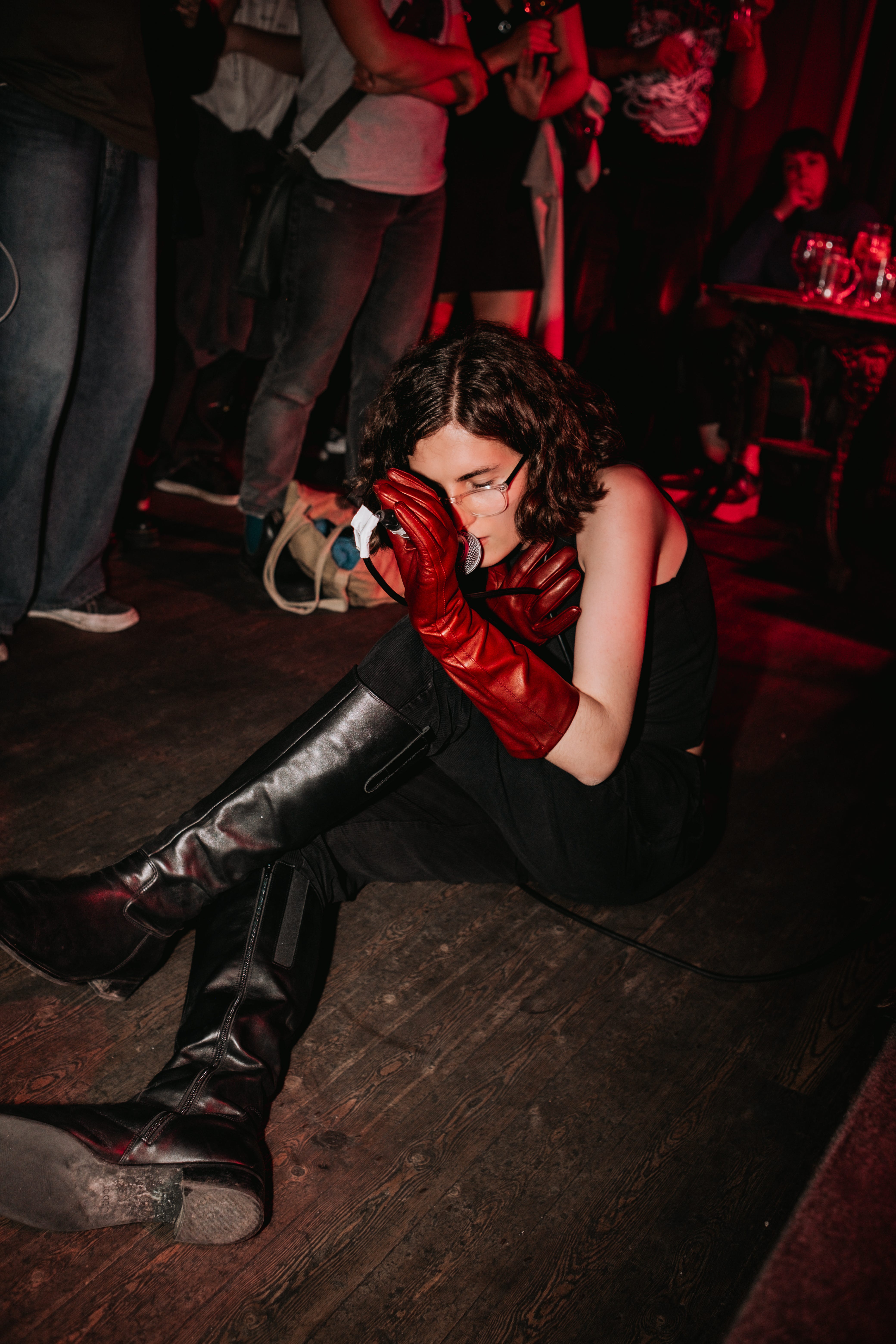
DL: I have historically, just through shit circumstances, been both quite geographically isolated from other people and prone to self-isolation, which is not good… “Introversion” can have an unfortunate tendency to feedback-loop when you internalise it as part of your personality. But performance is just super invigorating for me. I performed a lot as a kid and so I basically never get stage fright. It’s one of my favourite things to do, and I relish every opportunity I get, whether it’s playing music or acting. I’ve also started to dress up a little bit: the red gloves are significant to me and help me get deeper into that performance headspace. The songs are mostly quite dark so I want to have fun with them and draw out their intensity if I can.
Comments
Nothing yet. Say the first thing.
Sign in to join the conversation.