
Welcome back to Can’t Get Much Higher, the internet’s favorite place for music and data. If you enjoy this newsletter, check out my book Uncharted Territory: What Numbers Tell Us about the Biggest Hit Songs and Ourselves. It’s a data-driven history of popular music that I wrote as I spent years listening to every number one hit in history. This week we dive into the weird trend that sees Baby Boomers and Gen Z teaming up more regularly than ever.
The Intergenerational Duet
By Chris Dalla Riva
Last month, Olivia Rodrigo released her latest record, you seem pretty sad for a girl so in love. While the album topped charts around the globe—the third time the young artist has done such—I think it was notable for a something unrelated to sales and critical accolades: “what’s wrong with me,” the tenth track on the album, featured Robert Smith, the frontman of The Cure.
Robert Smith isn’t foreign to collaboration. In 2003, for example, he sang on blink-182’s “All of This.” But he’s also not hopping on anybody’s song. It’s a special occasion to get Robert Smith in the studio. And that’s usually the case with most musical legends. You can’t just call Taylor Swift up and get her on your track because you have a good idea.
Or maybe you can. Over the last few years, it feels like more artists are collaborating across generations.
Right around the same time that Olivia Rodrigo released her collaboration with Robert Smith, Sabrina Carpenter was on a song with Madonna
Bruce Springsteen, not known for duets, has collaborated with Zach Bryan, Bleachers, The Killers, and The Gaslight Anthem over the last few years
Elton John has been just as eager to join up with Britney Spears, Dua Lipa, and Ed Sheeran on a string of hits
These are all examples of what I have termed the “intergenerational duet,” a phenomenon that feels like it is becoming more prevalent by the day. I wanted to investigate (a) if this really is the case and (b) if so, where it came from.
Are the Young and the Old Singing Together More Often?
Let’s start by taking this somewhat fuzzy “intergenerational duet” concept and defining it specifically. To qualify, a song must be credited to two artists at least 15 years apart in age who don’t regularly perform together.
For example, in 1980 Olivia Newton-John and Andy Gibb had a hit with “I Can’t Help It.” While those two did not perform together regularly, this would not count as an intergenerational duet because Newton-John and Gibb were only born ten years apart. By contrast, Luther Vandross and Mariah Carey’s “Endless Love” would count because the two solo stars were born in 1951 and 1969, respectively. That’s an 18-year age gap.
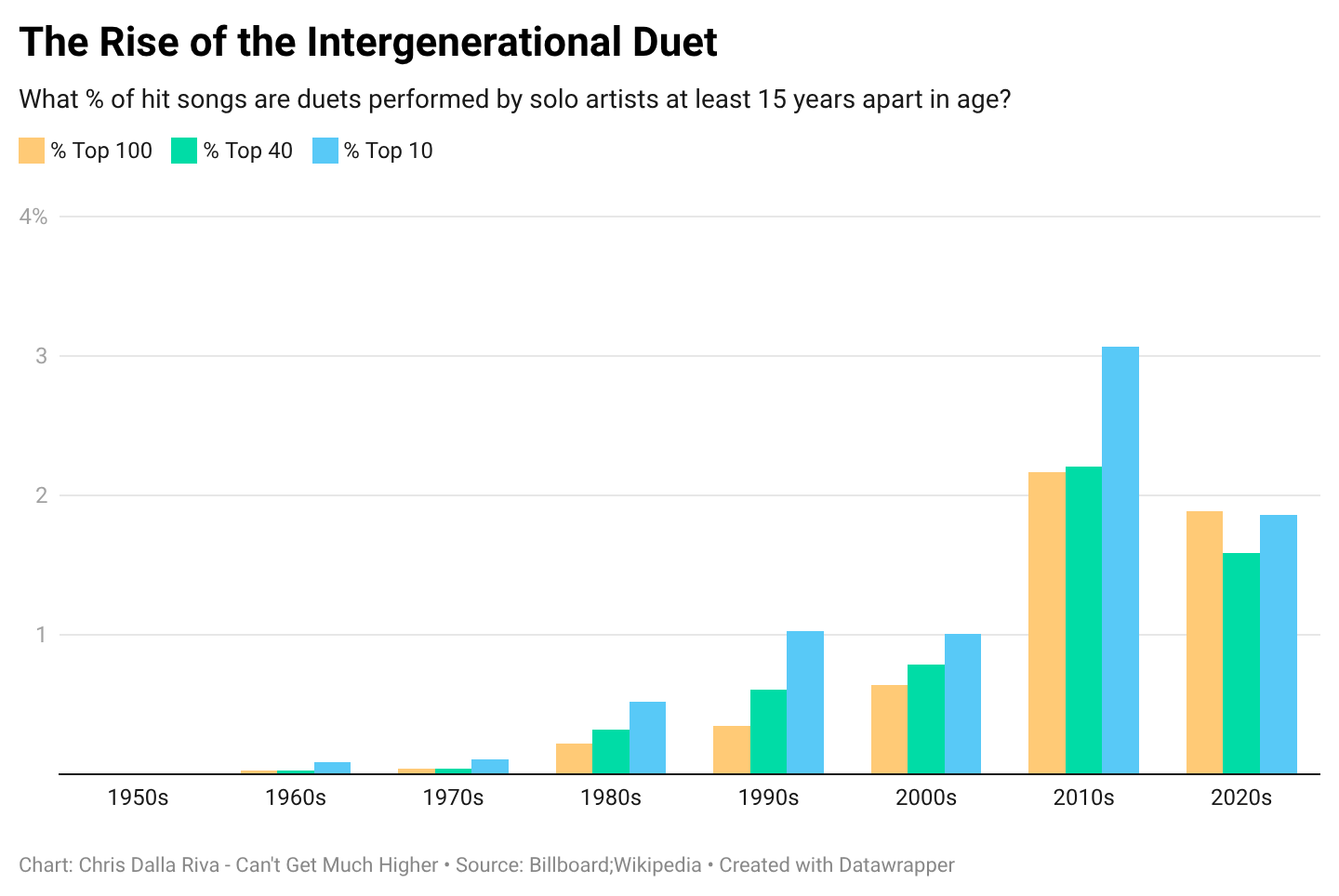
When we plot intergenerational duets as a percentage of total hits, we notice a few things. First, the intergenerational duet has never been that popular. At its peak during the 2010s, 2.2% of top 40 hits and 3.1% of top 10 hits were intergenerational duets. In other words, it’s not like every other hit song was Gen Z singing with a Baby Boomer.
But at the same time, that’s not nothing. 2.2% of top 40 hits qualifying as intergenerational duets in the 2010s is still 36 hit songs. And some of those hits were huge, like “Baby” by Justin Bieber and Ludacris (17-year age gap), “Magic” by B.o.B. and Rivers Cuomo (18-year age gap), and “I Love It” by Lil Pump and Kanye West (23-year age gap).
It’s also worth noting that the intergenerational duet really takes shape in the 1980s. Yes, there were some earlier examples, like “Somethin' Stupid” by Nancy Sinatra and Frank Sinatra (25-year age gap) and “Too Much, Too Little, Too Late” by Johnny Mathis and Deniece Williams (16-year age gap), but those are curiosities. A clear trend emerges during the Reagan years.
Paul McCartney and Michael Jackson (16-year age gap)
Kenny Rogers and Sheena Easton (21-year age gap)
Bryan Adams and Tina Turner (20-year age gap)
Whitney Houston and Aretha Franklin (21-year age gap)
Aretha Franklin and George Michael (21-year age gap)
George Michael and Elton John (16-year age gap)
It felt like the young and the old were getting together for a song every couple of weeks between 1980 and 1989. But why?
Understanding the Intergenerational Duet
This should go without saying, but musical duets were not new to the 1980s. They probably go back as far as music itself. But the 1980s saw stars from different eras recording hits more regularly than ever before. I think we need to point to a few things in order to understand this trend.
Increasing Life Expectancy
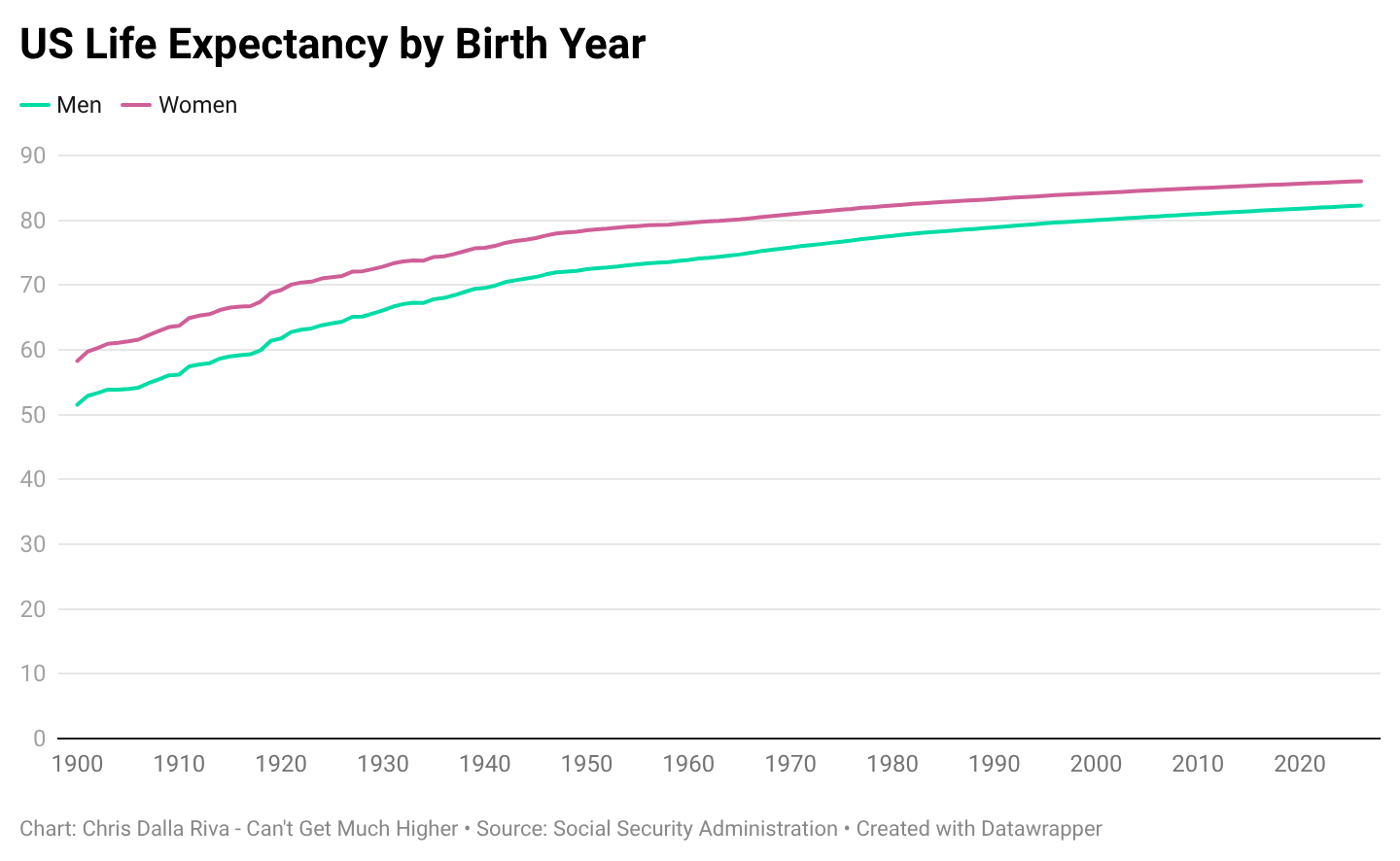
It’s harder to collaborate with your heroes if none of them are alive. Growing life expectancy thus makes the intergenerational duet viable. According to the Social Security Administration, US life expectancy was 66 and 73 for men and women respectively in 1930. By 1980, it had increased to 78 and 82.
While many of those gains were driven by decreases in infant mortality, older cohorts also felt the effects of antibiotics, vaccinations, and general improvements to public health. An incidental effect of this trend was more years to make music.
Musical Availability & Fidelity
While I was trying to debunk claims of musical stagnation last year, I used three songs to make my point: “June in January” by Bing Crosby, “Dreams” by Fleetwood Mac, and “Mood” by 24kGoldn and iann dior. “June in January” was the biggest hit of 1934. “Dreams” topped the charts in 1977 and then resurged in 2020 based on a TikTok trend. “Mood” was at number one during the “Dreams” resurgence.
I picked these songs to create a vivid historical comparison. “Dreams” finding new listeners when “Mood” was topping the charts in 2020 would be like “June in January” doing the same when “Dreams” was out in 1977. Of course, this did not happen. Despite how I’ve noted that nostalgia is not new, kids weren’t re-discovering Bing Crosby just before he died in the late 1970s.
Part of the reason for this is that the music of the 1930s was stylistically different from music of the 1970s. But an even bigger part is audio fidelity. As I argue in my previous piece:
Between 1934 and 1977, there were huge improvements in the fidelity of recorded music. The slight hiss in the background of “June in January” suggests that it might as well have been recorded in a different century when compared to the pristine sound of “Dreams.” That’s not to say that “June in January” is bad. But there is a notable difference in the quality of the recording.
Compare “Dreams” to “Mood,” the song that was at number one when “Dreams” resurged in 2020. While the song “Mood” is as different from “Dreams” as “Dreams” is from “June in January,” the actually fidelity of the audio hasn’t changed that much. Most hits since the expansion of multitrack recording are going to sound pretty pristine.
Because of this, the music from the stars of yesteryear—like the stars themselves—has a better chance to live on. The ability to live on is also enhanced by availability. Of course, in the streaming age you can get your hands on almost anything. But by the 1980s, older music was also more accessible and playable to a younger generation.
This might not have been case earlier. Throughout the first half of the 20th century, there were constant format changes that rendered some older recordings obsolete. It wasn’t until Columbia invented the LP in 1948 that consensus began to emerge.
Formats did continue to evolve with the advent of cassettes and CDs. But the LP was the bedrock of the industry for long enough that older music was much more available to younger generations.
A More Professionalized Music Industry
Finally, it is worth noting that between the 1950s and 1980s, the music industry not only became more corporatized, financialized, and professionalized but got much better at making, breaking, and managing stars. The intergenerational duet thus became a tool to introduce older stars, like Aretha Franklin, to a new generation of fans.
All of these factors have persisted into the 21st century. And the rise of hip-hop and streaming has only made the intergenerational duet more viable. Hip-hop has always been a collaborative genre, rappers regularly featuring on one another’s songs. As the genre has dominated the charts over the last 30 years, duets—and intergenerational duets—have grown more common.
Streaming, as I’ve noted previously, has also created tremendous upside for duets: “You want some more streams with minimal effort? Just mute your vocal in the second verse of a song you’ve already released. Email that version to a potential collaborator. Have them re-sing the verse. Put it out. You’ve got a ‘new’ song without even having to leave your couch.”
Not only does this require little effort, but it’s beneficial to all participants. Streaming services link to all artists involved in a duet. Post Malone dueting with Dolly Parton is likely beneficial for both parties. Fans of the former will be exposed to the latter and can easily go listen to more of her music. The same holds for fans of the latter.
None of these incentives and structures are likely changing in the short term. So, if you’ve been waiting for Drake to collaborate with Willie Nelson, the chances have never been higher.
Paid subscribers also get access to a new and old song recommendation each week. Sign up to see what I’m highlighting this week.
Comments
Nothing yet. Say the first thing.
Sign in to join the conversation.