
Thursday, Canada-U.S. Trade Minister Dominic LeBlanc spent more than three hours with U.S. Trade Representative Jamieson Greer at the latter’s office near the White House — twice as long as any of the pair’s other recent sit-downs. Prime Minister Mark Carney’s chief of staff, Marc-André Blanchard, was there too. When LeBlanc and Blanchard left, Canada’s chief negotiator, Janice Charette, stayed behind to keep working. “We had a long, detailed meeting,” LeBlanc told reporters afterward. “We’re very close. We continue to make progress. We’re going to stay here and do the work that’s necessary.”
Very close. Not done.
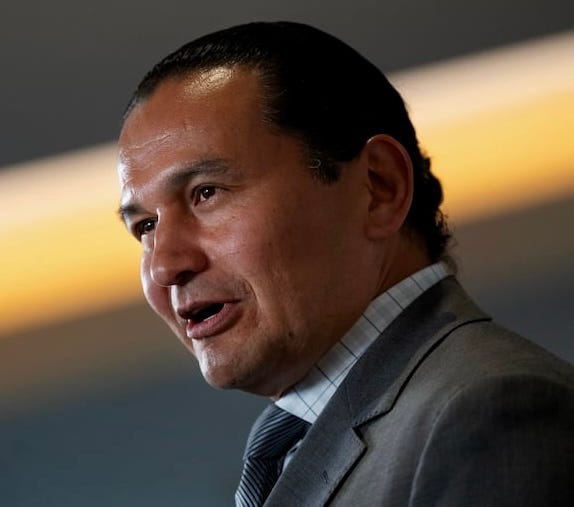
Earlier the same day, Manitoba Premier Wab Kinew went on Winnipeg radio, and later stood before reporters at the Manitoba Legislative Building, and said, in effect: don’t settle. He questioned whether Canada should be conceding anything at all, called Trump untrustworthy and “very weak,” and told Canadians not to buy American liquor even if it goes back on the shelves as part of whatever gets signed.
In other words, while Canada’s negotiators were still in the room trying to close this thing, one of the country’s premiers was on television telling Canadians the deal being negotiated for them wasn’t good enough.
Six months ago, I wrote a profile of Kinew for this publication. I called him “Smiley.” I wrote about a man who could walk into a tense room full of premiers and, with one quiet, unforced joke, get the whole table — including Carney himself — to visibly relax. I meant every word of it, and I still do.
Which is exactly why what I watched him do today stopped me cold.
The Liquor Loophole
Carney has asked provinces to put American liquor back on store shelves as part of the deal. Kinew’s answer was carefully worded: “We have not agreed to put American booze back on the shelves.” But he didn’t stop there. If it does go back, he said, “leave it there” — “don’t buy it” — buy Canadian instead.
That’s not neutral compliance. That’s a sitting premier instructing the public, on the very shelves his own government may agree to restock, on how to defeat the purpose of restocking them.
“Some People Are Calling It a Doctrine”
At one point early in the appearance, Kinew slipped into a Trump impression — the exaggerated, high-pitched, nasal cadence — to mock the president’s own language. “The doctrine,” he said, in that voice, “some people are calling it a doctrine.” It’s also, on the record, on video, exactly the kind of moment that doesn’t show up in a wire-service quote roundup, but sets the tone for everything that followed.
The Procurement Wink
It got more explicit from there.
According to Kinew, Carney also asked the provinces to no longer exclude American companies from their procurement policies. Kinew confirmed Manitoba's preference for Canadian and non-American suppliers has been in place since the trade war began — and by his account, it's produced an 82% year-over-year decline in the province's spending on American firms. "That's had a huge impact, by the way," he said. "You can see why the Trump administration is coming to Canada and asking for a deal."
U.S. companies earned over $3.5 billion in Canadian government contracts since 2023, according to Hill Times reporting.
Manitoba’s Opposition leader isn’t buying the number. PC Leader Obby Khan told CBC News the 82% figure is inflated, pointing out the province signed a $36-million contract with American-based Aramark in July 2025. “The premier is still doling out millions to American companies,” Khan said.
Whichever number is closer to true, Kinew’s own language about what happens next was telling. Asked about changing the policy as part of the deal, he said Manitoba “might change the language” — then, shaking his head, added: “We might continue to buy Canadian anyways.” He said it with a smile — the kind that makes clear the sentence had a second meaning underneath the first one.
“You Can’t Make a Deal With a Bad Person”
Kinew wasn’t shy about his opinion of the other side of the table, either.
“Donald Trump is very weak,” he says. “America is weaker around the world today than it was a year ago, and he’s about to get slaughtered in the midterms.” He calls Canada’s negotiating position one of strength, and he calls Trump “erratic,” “not to be trusted.” His conclusion, quoting Warren Buffett: “You can’t make a good deal with a bad person.”
He’s not wrong about any of it, necessarily. But being right isn’t the same as being wise, and what struck me wasn’t any single line — it was how many times he circled back to say it, in different words, across the appearance.
A reporter asked him directly whether Carney was, in effect, begging the provinces to fall in line. Kinew didn’t deny it outright. “I wouldn’t say that he was begging us, but what is a step before begging? So I get it from his perspective,” he said. Asked whether he expects to be satisfied with the final deal, he was blunt: he doesn’t. It’s not about him, he added — “ultimately it’s about Canada” — but the sequencing told you where his real answer landed first.
We’ve Been Here Before
Being right about Trump has cost this country money once already. Last October, Ontario Premier Doug Ford ran a $75-million ad campaign in the United States using Ronald Reagan’s own words to criticize tariffs. The substance of the ad wasn’t in dispute — Reagan’s actual views on trade weren’t misrepresented.
It didn’t matter. Trump got pissed off, plain and simple, and he made Canada pay for it. He called the ad “fraudulent,” terminated all trade talks with Canada that same night, and two days later slapped an additional 10% tariff on top of what the country was already paying. Carney ultimately had to apologize on Canada’s behalf just to get talks moving again.
That’s the volatility we’re dealing with. It doesn’t take a policy dispute to blow up a negotiation with this president — it takes an insult, real or perceived, and Trump deciding he’s been disrespected. Ford found that out the expensive way.
I’m not predicting Kinew’s remarks will trigger the same response. LeBlanc says the two sides are “very close,” not finished, and I’ll leave predictions about what happens next to people closer to the table than I am. What I will say is that Canada has already learned, recently and expensively, exactly how little it takes to set this president off — and a premier this skilled at reading a room should know that better than almost anyone in the country.
The Question That Actually Matters
This isn’t really about whether Kinew is right about Trump. Plenty of Canadians agree with him, and I don’t fault them for it. The real question is what a premier accomplishes by going this public, this pointed, while his own country’s negotiators are still at the table trying to close the deal he’s criticizing.
I’ve watched Kinew navigate hard rooms with genuine skill. I wrote about it. I still believe the man I described in February exists. But leadership isn’t just what you do when the room is calm enough for a well-timed joke. It’s what you do in the middle of a live negotiation, when the frustration is real and the cameras don’t blink. Today, I think the frustration won.
I wrote about Wab Kinew’s rise, his father’s influence, and his gift for connection back in February. If you want the fuller picture of who he is, that piece is here
Go Paid: If pieces like this — the honest ones, not the easy ones — are worth something to you, consider going paid. As a subscriber, you’ll get 2-3 Special Reports like this one every week, the weekly Thursday podcast and our regular Wednesday live chats coming up in September.
Comment: Did Kinew go too far today, or is he saying what a lot of Canadians are already thinking? Let me know in the comments.
Share: If this is a story you think needs to be told, share it — I don’t think anyone else is covering it this way.
Also worth your time: Children are dying. Meta is facing billions in damages that could threaten its survival. My deep dive into the courtroom fight now underway - and what it reveals about a company that chose profits over kids, again and again.
No posts
Comments
Nothing yet. Say the first thing.
Sign in to join the conversation.