
A NOTE FROM GEORGE
Every premier who walked out of that three-day meeting used the same word: united. Team Canada. But sit with what they actually said to reporters while they were there, and a very different picture shows up. One premier says he’s fighting alone. Two premiers say they won’t fight at all. And for the first time since this trade war started, premiers are saying in public that Carney isn’t giving them what he promised.
THE STAGE-MANAGED UNITY
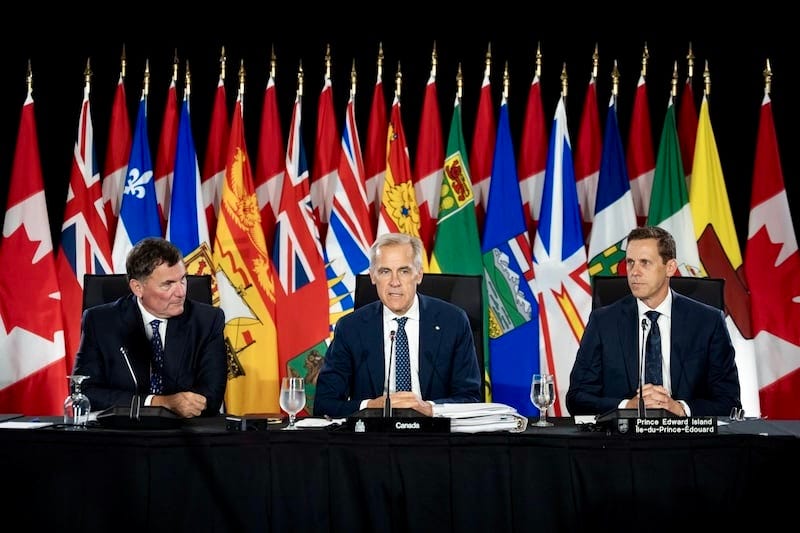
The Council of the Federation wrapped its three-day summer meeting in Charlottetown this week with a private sit-down between the premiers and Prime Minister Mark Carney. The timing could not be worse for Carney - Trump had just announced a fresh 50% tariff on a range of Canadian goods, with an August 19 deadline hanging over the room the entire time.
Every premier stuck to the script in front of the cameras: we are united, we are Team Canada. What they could not agree on, in the same breath, was what Carney should actually be doing about Trump. So they did something premiers don’t usually do in public - they told him. Premiers are now unilaterally calling on Carney to bring them an actual strategy in the coming weeks to stop the August 19 tariffs from landing, and to go back to regularly briefing them on where negotiations stand, something they say has quietly stopped happening in recent months.
THE ONE WHO’S DONE PLAYING NICE
Ontario Premier Doug Ford is the one actually saying it out loud: he’s exhausted, and he feels like he’s fighting this alone. Ford, whose province is bleeding jobs and investment over auto tariffs, wants Carney to start using Canada’s energy and resources as real leverage - not just talking points. He’s floating cutting off Ontario electricity to the U.S. entirely, or slapping a surcharge on the power Ontario sends to Michigan, New York and Minnesota.
Ford’s tone toward Carney has shifted hard. The two still text often, by Ford’s own account, but he’s said multiple times this week that he’s tired of carrying this fight while feeling like his province is taking the worst of it. He told reporters in Charlottetown he wants his fellow premiers and Carney himself to be “a little more vocal” against Trump, and that he “can’t do it alone.” Asked whether anything should be off the table in how Canada responds, Ford didn’t hedge: “I say everything’s on the table.”
That posture is nothing new for him. When Ford first floated cutting Ontario’s power to the U.S., he put it plainly: “It would turn off the lights to a million-and-a-half Americans. If they come at us we have to stand up for Canadians, we have to stand up for Ontarians.” He’s since said he’d escalate the surcharge or cut power off entirely if Washington “escalates” further.
He’s not just talking on energy, either - Ontario is still refusing to put American alcohol back on liquor store shelves, and he’s said that stays in place until Trump drops the tariffs hammering steel, aluminum and the auto sector, three industries that make up the backbone of Ontario’s economy.
He’s not alone on that front. New Brunswick Premier Susan Holt - whose province is a major fuel supplier to the northeastern U.S. - is backing Ford’s harder line and has left the door open to withholding fuel shipments as leverage. BC Premier David Eby went further than anyone, telling reporters in Charlottetown flatly: “There is not a chance in hell that U.S. alcohol is going back on the shelf in British Columbia.” Eby has held that line since BC pulled American alcohol from government shelves back in 2025, and he’s not moving regardless of what Trump threatens next.
THE PREMIERS WHO WON’T FIGHT AT ALL
Then there’s the other half of the room. Alberta Premier Danielle Smith, who governs Canada’s oil-rich province, is flatly against any retaliatory approach. Asked point blank this week whether oil or potash would be used as retaliation, her answer was immediate: “That’s not going to happen.” Her position on Ford’s electricity idea specifically goes back further and hasn’t moved - she’s called it “too dangerous to even talk about,” warning “wars have been started over that kind of conversation,” and has said plainly, “I’ve already said that we’re not going to retaliate on energy. That is such an essential product for American consumers and American businesses.” Her preferred approach right now is to “sharpen the focus” and get a deal done, saying she’s “hopeful things won’t drag into 2027.”
Saskatchewan Premier Scott Moe - whose province is a major U.S. potash supplier - flatly rejected using potash and energy as leverage too, saying he’s “positive and bullish” a deal can get done soon, though he added, “I’m not entirely confident that we will.” Quebec Premier Christine Frechette was just as clear on where she stands on retaliation: “not there.” Smith and Moe both want Carney to be “bullish” at the negotiating table and land a deal before August 19, but without retaliation of any kind. No electricity cutoffs, no fuel leverage, no more product bans. Just talk.
That is not a subtle disagreement. Ontario and BC are actively withholding goods from American shelves and floating cutting off power and fuel. Alberta and Saskatchewan already put American alcohol back on their own shelves last year and are telling Carney, in effect, to make a deal and stand down. That’s not Team Canada speaking with one voice. That’s two premiers pushing for confrontation and two pushing for capitulation, with Carney stuck trying to referee both in the same room.
Here’s what’s behind the paywall:
- Why this is the first time premiers have gone public with frustration over Carney’s lack of transparency - and what they’re privately saying about the promise he was elected on
- What Carney actually committed to premiers behind closed doors, and the timeline he’s now on the hook for
- What each side of this split - retaliation versus restraint - would actually cost Canadians if it goes their way
- Why the “united Team Canada” line doesn’t even hold up on the small stuff, let alone the Trump fight
- Fresh national polling on which side of this fight Canadians themselves are actually on - and it’s not close
- Why August 19 is the date that matters more than any other on the calendar right now
The rest of this report is for paid subscribers.
Comments
Nothing yet. Say the first thing.
Sign in to join the conversation.