
New polling data just released by the non-profit Angus Reid Institute confirms what Canadians have been saying for weeks: they wanted their negotiators to hold a hard line with Washington, and now that Ottawa has done exactly that, they’re standing behind the decision.
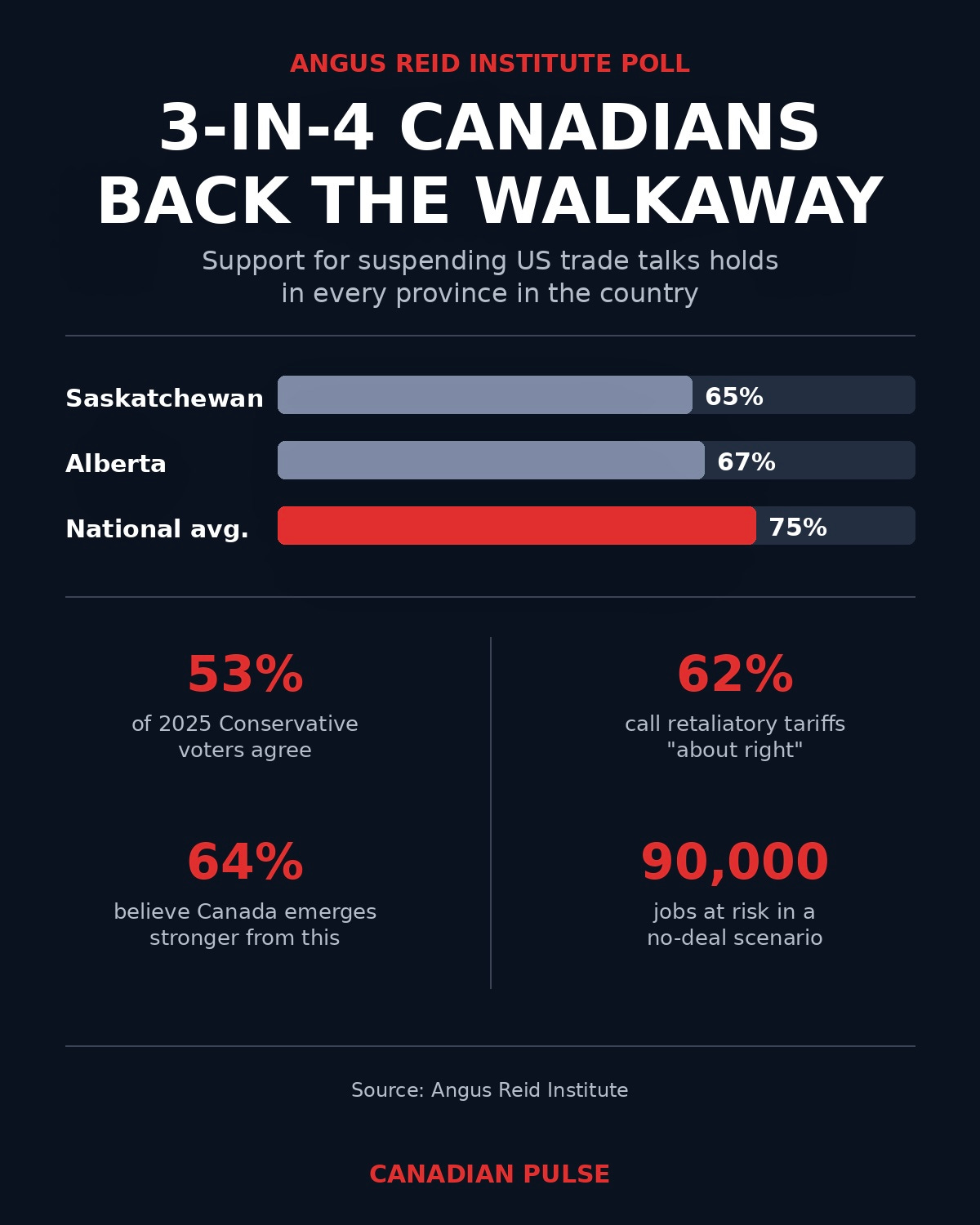
Three-in-four Canadians are endorsing Mark Carney’s move to suspend trade talks with the United States late Friday night and recall Canada’s negotiators to Ottawa. Support holds at majority levels in every single province, bottoming out at 65 per cent in Saskatchewan and 67 per cent in Alberta, the two provinces most economically exposed to a prolonged standoff with Washington. That detail matters. These are the regions with the most to lose in dollar terms, and they still backed the walkaway.
What’s more striking is how far the agreement stretches across party lines. Half (53 per cent) of 2025 Conservative voters say it was the right call. On an issue this consequential, that kind of cross-partisan alignment is rare, and it tells Carney something useful heading into whatever comes next: he isn’t negotiating alone out there. The country is behind the position, not just his party.
How we got here
The breakdown came after weeks of quiet progress. Federal negotiators, LeBlanc and Charette, had met their US counterpart Greer four times in three weeks, with a “phase one” framework reportedly on the table: Washington would ease, not eliminate, Section 232 tariffs on Canadian steel, aluminum, autos, and forest products, and hold off the Section 338 deadline, in exchange for Canada dropping retaliatory auto tariffs, accepting the US interpretation of dairy quota allocation, and winding down provincial Buy Canadian programs and alcohol boycotts. Bigger items, critical minerals access, the F-35 purchase, Golden Dome buy-in, energy guarantees, were pushed to a later phase two.
Carney had already moved first and alone on several fronts: cancelling the digital services tax, rolling back CanCon streaming funding requirements, agreeing to share Gordie Howe Bridge toll revenue despite Canada having funded the bridge’s full construction. Friday’s collapse came after last-minute changes to the proposed terms from the US side. Washington responded at midnight with 50 per cent tariffs on roughly $28 billion of Canadian goods, the first-ever use of Section 338. Canada announced matching dollar-for-dollar retaliatory tariffs, set to take effect September 8 rather than immediately, a built-in window that now looks less like a delay and more like a pressure valve.
What Canadians are bracing for
Public support for that retaliatory posture is strong: 62 per cent call the countertariffs “about right under the circumstances.” But the polling also captures real anxiety underneath the resolve. One-in-eight Canadian workers (13 per cent) say they’re “very” concerned about losing their own job over this, with a further quarter expressing some level of worry. That’s not an abstract number. Analysts are projecting a no-deal scenario could shave 0.4 per cent off Canada’s gross domestic product (GDP) and cost as many as 90,000 jobs.
The pain is already visible on the other side of the border, too. US wine exports to Canada fell 78 per cent in 2025, a $357 million loss, and US spirits exports dropped 85 per cent in the second quarter alone. Jim Beam halted bourbon production at its main Kentucky distillery in December amid the slump. Alcohol has become one of the more effective, and more overlooked, pressure points in this fight, and it’s one provinces like Ontario and Quebec have said they intend to keep using as leverage until a deal meets their bar.
Despite all of it, most Canadians (64 per cent) believe the country comes out of this stronger, betting that reduced dependence on the United States is worth the short-term cost. A quarter (26 per cent) aren’t convinced, worried the damage to the relationship with Canada’s most important trading partner won’t be easy to repair.
Where this leaves Carney
The numbers give him room to hold the line without a domestic political cost, at least for now. September 8 is the real test. If retaliatory tariffs take effect as scheduled, this poll becomes the baseline everyone measures the next one against, and whether that 75 per cent holds once Canadians start feeling the tariffs in their own wallets is the question worth watching.
Get the full picture, every week. A paid subscription to Canadian Pulse gets you 2-3 special reports like this one, the weekly Pulse: The Podcast, and our regular Wednesday live chat with myself and Tamara Stanners starting next month, for $49 CAD a year.
This is important information about Canada’s trade war with the United States. Sharing is caring.
Join the conversation. Have a story idea or a question about where this goes next? My door’s always open, just reply to this email.
No posts
Comments
Nothing yet. Say the first thing.
Sign in to join the conversation.