
For someone hooked up to Thou,
the world may have seemed a kind of half-finished sentence.
—”The Glass Essay,” Anne Carson
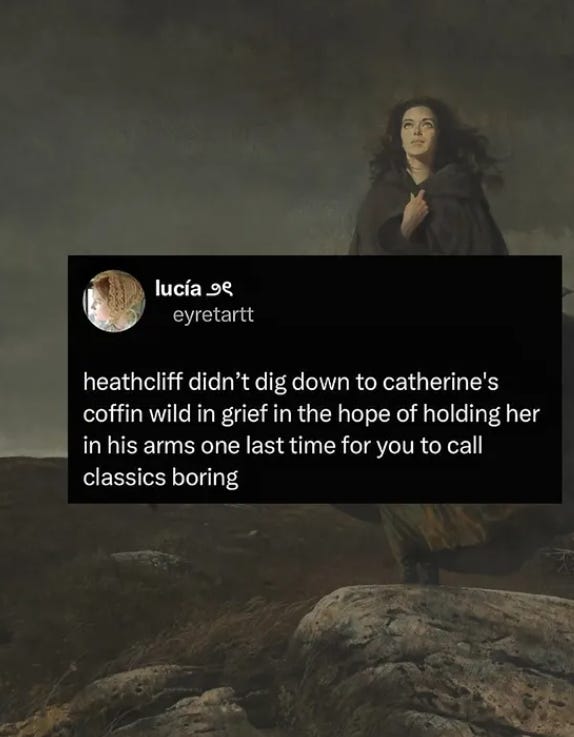
I started this post with, “I’ve been thinking about ghosts a lot lately.” That’s a lie though, because it’s not “lately.” The truth is I can’t remember a time when I wasn’t thinking about ghosts. Last year, I started teaching a course to undergrads on ghost stories, and as I re-read Wuthering Heights this winter, I kept hearing the question I ask the students again and again: why do we tell ghost stories at all? What’s the point?
Maybe this line from Anne Carson’s “The Glass Essay” (her long poem which circles the life and writing of Emily Brontë in order to understand grief and obsession) is an answer:
“You remember too much … Where can I put it down?”
In Carson’s poem, the speaker hears the moors and memory as inseparable: the dead are never fully gone, they’re just folded into the landscape of the living mind. Reading Wuthering Heights now, I find myself wondering if this is a ghost story not because of Cathy’s specter at the window, but because Heathcliff never finds the place to put down what he remembers? Carson keeps returning to the problem of memory that has no place to go, which is a pretty good way to define a ghost: as what appears when something is buried without ever being understood. Wuthering Heights might be one of our most horrific instructions in how that burial happens.
It isn’t so much that Heathcliff believes in ghosts, it’s that he embodies them. Early in the book he tries to master the world: property, law, revenge, inheritance. But in the final chapters, once every strategic move has been made, his real pain arrives because there’s nothing left for him to do but live inside his memories. Once he’s “won,” his grief then becomes so enormous it refuses to accept the boundary between life and death. Frankly—relatable!! Not for nothing, this is also when Heathcliff finally seeks Cathy’s ghost—not at the height of his power, but precisely when that power stops working.
Crucially, this collapse is triggered by Heathcliff’s understanding that Hareton and young Catherine are in love. This new bond, born perversely out of Heathcliff’s own hateful machinations, begins to undo the logic that has governed his life thus far. Hareton cuts down Joseph’s black currant trees so Catherine can grow a garden. Catherine confronts Heathcliff directly, accusing him of stealing Hareton’s land and money, as well as her own. When she says, “If you strike me, Hareton will strike you, so you may as well sit down,” something extraordinary happens. Heathcliff’s authority is supplanted not through law or violence, but through allegiance. Love reorganizes power. The cycle he built to reproduce suffering instead generates repair.
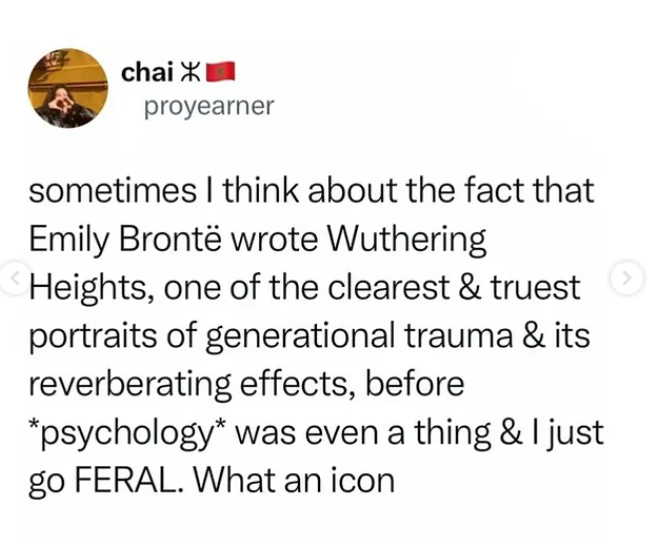
This is the moment when Heathcliff begins to realize a “strange change is approaching” in him; when his desire turns inward and memory becomes unbearable rather than instrumental. He has taken everything he once lacked—land, legal authority, domination—yet the world has slipped beyond his grasp. The past is no longer repeating obediently. It is being healed without him. And that, I think, is what finally allows Cathy’s ghost to return—and what makes Heathcliff begin to wish for death himself. The haunting arrives not because love endures, but because domination has failed.
And the ending, from Lockwood’s POV:
I sought, and soon discovered, the three headstones on the slope next the moor: the middle one grey, and half buried in the heath; Edgar Linton’s only harmonized by the turf and moss creeping up its foot; Heathcliff’s still bare.
I lingered round them, under that benign sky: watched the moths fluttering among the heath and harebells, listened to the soft wind breathing through the grass, and wondered how any one could ever imagine unquiet slumbers for the sleepers in that quiet earth.
Seriously Lockwood? You’re standing among the graves, still unable to hear what the novel has trained us to hear—the “unquiet slumbers for sleepers in that quiet earth”?? This ending feels like a final, eerie joke. After hundreds of pages teaching us how to listen to the dead, we end with someone who claims they are at rest. But if ghosts are social and historical — what remains when something crucial was never understood — then Wuthering Heights isn’t just a gothic romance. It’s a ghost story about how the past comes back, whether you listen or not.
Beyond the paywall are discussion questions and a supplementary reading that most English teachers will tell you is the REAL first chapter of Wuthering Heights.
& quick reminder: Below is the meeting/reading schedule. Zoom link will be sent to paying subscribers the day of our second meeting!
Comments
Nothing yet. Say the first thing.
Sign in to join the conversation.