
Well, well, well: book clubs across the country are reading Wuthering Heights (although, ahem, Bimbo Summit was the first I saw to announce—just saying) and I keep seeing the same baffled refrain in their IG posts: Wait—Heathcliff is supposed to be a heartthrob? This is a romance?

I was thinking through this as I read the third section for today, and (in addition to my MONSTERFUCKER THEORY), it occurred to me that what’s genuinely intoxicating about Heathcliff is not his cruelty or his broodiness, but the fact that this is a guy who has rearranged his entire life and inner world around a woman. He is, in this sense, inverse to the heterofatalism that Internet women and pop stars have been lamenting loudly for the past year +. Here’s Gabby Windey’s excellent distillation of the phenomena.
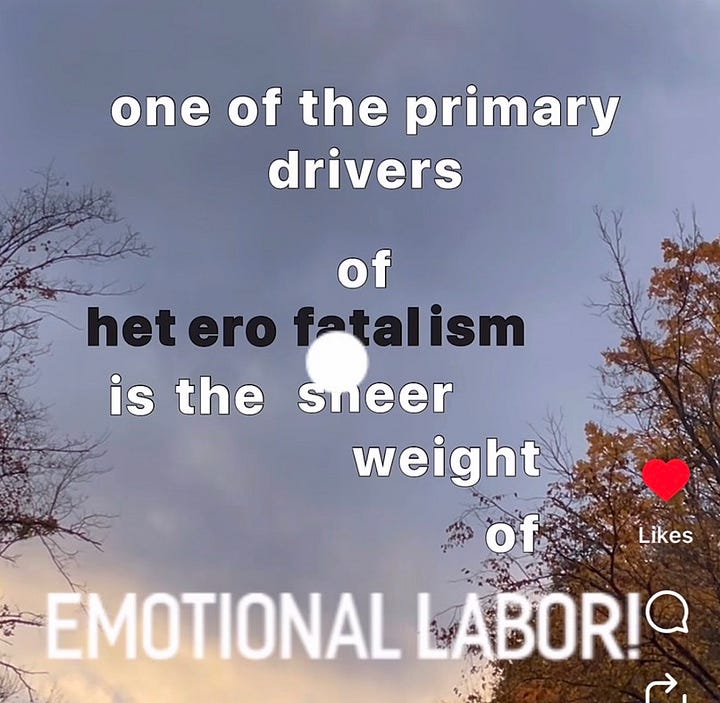



Heathcliff is not the above. Heathcliff is a man who returns your texts. Who makes plans for the future (beyond the grave). Who actually says how he feels—and means it, uh, disturbingly.
To be clear: I’m not saying this is a good thing. Read through the lens of trauma studies, this begins to look less like gothic excess and more like a brutal case study in how memory behaves under extreme emotional rupture. I.e., Cathy’s death doesn’t simply sadden Heathcliff; it arrests him. His life does not move forward so much as it repeats, replays, and literalizes the past. Love becomes infrastructure. Memory becomes destiny.
Here it’s tempting to turn to Cathy Caruth’s foundational work on trauma, especially her insistence that trauma is not defined by the original event so much as by its belated return—the way an experience is not fully known when it happens, but compulsively re-encountered afterward. Caruth does not, to my knowledge, write directly on Wuthering Heights, so I don’t want to overclaim here. But her account of trauma as an unassimilated shock that structures repetition rather than narrative resolution maps eerily well onto Heathcliff’s arc. Cathy’s death is not something he mourns and integrates; it is something he lives inside, again and again, until his adulthood becomes a kind of mausoleum built out of law, property, and revenge. (The same is of course true for Edgar, who won’t even celebrate his daughter’s birthday as it coincides with Cathy’s death.)
This is where the novel’s romance shifts into something more political—and where I want to name postcolonialism clearly rather than letting it remain an ambient vibe. Heathcliff’s transformation from orphan foundling to a legally savvy, estate-controlling power broker is not simply a personal revenge fantasy. It’s a story about learning the master’s tools and using them, as Nelly would say, devilishly. Critics such as Susan Meyer have long read Heathcliff as a figure entangled with Britain’s imperial economy—racially ambiguous, displaced, renamed, and violently excluded from inheritance, yet ultimately reproducing the same extractive logic that once crushed him.
Seen this way, Heathcliff’s obsession with Thrushcross Grange begins to look less like romantic fixation and more like colonial acquisition displaced onto the domestic sphere. Love doesn’t disappear—but it mutates. It becomes ownership. Administration. Control of future generations. The past is not healed; it is enclosed, fenced, and weaponized.
Which brings us back to the heartthrob question. Maybe what unsettles readers now isn’t that Heathcliff is cruel—it’s that he is legible. In a dating culture saturated with emotional evasiveness, his willingness to orient his entire existence around one woman reads, perversely, as devotion. But Wuthering Heights refuses to let that devotion remain sexy. It asks what happens when intensity is never metabolized, when trauma becomes identity, and when love—cut off from reciprocity or futurity—collapses into domination.
So the question I want to think over this week is not whether Heathcliff is romantic or monstrous, but something harder to sit with: Is Heathcliff’s tragedy that he loved too much—or that he learned too well how power actually works?
Beyond the paywall are discussion questions, plus info on “Where’s the Money Shot?: Erotics, Propriety, & Sublimation in Wuthering Heights” (the talk I gave at book club earlier this week).
& quick reminder: Below is the meeting/reading schedule. Zoom link will be sent to paying subscribers the day of our second meeting!
Comments
Nothing yet. Say the first thing.
Sign in to join the conversation.