
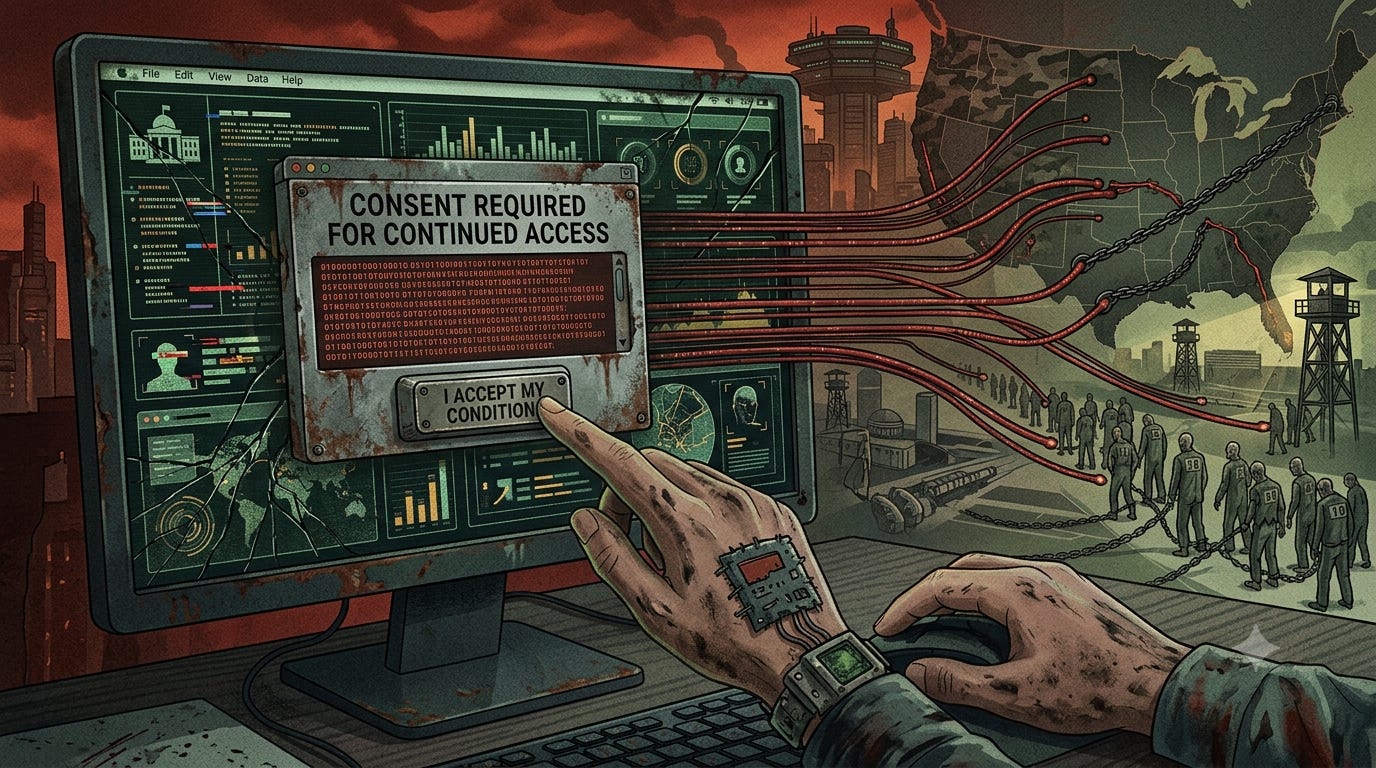
There was a time when power, in order to exercise itself, needed at least to pretend it was asking permission. From the Athenian agora to the contractualism of Hobbes, from the signature wrested from a king upon the fields of Runnymede to the ballot dropped into the urn, Western civilization erected, over the course of centuries, one of the most ingenious fictions on record, namely, that ruling over men requires, in some fashion, the assent of the governed. Broadly speaking, the whole architecture of modern politics rests upon that promise, since even the most shameless tyrants felt the need to commission plebiscites and to draft constitutions of façade. Consent could be forged, yet it could never be dispensed with altogether.
And now there arises, silent and efficient, a form of power that no longer bothers to ask. I refer to what Palantir Technologies, a company founded with the capital of Peter Thiel and captained by Alex Karp, represents with an almost didactic clarity. Now, this is not merely one more company that sells programs to the state, for that would be banal and as old as the state itself. It is something subtler and, precisely for that reason, more disquieting, inasmuch as the company does not confine itself to delivering the tool, but goes on to shape the direction of what the tool executes. It sells not only software but theses, conceptual frameworks and strategic positions about how nations ought to operate in a world defined by technological competition. And whoever supplies the direction, and not merely the instrument, begins to adopt the logic of state power while carrying none of the constraints that make a state something answerable.
The thesis I put to the dear reader is simple to state and uncomfortable to digest. Politics has ceased to arrive, exclusively, by way of law. It arrives, more and more, by way of infrastructure. Data platforms decide how information flows, algorithms determine who is flagged, prioritized or simply ignored, and integrated systems become the backbone of surveillance and enforcement. When such systems are deployed at scale, they operate as public policy in fact, even though no parliament ever voted upon the true extent of their effects. We are not facing an academic hypothesis nor a seminar abstraction, but something operational, already underway, functioning while the reader runs his eyes down these very lines.
Tocqueville, when he glimpsed the face of the despotism that would one day threaten the democracies to come, did not imagine the classical despot with sword in hand. He imagined instead an immense and tutelary power, meticulous and mild, which does not break wills but softens them, which does not torment but administers, and which reduces each nation to a flock of timid and industrious animals. What the French thinker foresaw with melancholy, we now contract out by public tender, and we even thank the vendor for the efficiency of the service.
It is worth observing the manner in which this expansion justifies itself, for every enlargement of power requires its alibi, and the alibi of the hour answers to the name of geopolitical competition. The argument is familiar and not devoid of truth, insofar as, should the United States decline to build such capabilities, China assuredly will. Yet, my friend, the very same reasoning has served, across the long span of history, to justify every manner of excess, from the widening of surveillance to the centralization of authority, always in the name of the sacred imperative of not falling behind. Now, once the criterion becomes matching the adversary, limits turn flexible, and where limits grow flexible, accountability tends to be the first casualty of the war.
It is worth enumerating, without fanfare, the concrete reach of this infrastructure, given that it touches military logistics and support for defense operations, intelligence analysis, the integration of police data, immigration and border operations, disaster and crisis response. This is not, therefore, marginal influence, but the nervous tissue of the contemporary state. And yet the public does not vote upon Palantir, nor does it approve its contracts directly, nor does it receive full visibility into what quietly decides upon its life. So that the question imposes itself, uncomfortable as every honest question, namely, how much power to govern can exist outside the very act of being governed.

A caveat is in order here, one that intellectual honesty demands, for the merit of the matter does not lie in speculating about private conversations or backroom collusion, which would sit rather well in a novel and very badly in a serious article. Figures such as Thiel and Karp cultivate broad passage among media, politics and technology, which, at that altitude of fortune and influence, is almost banal. The point that genuinely merits scrutiny is structural in nature and remains independent of the personal intentions of those involved. A private entity builds the systems employed by the state, those systems influence concrete outcomes in the lives of millions, the public holds limited visibility into their operation, and the same entity publicly advocates for how those systems ought to expand. This constitutes a concentration of power which, although not illegal by definition, is significant enough to demand permanent vigilance from anyone who still takes the word republic seriously.
Chesterton, in one of his Father Brown tales, offered a lesson worth more than an entire library of political science. He conceived of a murder committed by a man whom four honest witnesses swore they had never seen, though he had walked in through the front door in plain sight of them all. The man was the postman, and he had gone unnoticed not because he was hidden but because he was expected, mentally invisible, too ordinary for the eye to register as a presence at all. The new power is precisely of that kind. It does not conceal itself in cellars nor announce itself in manifestos, but operates in broad daylight, in the innocuous shape of a system update, of a service contract, of a platform that promises nothing beyond efficiency. We dreamed that tyranny, when at last it came, would arrive in boots and banners, preceded by drums, so that we might at least recognize it and resist. It arrives, on the contrary, without a face and without a sound, asking only that we accept the terms of use. And we, docile, after all, click I agree.
Comments
Nothing yet. Say the first thing.
Sign in to join the conversation.